
My sister called my son a bastard at every family gathering, so I made sure she would never open her mouth to say that word again.
The first time Delila said it, I was helping my mother set the table for Thanksgiving dinner. My son, Lucas, was eight years old, playing with his cousins in the living room, when I heard my sister’s voice cut through the warm chaos of our family gathering like a blade through silk.
“Well, at least my children aren’t bastards.”
She said it casually, but just loud enough for my mother and me to hear. My hands froze around the salad tongs. Mom pretended she hadn’t heard anything, suddenly becoming very interested in adjusting the centerpiece.
Delila gave me that particular smile she had perfected over the years. The one that said she knew exactly what she was doing and was daring me to react.
I didn’t. Not then.
My name is Andrea, and I’m going to tell you how I destroyed my sister’s perfect life. But first, you need to understand how we got here.
Delila and I grew up in a household where appearances mattered more than anything else. Our father, Richard, was a successful corporate attorney, a man who believed his daughters were reflections of his own accomplishments. Our mother, Patricia, came from old money and never allowed anyone to forget it.
We were raised in a beautiful colonial house in Connecticut, surrounded by manicured lawns and rigid expectations. Delila was three years older than me, and she learned early how to play the game. She earned straight A’s, dated the right boys, attended Yale, and married Kevin Montgomery, a man whose family owned a chain of luxury car dealerships throughout the Northeast.
They had two children, Olivia and Nathan, who attended private school and took tennis lessons at the country club. From the outside, they were everything our parents had ever wanted.
I took a different path.
I went to art school, which horrified my parents. I fell in love with a musician named Tyler, who had tattoos and rode a motorcycle. We never married, but we had Lucas together when I was twenty-five.
Tyler died in a car accident when Lucas was two years old. Because we weren’t married when it happened, I had committed what my family considered the ultimate sin: having a child out of wedlock.
Delila never let me forget it.
The comments started small, little observations about traditional families and proper values. She would talk about how important it was for children to have both parents, deliberately glancing at Lucas as she spoke. At Christmas, she mentioned how fortunate Olivia and Nathan were to have a stable home environment.
During Easter brunch, she would discuss the importance of marriage before children, her eyes finding mine across the table.
But it was at Lucas’s ninth birthday party that everything changed.
I had invited the family to my small apartment for cake and ice cream. Lucas was incredibly excited, showing everyone his new bicycle and art supplies. Delila arrived late, carrying expensive gifts for her own children and a token present for Lucas: a coloring book clearly intended for a much younger child.
We were all gathered in the kitchen when Lucas accidentally knocked over a glass of juice. It shattered on the floor, and he immediately began crying, apologizing over and over again.
I was cleaning up the mess, reassuring him that accidents happened, when Delila leaned toward Olivia and spoke loudly enough for everyone to hear.
“This is why bastards need proper discipline.”
The room went silent.
Lucas looked confused. He didn’t know what the word meant, but he understood her tone. My mother busied herself cutting the cake. My father checked his phone. Kevin suddenly needed to make a business call.
Not one of them said a word to Delila.
I asked everyone to leave.
Delila immediately acted surprised, playing the victim and insisting she was only concerned about proper parenting. My parents took her side, saying I was being overly sensitive and ruining Lucas’s birthday over nothing.
That night, lying in bed and listening to Lucas ask me what the word “bastard” meant, something inside me changed.
I had spent my entire life trying to be the bigger person, absorbing Delila’s cruelty because confronting her would somehow make me the problem. I had allowed my family’s silence to enable her because speaking up would have disturbed their precious peace.
Not anymore.
I started paying attention. Really paying attention. And when you look closely at someone who presents a perfect facade, you begin to notice the cracks.
The following morning, I called in sick to work and spent the day thinking. Lucas was at school, and the silence of my apartment gave me room to process everything that had happened.
Tyler’s photograph sat on the mantel, and I found myself talking to it, the way I sometimes did when decisions felt overwhelming.
“She’s not going to stop,” I told his picture. “And they’re all just going to keep letting her.”
Tyler would have confronted Delila immediately. He never had any patience for cruelty disguised as concern, but his direct approach had often made things worse with my family. They despised him for being rough around the edges, unsuitable, beneath their standards.
His death had almost seemed convenient to them, a problem that had solved itself.
I considered confronting Delila directly, having a private conversation in which I demanded that she stop. But I already knew exactly how that would end.
She would deny everything, twist my words, and make herself the victim. My parents would step in to mediate, telling me to be more understanding, to consider Delila’s perspective, and not to create unnecessary problems.
The pattern had been established over decades.
I needed something bigger, something that would make her behavior impossible to ignore.
So I began documenting everything.
From that point forward, I recorded every family gathering on my phone. I kept a journal with dates, times, and the exact things Delila said. I saved text messages in which she made snide comments about single mothers or children born outside marriage.
I collected evidence the way an attorney builds a case, which made sense considering how our father had raised us.
This documentation phase lasted about two months. During that time, I attended every family event with new eyes, recognizing patterns I had been too close to notice before.
Three weeks after Lucas’s birthday, we had Sunday dinner at my parents’ house. It was a tradition they insisted on maintaining, despite how uncomfortable these gatherings had become.
Delila arrived with a homemade dessert and her usual air of superiority.
During dinner, she announced that Olivia had been chosen for the lead role in her school play.
“We’re so proud,” she said. “The principal told us that children from stable homes tend to be more confident performers. Something about that sense of security allowing them to take creative risks.”
She looked directly at Lucas when she said it.
He was pushing his mashed potatoes around his plate, trying to make himself smaller.
“Lucas is very creative,” I said calmly. “His art teacher says he has real talent.”
“Oh, art,” Delila replied dismissively. “That’s fine as a hobby, but Olivia is developing skills that will actually serve her in the real world. Public speaking, confidence, leadership.”
“Lucas has those skills too.”
“Oh, really?” She laughed lightly. “I wouldn’t know. He barely speaks at these dinners. I suppose children sometimes withdraw when they sense something is wrong with their family structure.”
My father changed the subject to his latest case. My mother busied herself serving dessert.
The moment passed like all the others, swallowed by my family’s collective decision to pretend everything was fine.
But this time, I had it recorded.
Another piece of evidence.
Delila’s marriage was one of the cracks I began to notice.
She and Kevin had been together for twelve years, and from the outside, they looked like the ideal couple. But I started noticing things. Kevin constantly checked his phone during family dinners, sometimes with a small smile playing at his lips. Delila snapped at him over minor issues, her voice sharpened by something that sounded almost like desperation.
They slept in separate bedrooms, supposedly because Kevin snored.
During Thanksgiving, I watched Kevin excuse himself three times to answer phone calls. Each time, Delila’s jaw tightened a little more.
When he returned from the third call, she asked sweetly, “Important business on a holiday?”
“Just the dealership,” he replied. “You know how it is.”
“Oh, I know how it is,” she answered, but there was an unmistakable edge beneath the sweetness.
Later, while helping clean up, I overheard them arguing in the hallway. Kevin’s voice was low and defensive. Delila accused him of being distracted, absent, and disconnected from their marriage.
He shot back that she was controlling and impossible to please.
Their voices rose until they remembered where they were, then dropped back into furious whispers.
When they returned to the living room, they were both smiling.
The perfect couple once again.
But I had seen behind the curtain, and now I couldn’t stop seeing what was there.
I contacted an old friend from art school, Yasmin, who now worked as a private investigator. Over coffee, I explained the situation, and she agreed to investigate Kevin’s activities.
At first, I felt guilty. Delila was my sister, after all. But then I remembered Lucas’s face at his birthday party, and the guilt evaporated.
Yasmin was thorough and professional. She had built her business on discretion and results, serving clients who needed information but couldn’t afford public scandal.
During the investigation, we met weekly at a small downtown café, far from anywhere my family might see us.
“This could take time,” she warned during our second meeting. “If he’s careful, tracking his movements without alerting him requires patience.”
“I have time,” I told her. “And I need to be absolutely certain before I do anything with the information.”
While Yasmin worked on Kevin, I continued my own investigation into Delila’s life.
I began attending country club events as my parents’ guest, something I had avoided for years. The club represented everything I had rejected about their world, but now I needed to understand the territory where Delila held power.
The first event was a charity luncheon benefiting local schools.
Delila was in her element, moving through the crowd with practiced grace, blowing air kisses at other women and laughing at precisely the right moments. I watched her interact with different groups, noticing whom she embraced and whom she subtly dismissed.
A woman named Priscilla Chen tried to join a conversation Delila was having with three other club members.
Delila’s body language changed almost imperceptibly. A slight turn of her shoulder, a fractional step that closed the circle.
Priscilla stood there awkwardly for a moment before retreating.
“Who was that?” I asked my mother later.
“Priscilla?” Mom scoffed. “Her husband owns those Asian-fusion restaurants downtown. Very successful, but…”
She let the sentence trail off meaningfully.
“They’re new money, and the club has standards.”
I thought about that conversation for days.
Standards. It was a code word, a convenient label for the kind of exclusion my family practiced with surgical precision, shutting people out while maintaining plausible deniability.
I started talking to the club’s service staff: waiters, bartenders, maintenance workers, people my family barely noticed.
During events, I would chat with them, ask casual questions, and gradually build relationships.
One bartender, Marcus, mentioned that his wife, Sandra, worked in the club’s membership office.
“That must be an interesting job,” I said lightly. “Deciding who gets in.”
Marcus shook his head.
“Sandra hates it sometimes. She says there are members who make her job difficult, asking her to do things that don’t feel right.”
I carefully filed that information away.
Two months after the investigation began, Yasmin handed me a folder.
It was thick, filled with surveillance photographs, financial records, and a detailed timeline of Kevin’s activities. She had been even more thorough than I expected.
“He’s not particularly clever about it,” she said as I flipped through the pages. “Once I knew what to look for, the pattern was obvious. Same hotel, usually Tuesday and Thursday afternoons. A separate credit card he probably thinks your sister doesn’t know about.”
The photographs showed Kevin with a woman named Britney Calvel in various locations: restaurants, hotels, walking together through parks.
In one picture, his hand rested against the small of her back as they entered a building. In another, they were kissing inside his car.
“Does she work for him?” I asked, reading Britney’s background information.
“Sales representative at his largest dealership,” Yasmin confirmed. “She started there about two and a half years ago. The affair appears to have begun around six months after she was hired, so they’ve been together approximately two years.”
I studied Britney’s photograph.
She was conventionally pretty, young and fresh-faced, nothing like Delila, who was all sharp angles and meticulous maintenance.
“There’s more,” Yasmin said, pulling another section from the folder.
“The financial records show regular transfers to an account in Britney’s name. He’s also paying rent on an apartment under her name. He bought her a car, ironically from his own dealership, and there are charges for jewelry, clothing, and trips.”
“How much altogether?”
“Close to three hundred thousand dollars over the last two years. Possibly more. That’s just what I could verify.”
I leaned back, trying to process what I was hearing.
This was bigger than an affair.
Kevin had been systematically diverting marital assets to support his girlfriend. Money that partly belonged to Delila and should have been available for Olivia and Nathan’s future.
“The apartment lease is interesting,” Yasmin continued. “It’s in a building owned by his family’s company, which means he’s essentially paying rent to himself using funds diverted from the business. That could constitute embezzlement, depending on how the company is structured.”
“Can you find out how the company is structured?”
“Already did.”
She slid more papers across the table.
“Kevin is a minority partner, but his father still controls the majority interest. Any major financial decisions require board approval, which he definitely didn’t obtain for these transfers. If his father found out, it could be grounds for removing him from the company.”
I gathered the documents carefully, my mind racing through the possibilities.
This was leverage. Real leverage.
But I needed more than Kevin’s affair.
I needed something on Delila too, something that would show everyone that her perfect marriage was built on rot from both sides.
The following Sunday, I volunteered to help my mother organize donations for a club charity drive. It gave me an excuse to be at the country club during the week, interacting with staff members without raising suspicion.
I found Sandra during her lunch break, sitting alone in the employee cafeteria. She was a middle-aged woman with tired eyes and a guarded posture, someone who had learned how to make herself invisible.
“Do you mind if I sit?” I asked.
She seemed surprised but gestured toward the empty chair.
We made small talk for a while before I casually mentioned, “Your husband, Marcus, told me you work in membership. That must be interesting.”
Her expression changed. Something cautious settled over her face.
“It’s a job.”
“My sister, Delila Montgomery, is pretty involved in membership decisions, I think.”
Sandra’s hands tightened around her coffee cup.
“Mrs. Montgomery has very strong opinions about membership standards.”
The careful phrasing told me everything.
I leaned forward slightly, lowering my voice.
“Marcus mentioned that sometimes you’re uncomfortable with the things you’re asked to do. If something wrong is happening, I want to help.”
She studied my face for a long moment.
“Why would you help? She’s your sister.”
“Because doing what’s right matters more than family loyalty. And because I think they’re putting you in an impossible position.”
Sandra glanced around the cafeteria, checking who might be listening.
Then she made a decision.
“I keep copies,” she said quietly. “Of everything. Just in case I ever need to protect myself.”
“Copies of what?”
“Applications that were rejected for reasons having nothing to do with qualifications. Emails from Mrs. Montgomery with instructions about which families to discourage. Notes from membership committee meetings where she said things that… well, things that shouldn’t be said.”
My heart began beating faster.
“Would you be willing to share those copies if it meant stopping what she’s doing?”
“Yes. But I need protection. This job supports my family.”
“I understand. Let me figure out how to handle this properly.”
I wrote down my phone number and slid it across the table.
“Call me when you’re ready. And Sandra, thank you for having the courage to document this.”
Over the following weeks, I met with Sandra three more times.
She provided a meticulously organized file documenting Delila’s discriminatory practices. There were emails in which Delila referred to certain applicants as “not our kind of people,” meeting notes showing that she had argued against families based on their ethnicity or economic status, and records of qualified applications that were mysteriously rejected after Delila intervened.
It was damning evidence of systematic discrimination, and it had been happening for years.
I also learned something else during this process. Several families who had been rejected had noticed the pattern and were considering legal action, but they lacked concrete proof.
Sandra’s documentation could support a legitimate lawsuit against the club and anyone personally involved in the discrimination.
But I didn’t use it.
Not yet.
During this time, Lucas began attending therapy. Not because he was experiencing some dramatic crisis, but because I wanted him to have the tools to process the subtle cruelty he had been subjected to.
Dr. Angela Morrison was wonderful with him, helping him understand that the problem wasn’t who he was but how other people chose to treat him.
After one of Lucas’s sessions, Dr. Morrison asked to speak with me privately.
“Lucas is doing well,” she said, “but he’s internalizing more than you might realize. He’s developed coping mechanisms that concern me. Making himself small, apologizing excessively, taking responsibility for other people’s reactions.”
“Because of my family?”
She didn’t say it outright, but her expression told me enough.
“I believe so. Children are remarkably perceptive about power dynamics. Lucas has learned that speaking about his pain creates problems for you, so he’s decided it’s better to stay quiet.”
The revelation hit me hard.
I had believed I was protecting him by maintaining family relationships, by trying to model forgiveness and patience.
Instead, I had been teaching him that his pain mattered less than other people’s comfort.
“What should I do?” I asked.
“That depends on what you want him to learn. Right now, he’s learning that tolerating mistreatment is necessary for family acceptance. Is that the lesson you want him to carry into adulthood?”
I drove home thinking about all the ways I had been complicit in my son’s suffering.
Every time I had softened one of Delila’s comments, every family dinner I had forced him to attend, every time I had asked him to be patient with grandparents who allowed him to be mistreated, I had taught him that his dignity was negotiable.
That evening, I began planning in earnest.
No longer just gathering information, but designing a strategy for the perfect moment to use it.
I needed something that would force my family to confront its dysfunction in a way they couldn’t rationalize or ignore.
The opportunity arrived when my mother mentioned her fortieth wedding anniversary party during one of our phone conversations.
It was four months after Lucas’s birthday party, and I had been methodically collecting evidence the entire time.
“We’re planning something special at the club,” she said excitedly. “A celebration of family and commitment. Your father and I want everyone there. You, Delila, the grandchildren. It’s important to us.”
“Of course we’ll be there,” I said.
And I meant it.
Because this party, this elaborate celebration of their image as the perfect family, would be the ideal stage for the truth.
I spent the next three months preparing meticulously.
I worked with a technology consultant to make sure I could connect my phone to the venue’s projection system. I organized my evidence into a coherent presentation, complete with photographs, documents, and financial records, all arranged to tell a clear story.
I practiced the timing, knowing I would have to move quickly before anyone could stop me.
I also prepared Lucas, not for what was going to happen, but for the possibility that things with our family might change.
“What if we didn’t have to go to Sunday dinners anymore?” I asked one evening while we were making tacos together.
He looked up from grating cheese, hope and uncertainty mingling on his face.
“Really?”
“Really. What if we only spent time with family members who treat you kindly? Would that be okay with you?”
“Would Grandma and Grandpa be mad?”
“They might be. But you matter more to me than their feelings. You always have.”
He hugged me then and whispered, “I don’t like Sunday dinners. Everybody looks at me weird, and Aunt Delila makes me feel bad.”
“I know, sweetheart. I’m so sorry I made you keep going.”
“It’s okay, Mom. You were trying.”
But it wasn’t okay.
And I was finished with merely trying.
It was time to act.
The week before the anniversary party, I had one final meeting with Sandra.
She was nervous, fully aware that providing this evidence could have serious repercussions for her.
“Are you sure about this?” she asked, sliding a USB drive across the table. “Once this comes out, there’s no going back.”
“I’m sure,” I said. “And Sandra, I promise you’ll be protected. I’ve already spoken with an attorney about whistleblower protections. What Delila asked you to do was illegal. You’re not the one at fault here.”
“Some of those families she rejected,” Sandra said, her voice trembling, “had children who wanted to swim here during the summer, take tennis lessons. I had to tell them no because Mrs. Montgomery said they wouldn’t fit in.”
Her voice cracked slightly.
“One mother asked me directly if it was because they were Black, and I had to lie to her face.”
“You were in an impossible position,” I told her. “But now you’re doing the right thing.”
She nodded, wiping her eyes.
“I hope your son appreciates what you’re doing for him someday.”
“He already does. That’s why I have to see this through.”
Armed with that information, I waited.
I needed the perfect moment, the right setting for my revelation. I needed Delila to feel what Lucas had felt, to be humiliated in front of the people whose opinions mattered most to her.
The days leading up to the party felt surreal.
I continued my normal routines, going to work, taking Lucas to school activities, shopping for groceries, all while carrying the weight of what I was about to do.
Yasmin called twice to make sure I was certain about my plans.
“There’s no going back from this,” she reminded me. “Once you expose them publicly, your family relationships will fundamentally change.”
“They’re already fundamentally broken,” I said. “I’m just making everyone acknowledge it.”
Kevin called me three days before the party, which was unusual enough to put me on guard.
“Andrea, hi, it’s Kevin. I wanted to talk to you about something.”
“What is it?”
“It’s about Delila.”
He paused, and I could hear the tension in his voice.
“She’s been stressed lately, and I think she might say something at the party about Lucas and your situation. I just wanted to warn you.”
The audacity was almost impressive.
Kevin was cheating on my sister with his employee, embezzling money from the family business, and calling to warn me about Delila’s possible behavior.
“Thanks for the heads-up,” I said neutrally.
“For what it’s worth,” he continued, “I think she crosses a line sometimes. But you know how she is. She thinks she’s helping, being honest, you know?”
Helping.
After I hung up, I wondered whether Kevin sensed something approaching, whether some instinct warned him that his carefully constructed double life was about to collapse.
But it didn’t matter.
He had made his choices, just as Delila had made hers.
The night before the party, I couldn’t sleep.
I kept thinking about all the ways things could go wrong.
What if the technology failed? What if my family turned against me instead of confronting their own behavior? What if Lucas got caught in the crossfire and ended up even more hurt than before?
But then I remembered Dr. Morrison’s words about what I was teaching Lucas by tolerating his mistreatment.
I thought about all the future family gatherings where he would have to shrink himself to fit their narrow definition of what was acceptable.
I imagined him as a teenager, then as an adult, still carrying the shame they had placed on his shoulders.
Whatever happened tomorrow, it had to be better than continuing this pattern.
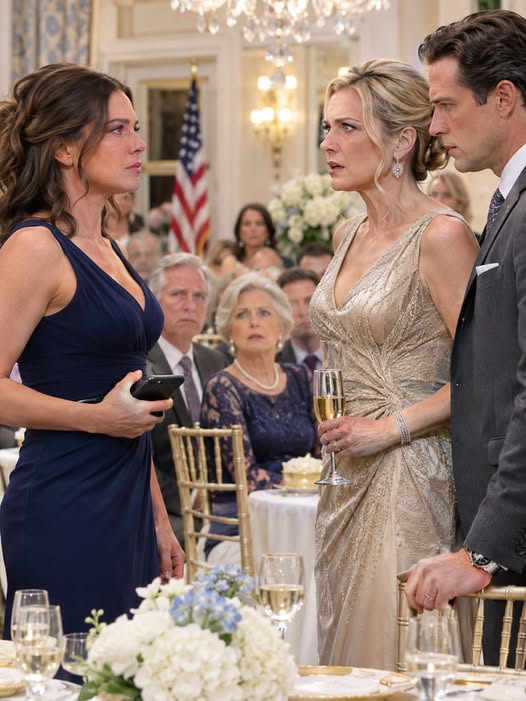
The opportunity finally came at my parents’ fortieth wedding anniversary celebration.
They had planned an elaborate event at the country club, the same place where Delila exercised her influence. There were two hundred guests, a live band, an open bar, and a formal seated dinner.
My parents had spared no expense, eager to display their successful marriage and, by extension, their successful family.
I wore a navy-blue dress Tyler had always loved and made sure Lucas looked handsome in his new suit.
Delila, of course, arrived dressed in designer clothing from head to toe. Kevin played the devoted husband, while Olivia and Nathan looked like perfect miniature reflections of their parents.
During the cocktail hour, Delila cornered me near the bar.
“I’m surprised you came,” she said, sipping champagne. “These events can’t be easy for you, being alone.”
“I’m not alone,” I replied. “I have Lucas.”
“Yes, but it’s not the same as having a real family, is it?”
She glanced toward Lucas, who was talking to one of our cousins.
“Poor thing. Growing up without a father, with a mother who never married. People talk, you know.”
“Oh, yes. Of course.”
“Everybody wonders what kind of example you’re setting. What kind of values you’re teaching him.”
She leaned closer.
“I worry about him, Andrea. Children from broken homes often have problems. And a bastard child especially—”
“That’s an interesting choice of words,” I interrupted. “You seem to use it a lot.”
She laughed.
“Well, if the shoe fits.”
“Tell me something, Delila. Does Kevin know about your discriminatory practices at the club? The families you’ve blocked because of their backgrounds?”
Her smile faltered slightly.
“I don’t know what you’re talking about.”
“And do you know anything about Britney Calvel?”
The color drained from her face.
“I thought we might have a conversation before dinner,” I continued. “Just the two of us. Maybe include Kevin. We have a lot to discuss.”
I walked away, leaving her frozen beside the bar.
I could feel her eyes on my back. I could almost imagine the panic taking hold as she tried to figure out exactly what I knew and how I had learned it.
Then the dinner announcement came, and everyone moved into the dining room.
The space was beautiful, decorated in silver and gold, with elaborate floral arrangements on every table. My parents sat at the head table alongside Delila, Kevin, and several other family members. I was seated nearby with Lucas.
The speeches began after the main course.
My father spoke about building a life with my mother, about the importance of family and legacy. My mother thanked everyone for coming and talked about how blessed she felt.
Then Delila stood up.
She was good at this, giving speeches and commanding attention. She talked about growing up with wonderful parents who had taught her the value of commitment and tradition.
She mentioned her own marriage, gazing lovingly at Kevin, who returned her smile with practiced ease. She spoke about their children and the importance of providing stability and proper values.
And then she looked at me.
“Of course, not everyone chooses the traditional path,” she said, her voice dripping with false compassion. “Some people make mistakes, but family means supporting one another, even when our loved ones don’t live up to expectations. Even when they have children under less-than-ideal circumstances.”
The room fell silent.
People shifted uncomfortably in their chairs.
Lucas lowered his eyes to his plate, and my heart broke for him all over again.
I stood up.
“You’re right, Delila,” I said. “Family should support one another. They should also be honest with each other.”
I took out my phone and connected it to the venue’s projection system.
The technical staff had been incredibly helpful when I explained that I wanted to show a surprise slideshow for my parents.
The large screen behind the head table came to life.
“Kevin,” I said, “could you explain to everyone who Britney Calvel is?”
The first image appeared.
Kevin and Britney were sitting together at a restaurant, his hand resting over hers on the table.
Delila gasped.
Kevin’s face went white.
“That’s from about six months ago,” I explained as more photographs appeared. “And here’s one from their weekend in the Hamptons last July. Kevin told everyone he was attending a dealership conference. He wasn’t.”
The room erupted in whispers.
My mother stood up in horror. My father looked from the screen to Kevin, his expression darkening with growing fury.
“Andrea, stop this immediately,” Delila hissed, but her voice trembled.
“Oh, we’re just getting started,” I replied.
More images appeared on the screen: hotel receipts, bank transfers, text messages.
“Kevin has spent nearly three hundred thousand dollars on his girlfriend over the past two years. Money he took from the family business.”
Kevin tried to speak, but no words came out.
Delila’s perfect facade crumbled before everyone’s eyes, her face contorted with shock and humiliation.
“But Delila,” I continued, “you’re not innocent either.”
The screen changed to display documents from the country club, the emails and records Sandra had provided.
“These are records showing how my sister has systematically prevented families from joining this club based on their race and economic status. She’s violated antidiscrimination laws and the club’s own bylaws.”
Delila was crying now, mascara running down her face.
“You vindictive bitch!” she spat. “You’ve ruined everything!”
“No,” I said calmly. “You did that yourself. I just made sure everyone found out.”
I looked around the room at all the faces turned toward me, our family, friends, and colleagues.
“My sister has called my son a bastard at practically every family gathering for years,” I said. “She’s turned his childhood into a source of shame. She’s punished him for the circumstances of his birth, something he had absolutely no control over. And every one of you let her.”
I turned toward my parents.
“You’ve prioritized appearances above everything else. You’ve allowed Delila to mistreat Lucas because addressing it would have been uncomfortable. Because it would have disrupted the image of the perfect family you’ve worked so hard to create.”
My mother was crying.
My father looked as though he had aged ten years in ten minutes.
“Lucas is the best thing that has ever happened to me,” I said, my voice cracking slightly. “He’s kind, creative, and loving. He deserves better than what this family has given him, and I’m done pretending otherwise.”
I took Lucas’s hand, and we walked out of the country club.
Behind us, the party descended into chaos.
I could hear raised voices, accusations flying, and the sounds of Delila’s perfect life imploding.
The aftermath was spectacular.
Kevin’s affair became public knowledge, leading to investigations into his business practices. He was removed from the family business and faced criminal charges for embezzlement.
The divorce was ugly and expensive.
The country club launched an investigation into Delila’s conduct. Several families came forward with complaints about being excluded or mistreated.
She was permanently expelled from the club, a social death sentence in her circles.
The club faced lawsuits in which Delila was personally named.
My parents were mortified.
Their anniversary party became infamous for all the wrong reasons. My father’s law firm lost clients who didn’t want to be associated with the scandal.
My mother was discreetly asked to resign from several charity boards.
But the real consequences struck where they mattered most.
Olivia and Nathan, Delila’s perfect children, had to leave their private school. The scandal followed them, and my sister couldn’t afford the tuition without Kevin’s income.
They ended up attending public school, experiencing many of the same challenges Lucas had faced.
Delila lost her house in the divorce and had to move into a small apartment.
Her social circle evaporated.
The friends who had once praised her perfect family disappeared when that perfection turned out to be a lie.
My parents tried to repair their relationship with me, but I kept them at a distance.
They were allowed to see Lucas occasionally under supervision, but only if they treated him with the respect he deserved.
Months passed before I allowed unsupervised visits, and I made it clear that any hint of judgment or cruel comments would result in their immediate removal from our lives.
Six months after the anniversary disaster, Delila called me.
Her voice was weak, nothing like the confident tone she had always used.
“Can we talk?” she asked.
We met at a coffee shop far from our old neighborhood.
She looked different.
Tired, older, humbled.
Her designer clothes had been replaced by basic, ordinary pieces. Her hair needed a touch-up, and her manicured nails were gone.
“I’m sorry,” she said without preamble. “For everything. For what I said about Lucas. For how I treated you.”
I took a sip of my coffee and waited.
“I was jealous,” she admitted.
“Your life looked messy from the outside, but you were happy. You loved Tyler, and then you loved Lucas, and you didn’t care what anyone thought. Meanwhile, I was trapped in a loveless marriage, following rules I didn’t even agree with, trying to be perfect for parents who would never be satisfied.”
“That doesn’t excuse what you did to Lucas.”
“I know. Nothing excuses it.”
Tears filled her eyes.
“He was an innocent child, and I took out my bitterness on him. I’m ashamed of myself.”
I studied her face, searching for signs of manipulation.
But all I saw was genuine remorse.
“Olivia asked me the other day why I was so mean to Lucas,” Delila continued. “She said kids at school are calling her names now, and she finally understands how it feels. She asked me if that was how Lucas felt when I called him that word.”
“And what did you tell her?”
“The truth. That I was wrong. That I hurt an innocent child because I was unhappy with my own life. That I’m trying to be better.”
She wiped her eyes.
“I don’t expect your forgiveness. I just wanted you to know that I understand now.”
I didn’t forgive her that day.
Forgiveness would take time, if it ever came at all. But I listened, and when she asked whether she could apologize directly to Lucas, I agreed to consider it.
That conversation with Lucas took place three months later in a therapist’s office.
Dr. Angela Morrison helped facilitate it, making sure Lucas felt safe and understood that none of what had happened was his fault.
Delila apologized without making excuses, explaining that her behavior reflected her own problems, not anything wrong with him or his family.
Lucas accepted her apology with a grace that surprised me.
He was ten years old by then, old enough to understand complexity and still young enough to believe in redemption.
Today, nearly two years after the anniversary party, my relationship with my sister is complicated, but it’s improving.
She attends therapy regularly and has acknowledged the damage she caused.
She has an ordinary job now, without the country club connections or the luxurious lifestyle, and she seems more genuine than she ever did before.
Olivia and Nathan spend time with Lucas occasionally.
They’re good kids who were just as much victims of their mother’s toxic behavior as anyone else.
They’ve adjusted to their new circumstances, and I believe they’re better for it.
My parents have slowly rebuilt bridges with me.
They’re more present grandparents to Lucas now, although they still struggle to let go of their obsession with appearances.
Old habits are hard to break, but at least they’re trying.
Kevin remarried Britney, which was an interesting choice.
The last I heard, his new car dealership business wasn’t doing particularly well.
Karma has its own timing.
As for Lucas and me, we’re thriving.
I started my own graphic design business, which has grown steadily.
Lucas is almost twelve now. He’s confident and creative, and he no longer carries the weight of other people’s judgments.
He knows his worth, and more importantly, he knows that he is loved completely and unconditionally.
People sometimes ask me whether I regret what I did at the anniversary party.
They frame it as going too far, being vindictive, destroying my family over a few words.
But here’s what they don’t understand.
I didn’t destroy my family.
My family was already broken.
I simply refused to keep pretending it wasn’t.
Delila spent years using shame as a weapon against my son. She used his very existence as a source of ridicule and moral superiority.
She made him feel inferior, somehow wrong simply for having been born.
And my family allowed it because confronting that cruelty would have been uncomfortable.
I made a decision to protect my son.
I chose his well-being over my family’s comfort. I chose the truth over the pretty lies they had wrapped themselves in.
If that makes me vindictive, I can live with it.
Because at the end of the day, Lucas no longer flinches when we attend family gatherings.
He doesn’t brace himself for insults disguised as concern.
He walks into rooms with his head held high, knowing he belongs there just as much as anyone else.
And Delila never, ever opens her mouth to call him that word again.
Some people might say I went too far, that the public humiliation was cruel, that I should have handled everything privately and given my sister an opportunity to change on her own.
But those people didn’t watch their nine-year-old son learn what the word “bastard” meant.
They didn’t watch him internalize shame over circumstances beyond his control.
They didn’t spend years listening to veiled insults while watching their family choose comfort over a child’s dignity.
I gave my sister years to change.
Every time she made a comment, I had the opportunity to expose her in that moment. Instead, I stayed quiet, hoping she would develop empathy on her own.
She didn’t.
She got worse.
So yes, I made sure everyone saw exactly who she was.
I made sure there were consequences for years of cruelty, and I made sure my son would never again have to endure her mistreatment in silence while our family looked the other way.
Lucas recently asked me if I was happy.
We were making dinner together, and the question came out of nowhere, the way his deepest thoughts often do.
“Yes,” I told him honestly. “I am.”
“Even though Grandma and Grandpa got mad and Aunt Delila lost her house?”
“Especially because of that,” I said. “Sometimes people need to lose things before they can become better. And you needed me to protect you. That was more important than keeping the peace.”
He thought about that while stirring the pasta sauce.
Then he suddenly wrapped his arms around me and held on tightly.
“I love you, Mom.”
“I love you too, sweetheart.”
That moment made everything worth it.
The family drama, the scandal, the ongoing complications of rebuilding relationships.
Every bit of it was worth seeing my son comfortable in his own skin, secure in the knowledge that someone would always stand up for him.
My sister learned a painful lesson about the consequences of cruelty.
My parents learned that appearances aren’t worth sacrificing your grandchildren.
Kevin learned that betrayal eventually catches up with you.
And I learned that sometimes the most loving thing you can do is refuse to be complicit in someone else’s mistreatment of your child, no matter who that person is.
Lucas will never again be called a bastard at a family gathering.
Not because my family suddenly developed better manners, but because they now know I will burn down their perfect facade every single time they try to hurt my son.
