
My name is Clay. When I was eighteen years old, my parents sat me down at the kitchen table and asked me to help convince my grandmother to give her house to my sister. I told them no. They kicked me out of the house that very night.
I drove to my grandmother’s house with everything I owned stuffed into a single duffel bag. I moved into her guest room and never called my parents again.
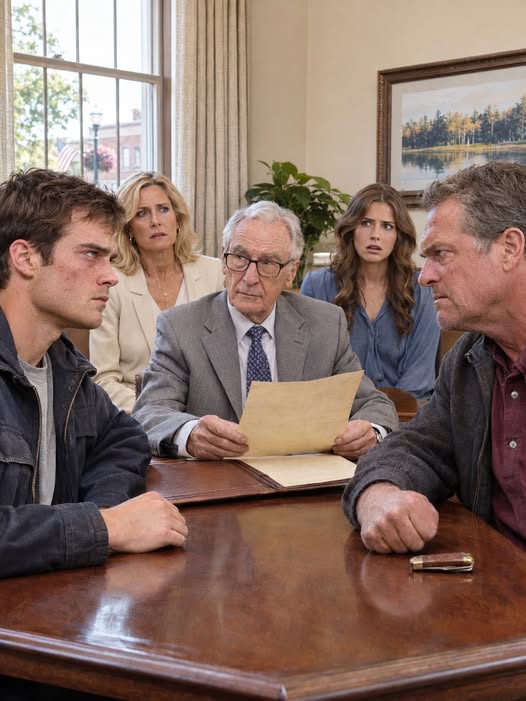
Seven years later, I found myself sitting across from them at a long table in a lawyer’s office in Fergus Falls. My grandmother had passed away eleven days earlier. My mother hadn’t stopped smiling the entire time we waited.
Just before the lawyer began speaking, she leaned forward and said, loudly enough for everyone to hear:
“Kenna and the baby can live there. Clay’s never home anyway because of that snowplow.”
Then the lawyer turned to the next page and read aloud the amount my father still owed my grandmother: fifty-eight thousand dollars.
After that, he read why my father still owed her the money.
That was the part my father never saw coming. Although, when I think about it now, he should have known.
But I’d better start with that night in the kitchen.
It was October of my senior year of high school. I had turned eighteen about a month earlier. I’d just come home from my after-school job at the grain elevator, where I swept floors and collected samples from the trucks that came in to unload.
When I walked into the house, both my parents were sitting at the kitchen table with the overhead light on.
In our family, that light being on meant somebody was in serious trouble. Usually, that somebody was me.
My father’s name is Darren. He makes his living installing tile, flooring, showers, and backsplashes in lake houses around Otter Tail County. He’s a big man with knees ruined by thirty years of working on them, and he talks as though every sentence out of his mouth is the final word anyone could possibly have on the subject.
My mother’s name is Tina. She kept the books for my father’s business, agreed with him whenever other people were around, and argued with him when they were alone in the car.
That night, there was a stack of documents in front of my father, held together by a large black binder clip.
“Sit down,” he ordered.
I sat.
My father laid out his plan with the same confidence he would have used to explain how to install a bathroom floor.
My grandmother was seventy-seven years old. Grandpa Lloyd had died eight years earlier. She was still living alone on that hill, four miles outside town down a gravel road, in a house that, according to my father, she would eventually be unable to maintain herself.
Someday she’d fall, or forget to turn off a burner on the stove, and end up in a nursing home. When that happened, my father explained, the state could come after the house to cover the cost of her care.
“Unless the house isn’t in her name anymore,” he added. “If she transfers it now and five years go by, they can’t touch it. It’s called the look-back period. I already talked to a guy who knows about this stuff.”
“Transfer it to who?” I asked.
“Your sister.”
Kenna was twenty-one that fall. She’d married Brady in June, and the two of them were renting half of a duplex in Fergus Falls from a landlord who never fixed anything.
“They need a little help getting started,” my father said. “Your grandmother has three bedrooms in that house, and there’s only one old woman living there.”
“Has Grandma said she wants to do that?”
My mother answered before my father could open his mouth.
“She doesn’t know what’s best for her. That’s exactly the problem.”
“She’s already told me no twice,” my father added. “But she listens to you. You’re out there every Sunday raking her yard. Tomorrow, after church, we’ll all drive over, and you’ll tell her this is what’s best for the family.”
I looked down at the first page of the documents.
My grandmother’s full name was typed in capital letters. LAVONNE. It looked strange that way, like the name of a stranger on a jury summons. Nobody thinks of their grandmother by her first name printed in capital letters.
“No,” I said.
My father looked at me as if I’d just told him one of his floors wasn’t level.
“What?”
“If she already said no, then no means no. I’m not going out there to convince her to give away her own house.”
“This isn’t about her house. This is about this family and what’s going to happen when that house isn’t hers anymore.”
“Dad…”
His chair scraped across the linoleum as he pushed it back. He didn’t stand all the way up. He just leaned over the table with both hands planted on its surface.
“Then you can go live with her.”
I waited for my mother to say something. Anything. I thought that, for once, she might step in and defend me.
But she kept staring at the papers.
“I’m dead serious,” my father continued. “You want to take her side? Then go take her side out there.”
So I went upstairs to my room and pulled my old duffel bag out of the closet.
It didn’t hold much. I packed my work boots, three pairs of jeans, a few shirts, my phone charger, and Grandpa Lloyd’s old canvas work coat, which my grandmother had given me the winter after he died.
When I walked back through the kitchen, my father was still sitting at the table, tapping the stack of documents against the surface to straighten the edges.
“Leave your key,” he ordered.
I put it on the counter, right beside the coffeemaker.
“Clay…” my mother said.
For a moment, I thought she was going to add something.
She didn’t.
Back then, I drove a 2004 Chevy with a heater that only worked on the driver’s side. It took me twenty minutes to reach my grandmother’s house. Her porch light was on. It was a quarter to eleven at night.
I knocked, and she appeared in her blue robe, her glasses pushed up on top of her head. First, she looked at my face. Then she lowered her eyes to the duffel bag sitting on the ground.
She didn’t ask me a single question.
She simply stepped aside to let me in.
“The guest bed is made,” she said. “It always is.”
The next morning, she made pancakes, and I told her the whole story: the documents, the look-back law, the plan involving Kenna, and the key I’d left on the kitchen counter.
When I finished, my grandmother set her fork down on her plate.
“Your father already asked me twice,” she said. “And I told him no both times. I never imagined he’d try sending you a third time.”
“He didn’t send me. I refused to do it.”
“I know you did.”
She picked up her fork again.
“That’s why you’re eating pancakes in my kitchen, and he isn’t.”
I explained that I had some money saved from my job at the grain elevator and that I could pay her rent. Whatever monthly amount she thought was fair.
She pointed her fork directly at me.
“Save your money. You’re not a tenant. You’re my grandson. Grandsons don’t pay rent. Grandsons carry in the groceries and reach things on the highest shelves.”
Then she fell silent for a moment, looking out the window toward the bird feeder Grandpa had built.
“Your father has always been very good with paperwork when somebody else’s name is written on it,” she murmured.
I didn’t understand what she meant.
I thought she was talking about the papers for the house.
But she wasn’t. And it would take me seven years to discover what she really meant.
My parents didn’t show up at my grandmother’s house that Sunday after church. They didn’t come the following Sunday, either.
When graduation came around in May, I looked up into the bleachers and saw exactly one person I knew: my grandmother, wearing her church dress and holding a camera that still used film.
When they announced my name over the loudspeakers, she stood up and shouted with everything she had. She somehow managed to stretch my name into three syllables, even though it only has one.
My parents didn’t attend.
Neither did Kenna.
That same summer, I got a job with the county highway department. My foreman was a man named Gene, who’d been clearing those roads with his snowplow since before I was born.
By my second winter, I had my own assigned route, and it passed right by the bottom of the hill where my grandmother lived.
Officially, her road wasn’t the first one on my route. Unofficially, it was the first one I cleared after every snowstorm for seven long years.
Gene knew.
He never said anything about it, except once, when he looked over my logbook and said:
“Funny how that road up the hill always gets cleared before the main highway.”
Then he simply signed the sheet.
My grandmother and I settled into our new life together.
There was nothing particularly exciting about it. It was simply a good life.
On Saturdays, we had breakfast at Dee’s Café. My grandmother ordered exactly the same thing every week: two eggs over medium, wheat toast with no butter, and coffee.
And every week, after taking her first sip, she’d complain:
“Dee, this coffee’s too weak.”
Dee would answer from behind the counter:
“Then don’t drink four cups, LaVonne.”
And my grandmother would drink all four cups.
I must have heard that little exchange about three hundred times. Today, I’d give anything to hear it just once more.
During the second winter I lived with her, she decided it was time to teach me how to make her pie crust.
“Because somebody in this family needs to know how,” she explained, “and your sister manages to burn toast.”
I ruined four batches in a row. My hands were too warm.
My grandmother took one of my hands between hers, turned it over, and examined my palm, roughened by years of handling shovels and snowplow levers.
“You’ve got your Grandpa Lloyd’s hands,” she declared. “Too warm for making pie dough, but mighty good for holding on tight to things.”
The fifth batch turned out right.
She ate a slice of the pie and announced that it was acceptable.
Coming from my grandmother, that was the equivalent of winning first prize at the county fair.
During our third winter together, she announced out of nowhere that she wanted to ride along on my snowplow route.
“Grandma, you can’t ride as a passenger in a county truck.”
“I pay taxes in this county,” she argued. “And I’ll sit there quiet as a mouse.”
So, at five o’clock one Sunday morning, with a foot of fresh snow on the ground, my grandmother climbed into the passenger seat of a ten-wheel snowplow truck.
She wore her best winter coat and held a thermos of coffee in her lap.
She waved at every mailbox we passed. Every single one.
When we finished the route, she looked back at the perfectly cleared road we’d left behind and declared:
“Well, now I know where my tax dollars go.”
Gene found out about our little adventure on Monday.
He called me into the shop office, and I walked in convinced I was about to be fired. He watched me over the top of his reading glasses through a long, uncomfortable silence.
“If anybody asks,” he finally said, “that woman was a safety inspector.”
And that was the end of it.
Then there was Lena.
Lena drove the rural mail route. She came up the hill every afternoon around one-fifteen in a little white postal Jeep with the steering wheel on the wrong side.
My grandmother waited for her at the mailbox every day, rain or snow, to hand over her outgoing letters and talk about whatever happened to be on their minds.
Lena was about my age, and she had a laugh so bright you could hear it clearly from the porch.
On days when I was off work, my grandmother’s hip would suddenly start hurting terribly at around one in the afternoon.
“Clay, could you take the mail down? Oh, this hip of mine…”
The funny thing was that an hour earlier, she’d been perfectly fine standing on a little stepladder.
So I’d walk down to the mailbox.
In January, she started sending me down with a thermos of hot coffee for Lena, arguing that the poor girl spent the whole day driving around in that weather.
Lena figured out the plan in about a week.
She’d take the thermos from my hands, look up toward the kitchen window, where my grandmother stood behind the curtain without making the slightest effort to hide, and burst out laughing as she waved at her.
Then I’d stand there awkwardly, saying something foolish about the weather. Lena would make some comment about the snow, drive away, and I’d walk back up the hill.
My grandmother was always waiting at the door.
“Well? What happened?”
“What do you mean, what happened?”
“Clay!”
“She’s the mail carrier, Grandma. She’s not supposed to be asking me anything.”
“Then you ask her!” she’d exclaim, throwing her hands toward the heavens. “Lloyd asked me to dance after looking at me one time. One look. And you’ve already looked at that girl about three hundred times this December alone.”
Every year, on the weekend after Thanksgiving, my grandmother would sit down at the kitchen table with a Christmas card and her good pen.
She’d write a message. Then she’d take out a second card, exactly like the first, and copy the same words, letter for letter.
She’d put the first one in an envelope, write my father’s address on it, attach a stamp, and personally walk down to the mailbox to send it, whether her hip hurt or not.
The second card went into a large envelope that she kept in her desk drawer. Then she’d lock the drawer.
The first year, I asked her what the whole ritual meant.
“It’s an offer that’s still on the table,” she replied.
“What kind of offer?”
“An offer for your father.”
She slipped the key into her apron pocket.
“That’s between him and me.”
The second year, I asked whether my father had ever responded.
“Not yet,” she said.
After that, I stopped asking. But every Christmas, I watched her repeat the same process: two identical cards, one destined for the mailbox and the other for the locked drawer.
My parents didn’t disappear completely from our lives.
They showed up with the same regularity as an overdue bill, and they almost never brought good news.
My mother called me for the first time during the week before that first Thanksgiving.
When I saw her name on my phone screen, my stomach turned over. For a moment, I thought maybe she was calling to apologize.
“Hello, sweetheart,” she greeted me.
“Hi, Mom.”
“How’s Grandma?”
“She’s fine. She’s making lefse for the church.”
“That’s good. I’m glad to hear it.”
There was a pause.
“Has she said anything about the house? Has she changed her mind?”
“She’s doing great, Mom. Thanks for worrying about her.”
And I hung up.
For the next seven years, my mother called about twice a year: once around Christmas and once sometime in the spring.
She always asked the same question, although she disguised it with different words.
Had Grandma started thinking about the future? Had she talked to anyone about her plans? Was she still being just as stubborn?
Not once, in seven years, did she ask how I was doing.
I counted those calls. I counted them because, after a while, counting was much easier than continuing to hope.
My parents visited in person exactly once a year, for my grandmother’s birthday in July.
They brought a cake from a grocery store in Fergus Falls, with her name spelled correctly in frosting. I’ll give them credit for paying attention to that detail, at least.
They’d sit on the porch for an hour and talk about the weather and property taxes.
My father never looked me directly in the eyes.
The first year, when I came outside carrying a pitcher of lemonade, he looked at the pitcher instead of at me.
“You’re still here?” he asked.
“Still here,” I answered.
Kenna and Brady came along on those visits, too.
Kenna was polite to me in the same way someone is polite to a waiter. Brady seemed like a pretty decent guy, although he always looked a little lost.
I don’t think anyone had ever explained to him how our family really worked. I think he spent seven years trying to figure it out on his own.
It was Mara, one of my father’s cousins, who told me what my parents had been saying about me behind my back.
It happened during my second summer living with Grandma, at a church potluck.
Mara cornered me between the casserole table and the desserts.
“Well,” she began in an overly friendly tone, “your father has been saying you moved in with your grandmother the minute you turned eighteen.”
“That’s what he says.”
“He also says you’ve had your eye on that house. That you’ve got your grandmother wrapped around your little finger so she’ll do whatever you want.”
She smiled as though she’d just warned me that I had something stuck between my teeth.
“I’m only telling you what people are saying.”
I felt my ears burning with anger. I set my plate down on the table because my hand was shaking.
“Mara, my father was the one who told me to go live with her. Those were his exact words. You can ask him.”
She never asked.
Nobody did.
It was too convenient a story.
It allowed my parents to present themselves as the victims of a greedy, manipulative boy they’d been forced to throw out, rather than admit they’d kicked out their own son because he refused to help them take an old woman’s house away from her.
For years afterward, guys I’d gone to school with would come up to me and say:
“Heard you got yourself a free house.”
And they’d laugh like they were paying me a compliment.
During the fourth year, I ran into my father by chance at a gas station beside the highway.
It was a Tuesday in April. I was filling my truck when his work vehicle pulled up at the next pump.
Painted on the side in bright blue letters were the words: LAKES AREA TILE.
I remembered perfectly the day those letters had been painted.
I was thirteen or fourteen. My father had come very close to losing the business that winter. At least, that was what I knew.
Then, suddenly, that spring, there was a new truck, a new sign, and a new tile saw.
My grandmother’s Buick had been parked in our driveway for almost that entire week, which was something that rarely happened.
At the time, I hadn’t connected the dots.
Kids usually don’t.
My father climbed out of his truck and stood on the other side of the pump.
“How’s she doing?” he asked.
It didn’t even sound like a sincere question.
“She’s eighty years old and sharp as a tack. She still beats me at cribbage.”
He nodded as though he hadn’t heard a word.
“Listen, Clay. She trusts you completely. You could convince her to sign one thing. It would take two minutes. I’ll bring the documents, and you put them in front of her. Tell her it’s the smartest thing she can do. That’s all.”
“No.”
He didn’t even blink. I think he’d already expected that answer.
“You really think you’re going to keep that house?”
“I don’t even think about it.”
“You’re the hired help out there, Clay. That’s all you are to her. A hired hand who doesn’t even get paid. The minute she dies, you’ll be out on the street, and you know it.”
“Have you called her?”
“What?”
“I asked if you’ve called her. Dad, she’s eighty years old. Call her yourself. Ask how she’s doing. It would mean a lot to her.”
His face turned that dark shade of red I remembered so well from childhood, whenever I broke something in the house.
“I don’t need some snowplow driver lecturing me.”
“No,” I said, putting the gas nozzle back in place. “What you need is a signature. And you’re not getting it through me.”
I climbed into my truck, started the engine, and drove away.
I couldn’t unclench my jaw until I was halfway up the hill.
When I got home, I told my grandmother everything.
She was sitting at the kitchen table doing a word search with a pen. She said pencils were for people who lacked confidence.
She listened carefully, then spent a long time looking out the window toward the road.
“He’s running out of time,” she finally said quietly. “And he doesn’t even realize it.”
I thought she was talking about her own old age.
In a way, she was.
But that wasn’t all she meant.
Her last birthday was in July of last year. My grandmother turned eighty-four.
My parents arrived as usual, carrying a cake from the grocery store. Kenna and Brady came, too, but this time they brought their daughter, my niece Ivy.
The baby was six months old. She wrapped her little hand around one of my fingers and refused to let go.
For about ten seconds, I completely forgot whose daughter she was.
Kenna walked through the house with Ivy resting on her hip, looking around the rooms as though she were inspecting a property during an open house.
She stopped at the foot of the stairs.
“Grandma, which upstairs bedroom gets the morning sun?”
“The little one, right at the top of the stairs,” my grandmother answered. “Why do you ask?”
“Oh, no reason. I was just thinking it would make a beautiful room for the baby.”
The kitchen fell completely silent.
“That’s Clay’s room,” my grandmother clarified.
Kenna shifted the baby to her other hip and smiled without the slightest trace of discomfort.
“Well, eventually it’ll be the baby’s.”
My father let out a short laugh. Not a full laugh, just a little snort through his nose, as though Kenna had said something funny.
“Kenna…” my mother said.
But she said it in the same tone someone uses to tell a dog no when they don’t really care what it’s doing.
My grandmother picked up the cake knife, cut a slice, put it on a plate, and handed it to Kenna.
“Eventually comes for all of us, sweetheart,” she said. “It’s just that some people know how to make much better use of their time than others.”
They left twenty minutes later.
My grandmother waved goodbye from the porch until they disappeared at the bottom of the hill. Then she finished washing the dishes and never mentioned the matter again.
In October, she asked me to take her for a drive.
It was a Saturday afternoon, surprisingly warm for that time of year, and most of the trees had turned gold.
I’d just come inside from chopping firewood when I found her sitting on the porch, her purse in her lap and one of her best sweaters on.
“Let’s go for a drive,” she suggested.
“Where to?”
“Nowhere in particular. I’ll tell you where to turn.”
So I drove.
She pointed out roads, and I turned.
For two full hours, she told me the story of her life, stopping at a different place each time.
First, she had me pull over in front of the old dance pavilion by the lake.
“This is where your Grandpa Lloyd asked me to dance,” she said. “Back in 1960. He stepped on my feet the entire night. Both feet. I went home and told my mother I was never going to see that boy again.”
She smiled at the memory.
“He came back the following Saturday and stepped on them again.”
Then she had me drive past the elementary school in Henning, where she’d worked as a cook for thirty-one years.
She could still remember the names of the children who refused to eat her chili.
“The Lindberg boys,” she said. “Every last one of them. All five.”
She shook her head.
“Now two of them come up to me at church and tell me they’ve never tasted chili as good as mine since. Liars.”
We passed the white Lutheran church where she and my grandfather had been married when she was nineteen.
“Forty dollars,” she remarked. “That’s what the entire wedding cost. Forty dollars and a borrowed dress. The dress was too long, so I tripped walking down the aisle. Your grandfather caught me before I fell and said it was only fair after everything he’d done to my feet.”
Finally, she asked me to stop the truck at a place where we could see our house across the low fields.
“He built that house with his brother’s help,” she told me. “Took them three summers. Half the time, they didn’t have the faintest idea what they were doing.”
She pointed toward the house.
“There’s a wall in the back bedroom that isn’t quite straight. Lloyd never wanted to fix it. He said every house ought to have at least one thing that admits it was built by human beings.”
We sat on the tailgate of my truck, enjoying the last rays of sunlight.
That morning, she’d baked an apple pie using my crust. Although she’d never have admitted it out loud, she’d carefully wrapped it in a towel and brought it along with two forks, as though she’d planned the whole afternoon.
And, of course, she had.
We ate straight out of the pie dish.
“I’ve had a good life, Clay,” she told me. “Much better than I expected. Some days, even better than I deserved.”
“You deserved every good thing that ever happened to you.”
“Hush. I’m talking.”
She set her fork down in the dish.
“And these last seven years have been among the best years of my life. I want you to know that. I want you to know that you made that possible.”
I didn’t know what to say.
I couldn’t speak.
I just sat there looking at the house in the distance, across the field.
She patted my knee.
“I’ve done everything that was in my power to do,” she said. “The paperwork will take care of the rest.”
“What paperwork?”
She didn’t answer.
She picked up her fork again and pointed it at me.
“Now tell me, is that nice mail carrier still single?”
“Grandma…”
“It’s a very simple question.”
“I think so.”
“Then, for the love of God, Clay…”
She shook her head and took another bite of apple pie.
We drove home after dark.
My grandmother spent most of the drive humming some old song I didn’t recognize.
The next morning, she didn’t come downstairs for coffee.
She always got up before me and made the first pot.
She had passed away in her sleep, in her own bed, inside the house my grandfather had built.
I’m not going to say much more about that morning.
I’ll only say that she looked like a woman who, for once in her life, had finally decided to sleep in.
And God knows she’d earned it.
The funeral was held the following Saturday.
I’d like to say I took care of all the arrangements, but that would be a lie.
My grandmother had already handled absolutely everything herself.
Back in March, she’d visited the funeral home in Henning and chosen every detail: the hymns, the casket, the luncheon menu, and the Bible verses.
She’d even paid for everything in advance.
When my father showed up at the funeral home the morning after her death, ready to take charge of the situation, the funeral director simply handed him a folder.
“LaVonne arranged all of this back in March,” he explained.
The church was full.
All five Lindberg brothers came to the funeral. Dee made the coffee for the luncheon that day.
Gene showed up wearing a sport coat that had to be about thirty years old.
Lena came, too.
She sat in the back row wearing her postal service jacket because she’d come straight from her route.
When I walked past her behind the casket, she reached out and squeezed my hand once.
Then she let go.
During the luncheon in the church basement, I was standing beside the coffeemaker when Kenna approached with Ivy asleep on her shoulder.
“I’ve been thinking about the room that gets the morning sun,” she told me quietly. “We’d like to paint it. I think there’s still some of the original paint stored in the basement. You know where it is.”
I don’t think she was trying to be cruel.
I don’t think she even realized what she was saying.
Someone had spent seven years assuring her that the house would eventually belong to her, and in her mind, she’d already moved in.
“I don’t know, Kenna,” I replied.
And I walked away.
Two days later, on Monday morning, I discovered just how completely my parents had mentally moved into the house, too.
It was around eight o’clock. I was standing by the kitchen window holding my coffee when I saw Brady’s truck coming up the hill.
He was pulling a sixteen-foot enclosed trailer.
My parents’ car was following right behind him.
They pulled into the yard and parked on the grass as though they owned the place.
I stepped out onto the porch.
Brady was the first to get out of his vehicle. He couldn’t bring himself to look me in the face. He walked around to the back of the trailer and stood there with his hands in his pockets.
Through the open side door, I could see a crib that hadn’t been assembled yet and several cardboard boxes with the words “KITCHEN” and “IVY” written on them in marker.
My mother climbed the porch steps with her purse hanging from her arm.
She was smiling.
It wasn’t a malicious smile. It was a pleasant, almost affectionate smile, as though she’d come to drop off a dish of freshly cooked food.
“Good morning, Clay,” she said. “We thought it would be better to get a head start. Your sister can move in now. It makes the most sense. You’ll have to find somewhere else.”
Then she added, still smiling:
“After all, you’ve done it before.”
I stood motionless in the doorway with my coffee mug in my hand.
“We’re going to wait until we talk to the lawyer,” I replied.
My father came up onto the porch behind her.
He looked much older than I remembered, but his voice was exactly the same.
“I’m her son,” he said. “Her only son. There’s nothing to wait for.”
“Then it won’t hurt you to wait until Thursday.”
Mr. Stran, my grandmother’s attorney, had called me the day after she passed away. Before that, he’d been Grandpa Lloyd’s lawyer.
All he’d told me was that LaVonne had requested that the entire family meet in his office, together in the same room. He’d also instructed me to keep the house locked until then.
I didn’t know anything else.
But I knew my grandmother. And my grandmother never asked for something without a good reason.
“I got a call from Mr. Stran’s office,” I explained. “We’re all supposed to be there Thursday at ten in the morning. He told me to keep the house locked until then, and that’s exactly what I’m going to do.”
My father climbed one more step until we were face-to-face.
“You have no right to keep my family out of my own mother’s house.”
“Then you can hear that straight from the lawyer on Thursday. And you can come back Friday with your whole trailer.”
Nobody said anything for a moment.
A crow flew overhead.
“Darren,” Brady finally spoke up, “maybe we should just wait.”
“Unhook the trailer,” my father ordered him. “Leave it here. We’ll unload it Friday.”
“Take it with you,” I warned.
My father turned his head toward me again.
“That trailer isn’t staying parked in Grandma’s yard,” I insisted. “Either you take it, or I’ll have the county tow it to the impound lot. I know the guy who drives the tow truck very well.”
I paused.
“That guy is me.”
The truth was, I had no idea whether I could legally do something like that. I drove snowplows, not tow trucks.
But my father didn’t know that, either.
Brady didn’t want to stick around to find out who would win that argument.
He climbed back into his truck, turned the trailer around in the yard, and headed back down the hill.
My parents stood there for another minute.
“It’ll be by the first of the month, Clay,” my mother warned as she walked back toward her car. “Kenna already gave her landlord notice. If I were you, I’d start looking for somewhere else to live.”
I went inside, locked the door, and sat down in my grandmother’s place at the kitchen table.
Her word-search book was still open to exactly the page where she’d left it.
Thursday finally came.
Mr. Stran’s office was on the second floor of an insurance agency on Lincoln Avenue.
The man was about seventy-five years old, wore thick glasses, and spoke in the slowest voice I’d ever heard, as though every word cost him twenty-five cents and he was determined to get his money’s worth.
The others were already there when I arrived.
My father, my mother, Kenna, and Brady were sitting along one side of a long table.
My mother was wearing her nice coat, and her hair was perfectly arranged.
When I sat down across from them, she smiled at me. Then she leaned toward Mr. Stran and said, clearly and loudly enough for everyone to hear:
“Kenna and the baby can live there. Clay’s never home anyway because of that snowplow.”
Mr. Stran watched her over the top of his glasses for a second.
He didn’t say anything.
He simply opened a brown folder.
“LaVonne asked me to read this to all of you,” he began. “Here, in person, with everyone together. She was very specific about that. So I’m going to ask that you allow me to read it all the way through.”
He began with the usual legal language, the part about being of sound mind and acting of her own free will.
Then he came to the section establishing who would administer the estate.
“I appoint my grandson, Clay, as the personal representative of my estate.”
My father leaned forward.
“That has to be a mistake.”
“It isn’t,” Mr. Stran replied.
And he kept reading.
“To my grandson, Clay, I leave my house, all structures, the forty acres of land on which they stand, and absolutely everything contained within them.”
Kenna let out a small, strangled gasp.
My mother’s smile remained on her face, but it had gone stiff, as though it had been left out in the cold too long.
“She wasn’t right in the head these last few years!” my father exploded. “Anybody could see that! He’s spent seven years out there manipulating her!”
Mr. Stran turned a page in the folder and slid a document across the table toward my father without taking his eyes off him.
“She signed this will in March,” he said slowly. “Right here in this office, in the presence of two witnesses. She also brought a letter from her doctor, dated that same week, certifying that she retained all her mental faculties. She delivered the letter to me herself.”
He paused briefly.
“She told me you would say exactly what you just said.”
My father didn’t even touch the document.
“There are two additional gifts,” the lawyer continued. “To my granddaughter Kenna, I leave my sewing machine, which she always admired, along with my wedding photographs. To my son Darren, I leave his father’s pocketknife, which he asked about at his father’s funeral and never inquired about again.”
Mr. Stran placed a small brown pocketknife on the table in front of my father.
It was the same one Grandpa Lloyd had always carried.
My father eyed it suspiciously, as though it might bite him.
Then the lawyer announced:
“There remains the matter of the promissory note.”
He turned to the next page.
“On April ninth, 2015, I loaned my son Darren the sum of fifty-eight thousand dollars to save his tile installation business. He signed a promissory note for that amount and placed a mortgage on his house in Fergus Falls as security for the loan. The entire outstanding balance shall become due and payable upon my death.”
He continued reading.
“I leave that promissory note, together with the full amount owed under it, to my grandson Clay.”
Nobody moved a muscle.
And there, sitting at that table, I finally understood what had happened so many years earlier.
The new truck.
The new signs.
The new tile saw.
That spring when I was thirteen years old.
My grandmother’s Buick parked in our driveway for an entire week.
And the words she’d spoken during our first breakfast together:
“Your father has always been very good with paperwork when somebody else’s name is written on it.”
“That’s not right,” my father protested.
His voice had risen in pitch.
“She forgave that debt. We settled that years ago.”
“No,” Mr. Stran replied. “She did not forgive the debt. What she did was offer to forgive it.”
He reached into the brown folder and pulled out a large envelope.
I recognized that envelope immediately.
I’d watched it disappear into my grandmother’s desk drawer seven times.
The lawyer tilted it over the table.
Seven Christmas cards slid out, one after another.
“LaVonne gave me these cards in March,” he explained. “She told me they were exact copies of the cards she’d mailed to Darren every Christmas. She also expressly requested that I read them aloud. Every one of them.”
He picked up the first card.
It had a red cardinal printed on the front.
He opened it and began reading in that slow, deliberate voice.
“Christmas 2019. ‘Darren, I will tear up the promissory note the same day you call your son. Don’t do it for me. Do it for him. One phone call is all it takes. Merry Christmas. Mom.’”
He picked up the next card.
“Christmas 2020. ‘Darren, the offer still stands. Call your son. Mom.’”
Then he opened the third.
“Christmas 2021. ‘Darren, he clears my road first every time it snows. He thinks I don’t notice. Call him. Mom.’”
When I heard that, I had to lower my eyes toward the table.
Honestly, I’d always believed my grandmother didn’t know.
Mr. Stran continued.
He read the cards from 2022, 2023, and 2024. Each contained the same offer, repeated year after year with a few different words.
Call your son, and the debt will disappear.
Then he picked up the last card.
“Christmas 2025. ‘Darren, this is the seventh card. I am eighty-three years old, and I don’t know how many more Christmases the Lord has planned for me. I will not write this again. One phone call. That is all I have ever asked of you. Mom.’”
Mr. Stran placed the card beside the others.
The seven cards lay in a neat row across the table, like a hand of cards laid out for a game of solitaire.
My father stared at them.
All the color had drained from his face. His jaw moved as though he were chewing something he couldn’t manage to swallow.
Kenna turned toward my mother.
“What does all this mean?” she demanded. “What promissory note? You told me Grandma was confused. You told me Clay had been manipulating her all these years. You promised me the house would be ours.”
“That was between your father and Grandma,” my mother excused herself.
She didn’t look at Kenna.
Her eyes were fixed on the cards.
“You knew,” my sister insisted. “You read these cards every year. You knew what they said.”
My mother didn’t answer.
And that silence was all the answer Kenna needed.
Brady kept staring at the ceiling tiles, as though he’d decided to count them.
“There’s one more thing,” Mr. Stran announced. “A letter. It’s quite brief. LaVonne dictated it to me in March.”
He unfolded a single sheet of paper and cleared his throat.
“‘Darren, you never called because you thought waiting wouldn’t cost you anything. You knew that when I was gone, everything would eventually find its way back into your hands one way or another, and the promissory note would simply disappear into your own pocket. That is the only logical explanation I can find.
“‘I gave you seven long years to prove me wrong. You did not.
“‘So none of this will go back into your hands. Everything will go into the hands of the person who was actually there.’”
The lawyer moved to the final part of the letter.
“‘And to Clay: the money is all yours. Put a new roof on the house before it starts leaking, because I assure you it will. And for the love of God, ask that girl out to breakfast.’”
Mr. Stran folded the letter and placed it on top of the folder.
For the first time that morning, the corners of his mouth lifted just a little.
For all those years, I’d thought my grandmother was simply allowing me to live in her guest room.
But that wasn’t what she’d been doing.
She’d been trying to get my father back for me.
Every Christmas, she sat at our kitchen table and tried to buy, with fifty-eight thousand dollars of her own money, a single phone call from a father to his son.
And every year, my father had decided that phone call wasn’t worth it.
My hands were resting on my knees beneath the table.
When I looked down, I realized they were shaking.
So I clenched them tightly.
My father stood up so abruptly that his chair slammed against the wall.
“This is ridiculous!” he shouted. “She was nothing but a bitter old woman!”
“She was a woman with a signed promissory note and a properly recorded mortgage,” Mr. Stran replied with absolute calm. “You have ninety days, Darren. Those are the terms of the estate. You’re welcome to consult your own attorney if you wish. I’m certain he’ll tell you exactly the same thing.”
My father left the pocketknife on the table.
My mother picked it up and slipped it into her purse as they left the office.
When I came outside, I found them waiting beside their car in the parking lot.
I had to walk past them to reach my truck.
“Clay,” my father called.
I stopped.
“Let it go,” he asked. “Just let it go, for your mother’s sake. It’s family money. Your grandmother would have wanted—”
“Grandma gave you seven years to let it go, Dad. All you had to do was call.”
“It’s fifty-eight thousand dollars,” my mother interrupted.
Her voice cracked as she said the amount.
“Where are we supposed to get fifty-eight thousand dollars?”
“You have ninety days to figure that out,” I replied. “That’s ninety days more than I got. I barely had twenty minutes to pack my things into a duffel bag.”
My father’s face turned red with anger again.
“You’d really take money from your own father?”
“It’s not your money. It was Grandma’s. You only borrowed it.”
I took my keys out of my pocket.
“You have ninety days, just like the paper says.”
I climbed into my truck, started the engine, and drove back to the hill.
When I arrived, I shut off the engine and sat in the driveway, looking at the house my grandfather had built, with that one wall that had never been quite straight.
Here’s what happened afterward.
About a month later, my mother called.
The bank had refused to refinance their house, and she wanted to know whether I’d agree to let them pay off the debt in installments.
Maybe over twenty years.
“The promissory note says it has to be paid in full,” I replied. “Grandma was the one who set the terms. I’m just the person holding the document now.”
And I hung up.
My father ended up withdrawing all the money from his retirement account.
He was fifty-two years old.
That meant he had to pay an early withdrawal penalty, along with the applicable taxes.
So getting that fifty-eight thousand dollars cost him considerably more than fifty-eight thousand dollars.
And even then, it wasn’t enough.
He had to sell his work truck.
The same truck with LAKES AREA TILE painted on the side in bright blue letters.
The same truck he’d bought with my grandmother’s money in the first place.
It was sold at an equipment auction in Perham during December, along with his tile saw.
Now he works for a contractor outside Alexandria, kneeling on other people’s floors with those same ruined knees, driving a truck with another man’s name painted on the side.
The story about the Christmas cards spread through the whole town.
Of course, I didn’t tell anyone.
I didn’t have to.
Kenna told Mara, and Mara made sure the entire church congregation knew the story before the week was over.
One Saturday at the café, Dee brought a cup of coffee to my table.
“Heard Darren sold his truck,” she remarked.
“I heard that, too.”
“Heard about the Christmas cards, too.”
She wiped her hands on her apron.
“Seven of them, from what I was told.”
“Seven,” I confirmed.
Dee slowly shook her head.
“Your grandmother sat at that same table every Saturday for forty years,” she said. “And not once did she say a bad word about that man. Not once.”
She walked back toward the counter.
Then she turned around and repeated those last two words more loudly, so the entire café could hear.
“Not once!”
Since then, nobody has made another comment to me about getting a free house.
By the time Kenna called the landlord of her duplex and tried to get it back, he’d already rented it to somebody else.
She and Brady ended up moving into a smaller apartment near the highway, where they pay considerably more every month.
The crib is still sitting in a storage unit in Fergus Falls, unassembled and packed away in its boxes.
Kenna sent me a text message a couple of weeks after our meeting at the lawyer’s office.
Just one.
“Did you know about the cards?”
I didn’t answer.
The truth was, I hadn’t known anything until that very Thursday.
She never wrote to me again.
And that’s okay.
I learned a long time ago that sitting around waiting beside the phone is a family tradition I have absolutely no obligation to carry on.
Day ninety fell on January twenty-third.
My father brought the check himself because Mr. Stran had warned him that the document releasing the debt had to be signed in person.
It was the first time he’d come up the hill since that morning he’d arrived with Brady’s trailer.
He climbed the porch steps very slowly, one at a time, the way people climb steps when their knees are worn out.
He handed me a cashier’s check for fifty-eight thousand dollars.
I took it and signed the release document Mr. Stran had prepared.
I signed it right there on the porch railing, using my grandmother’s good pen.
The mortgage securing the loan against my parents’ house was canceled.
My father stood in front of me with his hands buried in his coat pockets.
He looked up at the house and stared at the small window at the top of the stairs.
The bedroom that caught the morning sun.
My bedroom.
“You know phones work both ways,” he finally reproached me. “It was seven years. You could have called me, too.”
“I didn’t owe you a phone call, Dad,” I replied. “You owed one to her.”
He couldn’t find anything to say to that.
He turned around, walked slowly down the steps, one at a time, and drove away in his car.
He didn’t raise a hand to say goodbye.
I hadn’t expected him to.
That very night, it snowed.
Fourteen inches fell during the biggest storm of the entire winter.
By four in the morning, I was already out working in the county truck.
And, to tell the truth, that wasn’t my route anymore.
Technically, Gene had reorganized all the routes during the fall.
But the road up the hill was once again the first one cleared.
Gene didn’t make any comment when he reviewed the logbook.
He simply signed it.
At one-fifteen that afternoon, I was standing beside my grandmother’s mailbox at the end of the driveway, holding a thermos of hot coffee.
The little white postal Jeep appeared, climbing the freshly cleared road and following the tracks my snowplow had left behind.
It stopped in front of me.
Lena rolled down the window.
First, she looked at the thermos in my hand. Then she raised her eyes toward the kitchen window, where there was no longer anybody standing behind the curtain.
“Your grandmother isn’t here to send you out anymore,” she said softly.
“No,” I replied. “She isn’t. But this time, the coffee’s on me.”
I handed her the thermos.
Then, because seven years and about three hundred exchanged glances were more than enough time, I asked if she’d like to have breakfast with me that Saturday at Dee’s Café.
Lena let out that bright laugh you could hear all the way from the porch.
“It’s about time,” she replied. “Your grandmother asked me every single week whether you’d finally asked me out. She did that for an entire year.”
That Saturday, Dee seated us at my grandmother’s table without either of us having to ask.
I ordered my breakfast exactly the way I’d heard my grandmother order it about three hundred times.
Two eggs over medium, wheat toast with no butter, and coffee.
I took a sip.
Then I looked up.
“Dee,” I said, “this coffee’s too weak.”
Dee put one hand on her hip and stared at me for a long second.
Then she smiled.
“Then don’t drink four cups, Clay.”
