
“You were his taxi. Taxis don’t inherit.”
My mother said that at my grandfather’s funeral luncheon, in the fellowship hall of First Christian Church, with a paper plate of ham salad in one hand and a plastic fork in the other.
She said it quietly enough that the church ladies gathered around the coffee urn couldn’t hear her, but loudly enough to make sure my sister did.
“Half of that money goes to your sister by Friday,” she told me. “Your grandfather would have wanted things to be fair.”
Grandpa had left me $38,000. I had spent four years driving him to doctors’ appointments, picking up his prescriptions, and making sure he had everything he needed. My sister Cassie had visited him twice during those four years, and one of those visits had mostly been an opportunity to take a picture for Facebook.
I set my plastic fork down on the table.
“Sure,” I said. “Half of what’s left comes to five dollars and fifty cents.”
Mom laughed.
It was that short, sharp laugh she used at the license branch whenever somebody asked if they could skip the line. Cassie didn’t laugh. Her husband, Chad, who was working on his third plate of scalloped potatoes, stopped chewing.
“He’s joking,” Cassie said. She looked at me. “Holden, you’re joking, right?”
I wasn’t.
At nine o’clock that morning, two hours before the funeral service, I had stood at the teller’s window at Prairie Trust on Walnut Street, holding Grandpa’s death certificate in a manila envelope and his account number written in his own handwriting on the back of a gas station receipt. When I walked out of that bank, exactly eleven dollars remained in his old savings account.
Grandpa had chosen that number himself.
My name is Holden. I’m twenty-nine years old, and I work as a lineman for the electric cooperative outside Muncie, Indiana.
This is the story of the week my mother tried to collect my grandfather’s inheritance before the flowers from his funeral had even started to wilt.
What she didn’t know was that Grandpa had seen that funeral luncheon coming. He had seen it coming a full year before he died, sitting at his kitchen table with a cashed check in his hand, my name written on the memo line of a check I had never touched.
He had also left my mother something in his will. Something nice, as a matter of fact. But there was a condition attached to it, and she managed to break that condition in two days.
To explain how we ended up in that church fellowship hall, I need to go back four years, to the fall when Grandpa failed his eye exam.
My grandfather’s name was LeVerne. Not Vern, not Bernie, not Laverne. LeVerne. If you called him anything else, he’d just keep reading his newspaper until you got it right.
He had operated a tool-and-die machine at the old glass factory for thirty-six years. He’d outlived my grandmother by eleven years and lived alone in a white house on Jackson Street. His porch light came on at exactly seven every evening because he’d wired it to a timer in 1982 and had never seen a good reason to change it.
He was eighty years old when the eye doctor told him he couldn’t drive anymore.
He took the news about as well as you might imagine. He drove himself home from that appointment, parked his pickup in the garage, hung the keys on the nail beside the back door, and never touched them again.
The problem was that an eighty-year-old man had a lot of medical appointments.
There was the cardiologist, the kidney specialist, the eye doctor who had supposedly ruined his life, a podiatrist, and a laboratory that wanted his blood every three weeks. He couldn’t walk to any of those places, and the bus didn’t run down Jackson Street.
So my mother called a family meeting.
We had it at Grandpa’s kitchen table on a Sunday afternoon. There were sloppy Joes for lunch, and Grandpa sat at one end of the table with his hands folded in front of him, looking like a man waiting to hear his sentence.
Cassie wasn’t there in person. She was on speakerphone from Yorktown, which she insisted was forty minutes from Grandpa’s house if you caught all the red lights. You could hear her two children arguing over a tablet in the background.
“I can’t just walk out of the branch whenever I feel like it,” Mom said.
My mother had worked the front counter at the county license branch for nineteen years.
“They’d write me up.”
“It’s forty minutes, Mom,” Cassie said through the phone. “And I’ve got Jace and Kaylee. It’s too much.”
Somewhere behind her, Chad shouted, “Tell her about my back!”
“Chad’s back has been acting up,” Cassie added.
Grandpa sat through all of it, listening to his family decide which one of them was going to get stuck with him. He didn’t say a word. Every now and then, he’d turn his coffee cup a quarter turn on the table, as though he were adjusting a dial on one of his old machines.
I was twenty-five at the time. I lived in an apartment near McGalliard Street, about ten minutes from Grandpa’s house. I worked four ten-hour shifts at the cooperative, Monday through Thursday, which meant I had every Friday off unless a storm came through.
“I’ll do it,” I said.
Mom let out a breath like somebody had just lifted a fifty-pound sack of feed off her shoulders.
“Well, you don’t have a family,” she said. “So that works out nicely.”
Grandpa looked at me from the other end of the long kitchen table. He didn’t smile. He just gave me one short nod, the same way he used to nod when a part came off the machine exactly the way it was supposed to.
“Good,” he said. “Fridays, then. I’ll get them to move everything to Fridays.”
And for the most part, he did.
The cardiologist wouldn’t cooperate, and the laboratory had its own ideas about scheduling, so on those days I traded shifts with a guy on my crew named Clemens.
The first time I asked Clemens to switch a Tuesday with me, he studied me for a long moment.
“You owe me a Christmas Eve,” he said.
I worked his Christmas Eve that year, and the next three Christmas Eves after that. He kept a list.
Grandpa’s appointment cards started piling up in my truck. Every time a receptionist handed him one, he’d pass it to me, and I’d tuck it behind the sun visor so I wouldn’t lose it.
After a couple of months, there were too many cards to fit comfortably, so I wrapped a rubber band around them. Then I needed a bigger rubber band.
By the end of the first year, the visor wouldn’t stay up on its own anymore. I had to hold it in place with a clothespin.
Grandpa came up with his own description of the arrangement.
“That’s a filing system,” he told me one morning.
“It’s a clothespin, Grandpa.”
“It’s a filing system with a clothespin,” he said.
Those drives were never a burden.
Grandpa was the funniest man I’ve ever known, and almost nobody knew it because he only talked when he figured something was worth saying. In my truck, apparently, a lot of things were worth saying.
He used to rate medical waiting rooms out loud on our way home. The cardiologist got a seven because the chairs had armrests. The podiatrist got a two because the only magazine in the place was from 1996, and somebody had filled out the crossword puzzle incorrectly in ink.
The laboratory got a negative score because there was a television playing the same cooking show on a continuous loop, and Grandpa had watched the same man make the same lasagna forty-one times.
“He’s using too much ricotta,” Grandpa said one afternoon.
“You’ve already told me that.”
“I’ve told him, too.”
“He can’t hear you, Grandpa. It’s a recording.”
“Then he’s never going to learn.”
After every appointment, he’d make me stop at the drive-through on Jackson Street for a small vanilla ice cream cone.
Just one cone.
He’d eat it in the truck with a napkin tucked into his shirt collar like a bib, carefully turning the cone as he worked his way around it.
“Don’t tell your mother,” he said the first time. “She thinks I’m watching my sugar.”
“Are you?”
“I’m watching it go down.”
Then, a second later, staring through the windshield, he added, “Your mother believes a lot of things.”
I didn’t ask him what he meant by that.
I should have.
The money business started about six months into our arrangement. We were sitting in his driveway after an appointment with the kidney specialist when Grandpa reached into his shirt pocket and held out two folded twenty-dollar bills.
“For gas,” he said.
I shook my head.
“No, Grandpa. I’m not charging you to ride in my truck. Put that away.”
He put the money back in his pocket, but he didn’t look particularly happy about it.
A week later, he tried again. This time he handed me a check.
I tore it in half right in front of him and dropped the pieces into the old coffee can he kept beside the back door.
After that, he stopped offering me money.
Or so I thought.
That Thanksgiving, Mom told Pastor Widler’s wife that she was the one taking care of Dad’s medical appointments.
She said it while I stood less than six feet away, holding a pie I’d picked up for her on the way over from Grandpa’s house.
At Easter, Cassie went to see Grandpa for the first time that entire year. She stayed forty minutes. She took a picture of herself leaning beside his recliner, both of them squinting into the camera, and posted it that evening with a caption about how nothing was better than spending time with Grandpa.
On her way out, she asked if she could borrow his snowblower since he didn’t need it anymore. In April, he gave it to her.
That snowblower never came back.
Every Sunday when I pulled into Mom’s driveway to drop Grandpa off for dinner, she’d open the front door, turn toward the inside of the house, and call out, “Dad, your taxi’s here!”
The first time, I laughed. I thought she was making a joke.
By the tenth time, I realized it wasn’t a joke.
That was just what she called me. His taxi. His ride.
“Holden’s on Grandpa duty this week.”
She said it like somebody had assigned me the job, when I’d been the one who raised my hand at his kitchen table while everyone else was busy explaining why they couldn’t do it.
Grandpa heard it every time. He’d climb slowly out of my truck, brace one hand against the door to steady himself, and say nothing.
But one Sunday, after Mom shouted her usual announcement, Grandpa looked back at me over the bed of the pickup.
“Taxis get paid,” he said.
“Not this one,” I answered.
He considered that for a moment.
“Should’ve asked about that, too,” he said.
The second year went about the same way, and so did the third.
Grandpa’s list of doctors grew longer, and his steps got shorter. The rubber band around the appointment cards broke twice and eventually got replaced by a thicker one from the produce section at the grocery store.
Clemens started calling my truck the LeVerne Express.
Cassie came once more during the third year, at Christmas. She stayed about twenty minutes, mostly so the kids could see him. Chad remained in the car with the engine running.
That was visit number two.
There wouldn’t be a third.
Through all of it, my mother continued telling people at church that she didn’t know how she managed to juggle everything between her father and the license branch.
Then April came around in the fourth year.
I’d picked Grandpa up for an appointment with his cardiologist. He was in a good mood, which for Grandpa meant he’d said more than nine words before we reached the end of Jackson Street.
We were stopped at a red light on McGalliard when he reached over and patted my arm.
“I’m glad you finally started taking that gas money,” he said.
I glanced at him.
“What?”
“Three years,” he said. “I figured you’d come around eventually.”
I looked at him again.
“What gas money?”
He looked right back at me.
The light turned green. Somebody behind us honked. I didn’t move, and neither did Grandpa.
“Four hundred a month,” he said slowly. “I give your mother a check on the first Sunday of every month. Says ‘Holden gas’ right there at the bottom. She gives it to you.”
“Grandpa, Mom has never given me a check in my life. Not for gas, not for my birthday, not for anything.”
I eased the truck forward through the green light.
Grandpa didn’t say another word for the rest of the day. He didn’t even rate the waiting room chairs.
I didn’t stop at the drive-through afterward, and he didn’t ask me to.
When we got back to his house, he walked straight past his recliner to the little desk in the dining room where he kept his bills.
He pulled out a thick folder of bank statements.
Prairie Trust mailed photographs of the front and back of every processed check, and Grandpa had saved every single one.
He spread them across the dining room table like a hand of playing cards.
Every check had the same words written in his square, careful handwriting on the memo line.
Holden gas.
Four hundred dollars.
And on the back of every single one, in blue ink, was my mother’s signature.
Jolene.
She had deposited them into her own account at the credit union.
I counted thirty-six checks.
Three years, beginning the month after I’d torn up the first check right in front of Grandpa.
“That’s fourteen thousand four hundred dollars,” Grandpa said.
He didn’t need a calculator. He’d spent thirty-six years doing measurements on steel with tolerances down to a thousandth of an inch.
For about a minute, I didn’t say anything.
My hands were flat on the dining room table, and I realized I was pressing down so hard that my knuckles had turned white.
“I’m going over there,” I finally said.
Grandpa looked at me.
“I’m going tonight,” I told him. “You can come with me, or you can stay here, but I’m going.”
He studied me for a long time.
Then he reached into the pile, selected the most recent check, the one from that April, and slid it across the table toward me.
“Take that one,” he said. “She’ll say it isn’t true. Harder to say that when you’ve got it sitting right in front of you.”
Mom was halfway through dinner when I knocked on her door.
She opened it with a dish towel over one shoulder and her reading glasses pushed up on top of her head.
“Holden? Is Dad okay?”
“Dad’s fine.”
I held up the check.
“This one’s from April. Says ‘Holden gas’ on the bottom. And that’s your name on the back.”
She looked at the check, then at me, then back at the check, as though the writing might change if she gave it another chance.
“Come inside,” she said. “You’re letting the heat out.”
“I’m fine right here.”
I kept the check raised between us.
“There are thirty-six of these, Mom. Three years. Fourteen thousand four hundred dollars. I haven’t seen one penny of it.”
She folded the dish towel very carefully into a square.
“I used it for your tires.”
“I bought my tires from Clemens’s brother. Paid cash. I’ve got the receipt in my glove compartment right now. You want to walk out to the truck and see it?”
She didn’t want to walk out to the truck.
Instead, she pressed her lips together and looked past my shoulder toward the street.
“Cassie’s had a couple of hard years,” she said. “You know Chad’s back is bad. Jace needed braces, and their car insurance went up after that thing with the mailbox.”
I stared at her.
“You’re single, Holden,” she continued. “You make good money at the cooperative. You would’ve just spent it on fishing lures anyway.”
“Grandpa wrote my name on every single one of those checks.”
She lifted her chin.
“Your grandfather doesn’t need to get upset about money at his age. If you go over there and stir him up, and something happens to his heart, that’ll be on you.”
I took a moment before answering because I wanted to get the words exactly right.
“He’s already upset, Mom. He’s the one who found the checks.”
Her expression changed.
“And I’m going to tell him exactly what you just told me,” I continued. “Word for word. The tires, the fishing lures, all of it.”
“Holden—”
I turned and walked back toward my truck.
I didn’t slam the door. There was no reason to.
Behind me, I heard her front door close very softly, and somehow that sounded worse than if she’d slammed it.
I drove back to Grandpa’s house and told him everything, word for word, just as I’d promised.
He listened from his recliner with the television turned off. When I got to the part about the fishing lures, his jaw tightened, but he didn’t interrupt.
The next day, he called her.
I wasn’t there to hear the conversation. He told me about it later while we were riding in the truck.
“She said you told her you didn’t want the money,” he explained. “Said she was saving it for you.”
“Saving it? Where?”
“That’s what I asked her.”
Grandpa turned his head toward the passenger window.
“She said in savings.”
“Which bank?”
“I asked her that, too. She said she’d have to look.”
He watched the fields slide past outside.
“And?”
“She looked,” he said. “Still looking.”
For about a week after that, Grandpa hardly spoke at all. Not even in the truck. Not even when the laboratory television played that same lasagna recipe again, and the man on the screen was still using entirely too much ricotta.
Then, one Friday in May, Grandpa asked me to take him someplace that wasn’t a doctor’s office.
“Eversole’s,” he said. “Downtown. Upstairs over the old shoe store. Then the bank.”
Gilbert Eversole was eighty-one years old and had been Grandpa’s lawyer since before I was born.
His father had been Grandpa’s lawyer before him.
The sign on the upstairs office door still read Eversole & Eversole. Once, when I’d asked him which Eversole he was, he’d said, “The one that’s left.”
Mr. Eversole spoke more slowly than anybody I’ve ever met. You could start a conversation with him, go get yourself a glass of water, and come back in time to hear the verb.
I waited in the hallway while Grandpa went into his office.
He was in there almost two hours.
When he finally came out, Mr. Eversole accompanied him to the top of the stairs, shook his hand, and looked at me over his glasses.
“You’re the grandson who drives,” he said.
“Yes, sir.”
“Hm.”
Then he turned and went back into his office.
The following week, Grandpa had me take him to see Dr. Artsock, his regular physician, for an appointment that wasn’t written on any of the cards behind my visor.
He came out with a sealed envelope.
That same afternoon, he handed it directly to Mr. Eversole.
I didn’t know what was inside it. I would find out later.
Then we went to Prairie Trust.
Grandpa sat at the desk of Mrs. Bonreger, a bank employee who had known him since she was a little girl. I watched him sign a form while she pointed to the places where he needed to write his name.
That evening, sitting at his kitchen table, Grandpa finally explained what he’d been doing.
He had a savings account at Prairie Trust. He’d been putting a little money into it every month since his days at the glass factory, and he’d never taken anything out.
The balance was around thirty-eight thousand dollars.
That day at the bank, he’d put my name on the account as the person who would receive the money when he died.
Mrs. Bonreger called it payable on death.
That meant the account wouldn’t go through his will at all. It would pass directly to me.
Nobody else could touch it, and nobody could argue over it in a lawyer’s office.
“That’s for the gas,” Grandpa said. “And the ice cream cones. And every Christmas Eve you worked for that tall fellow.”
I opened my mouth to say something, but he raised one hand.
“I’m not finished. You’re going to want to tear this up, too. And you won’t be able to, because I’ll be dead. So that’s settled.”
Then he told me about his will.
He had left the house on Jackson Street to my mother. The entire house, along with the property.
I must have looked surprised, because he shrugged.
“She’s my little girl,” he said. “I held her when she was born. She’s done wrong, but she’s my little girl, and I want her to have the house her mother took care of.”
He rested his hands on the table.
“I want to give her a chance to do right.”
“Okay,” I said.
“But there’s a clause in there,” he continued. “Eversole wrote it, but I told him exactly how I wanted it.”
“What kind of clause?”
“If your mother goes after what I left you, if she makes any kind of claim against that bank account, the house goes to you instead.”
I leaned back in my chair.
“Grandpa, she’s going to—”
“Maybe,” he interrupted. “Maybe not. That’s up to her. I’m not going to make her decisions for her. I’m just going to make sure there’s a price for making the wrong one.”
He tapped the table with one finger.
“And there’s another thing.”
I waited.
“Banks don’t always find out right away when somebody dies. Your mother knows I keep my checkbook in that desk. She knows where I keep my bank card.”
He looked directly at me.
“The day you get my death certificate, don’t wait. You go to Prairie Trust, you tell Mrs. Bonreger, and you move every dollar into your own account. You hear me?”
“I hear you.”
“Every dollar except eleven.”
I waited for an explanation.
None came.
“Why eleven?” I finally asked.
Grandpa picked up his coffee cup and turned it a quarter turn.
“Because that’s about what she spent on me in four years,” he said. “A birthday card and a box of crackers. Leave her that much. It’s only fair.”
I laughed. I didn’t mean to.
Grandpa didn’t laugh, but one corner of his mouth moved in what was about as close to a smile as he ever got.
Then he did one more thing.
He reached into his shirt pocket, pulled out a gas receipt from the station on Walnut Street, and wrote his account number on the back in square pencil figures.
He folded the receipt once and handed it to me.
“Put that behind your visor,” he said. “With the filing system.”
That summer and fall were mostly good.
That’s the part I want people to know.
Grandpa got weaker, but he never became a sad man. We kept going through the drive-through for vanilla cones. He kept rating waiting rooms.
The podiatrist finally got some new magazines, and Grandpa raised his score to a four.
Clemens brought him an old lawn chair with LeVerne Express painted across the back. Grandpa sat in that chair every afternoon until the porch light came on at exactly seven.
He took a bad turn in October and was admitted to the hospital.
On the third day, he looked at me from his bed and said, “The morning they give you that paper, I want you standing at the bank when they open. Before she gets there.”
“I will.”
“You’ll be there when they open?”
“I’ll be there when they open, Grandpa. Before her.”
“Good,” he said.
Then he closed his eyes.
Grandpa died that Thursday afternoon in the hospital, with a baseball game playing quietly on the television.
I was there.
My mother arrived at eight.
Cassie said she hadn’t been able to find a babysitter.
Grandpa had paid for his own funeral back in 2009, after Grandma died. He’d gone to Oyster’s Funeral Home on Jackson Street and made all the arrangements himself.
He said he didn’t want anybody fighting over who had to pay for the casket.
So there wasn’t anything to argue about. Oyster’s handled everything.
The service was scheduled for Tuesday at eleven.
At eight-fifteen Tuesday morning, Mr. Oyster met me at the funeral home’s front door and handed me an envelope containing certified copies of Grandpa’s death certificate.
Grandpa had ordered extra copies.
“LeVerne asked me to get these to you first thing,” Mr. Oyster said. “He was real particular about that. Said ‘first thing’ about four times.”
At five minutes to nine, I was standing outside the locked glass doors of Prairie Trust, wearing my funeral suit and holding a manila envelope and an old gas receipt.
When Mrs. Bonreger unlocked the door and saw me, she didn’t even have to ask.
“He told me you’d come,” she said. “Sat right there in May and told me.”
She looked me up and down.
“Said you’d show up early, wearing a tie that didn’t match.”
I looked down at my tie.
It didn’t match.
The whole thing took about twenty-five minutes. Mrs. Bonreger transferred the account into my name.
Then I asked her to move $37,989 into my own account at the credit union.
She printed the receipt and slid it across the counter.
“Eleven dollars left,” she said, glancing at the screen. “He told me about the eleven dollars, too.”
“What did he tell you?”
She gave me a small smile.
“Said if anybody asked, it was for crackers.”
Two hours later, we buried Grandpa.
Clemens and four guys from my crew came in their work boots and stood along the back of the church like a wall.
Mom cried in the front row. Cassie cried beside her.
I’m not going to say they didn’t feel grief. I believe they did, in their own way.
Afterward, we went to the fellowship hall for ham salad, and my mother told me I was a taxi.
That’s where I started this story.
I’d told her that half of what remained in Grandpa’s account was five dollars and fifty cents. Cassie had asked whether I was joking, and when I didn’t answer, Mom lowered her paper plate.
“What does that mean?” she demanded. “What do you mean, what’s left?”
“It means Grandpa put my name on his savings account a long time ago,” I explained. “And this morning I did exactly what he told me to do with it.”
Her face turned a color I’d never seen before. It was like somebody had reached over and turned down the brightness.
“This morning?” she repeated. “Before the funeral?”
“He told me to do it first thing. Said it about four times.”
Chad finally swallowed his scalloped potatoes.
“He can do that?” he asked.
“He already did,” I said.
Mom stepped closer to me. Close enough that I could smell the coffee on her breath.
“You went behind this family’s back on the very day we buried my father.”
“No, Mom. I went to the bank on the day he told me to go. You’re the one who went behind this family’s back for three years, taking four hundred dollars at a time.”
Cassie looked at Mom.
Mom didn’t look at Cassie.
I picked up my plate and stood.
There was one more thing I wanted to say before I left, because I’d promised Grandpa I would give Mom the chance he wanted her to have.
“Grandpa told me what to say if you came after the money,” I said. “He told me you should talk to Mr. Eversole. He’s got Grandpa’s will.”
Mom stared at me without speaking.
“Honestly, Mom, I’d think very carefully before Friday.”
“That man is a hundred years old,” she snapped.
“Eighty-one,” I corrected her. “And he’s got an excellent memory.”
I threw my plate in the trash and drove home.
My phone buzzed at ten that night.
It was a text from Mom.
Half by Friday, or I’m getting a lawyer. Don’t make this ugly. Your grandfather would be ashamed of you.
I read it twice.
Then I typed back, Bring him to Eversole’s office Friday at ten in the morning.
After that, I called Mr. Eversole’s office and left a message.
He returned my call at seven the following morning, which made me suspect he’d been sitting beside the telephone waiting for it to ring.
“Your grandfather left me instructions,” he said, speaking in that slow, deliberate way of his. “He asked that I review his will with the family within ten days of his funeral. Friday at ten will be fine. I’ll call your mother.”
“She’s getting a lawyer,” I warned him.
There was a long pause, even by Mr. Eversole’s standards.
“Is she, now?” he finally said. “Well, let’s see what she does.”
What she did became clear Wednesday afternoon.
I was up on a utility pole along County Road 500 North, replacing a cracked insulator, when my phone buzzed inside my work vest. I didn’t check it until I was safely back on the ground.
It was an email with a letter attached.
The letterhead said Grant Pettibone, Attorney at Law. His office address was in a strip mall near the bypass, between a tanning salon and a cellphone repair shop.
The sign in his window advertised traffic tickets, divorces, and wills, in exactly that order.
The letter was one page long.
It stated that, on behalf of his clients, Jolene and Cassie, Mr. Pettibone formally demanded that I surrender half the funds from the late LeVerne’s Prairie Trust savings account, totaling nineteen thousand dollars, within ten days.
If I failed to comply, his clients intended to pursue every legal remedy available to them.
The letter went on to describe Grandpa as an elderly, isolated man who had been entirely dependent on me. It accused me of exercising undue influence to persuade him to place my name on his account.
Clemens read the letter over my shoulder while we were sitting in the work truck.
He read it twice.
Then he shook his head.
“Undue influence,” he said, drawing the words out like he was trying to taste them.
“Yep.”
“Well, you sure exercised some influence over me on Christmas Eve. Four of them, matter of fact.”
“Yeah,” I said. “Guess I did.”
I took a picture of the letter and sent it to Mr. Eversole’s office.
He called twenty minutes later.
“Dated today,” he observed.
“Yes, sir.”
“Signed by an attorney acting on her behalf.”
“Yes, sir.”
“A claim against the account.”
“Yes, sir.”
He went quiet for a while.
Then he said, “Well. That settles that, then. Bring your grandfather’s appointment cards on Friday.”
“All of them?”
“All of them.”
“How do you know about the cards?”
“LeVerne told me about the filing system,” he replied.
Then he hung up.
Thursday night, Cassie sent me a text.
Just Cassie, not Mom.
Mom says you’ll come to your senses tomorrow. Please don’t be like this, Holden. Chad already put a down payment on a four-wheeler for the kids for Christmas.
I didn’t answer.
I honestly didn’t know what to say to something like that. Besides, Grandpa always said that if you didn’t know what to say, that was usually your answer.
Friday morning, I removed the clothespin from my sun visor and pulled down the entire stack of appointment cards.
There were 211 of them, held together by a thick green rubber band from the produce department. Tucked in with them was the gas station receipt with Grandpa’s account number written on the back.
I put everything into a gallon-sized plastic storage bag.
Then I grabbed the folder containing the photographs of the cashed checks and drove downtown.
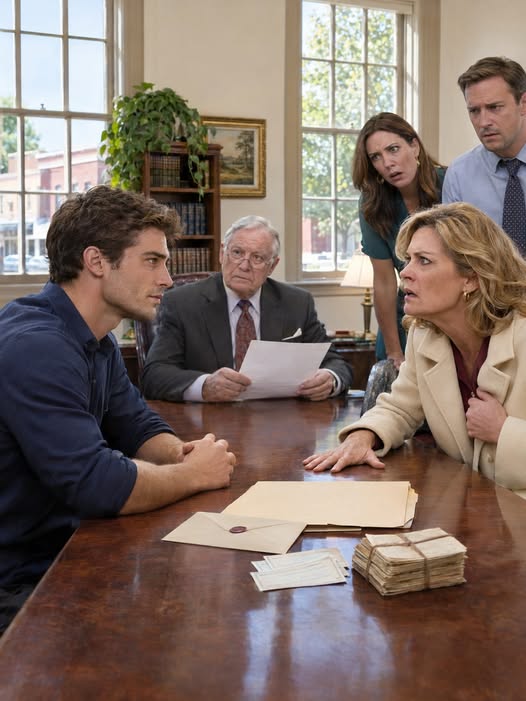
Mr. Eversole’s office had one long conference table. It was old, heavy, and polished smooth from years of use, the sort of table that had probably occupied the same room for so long that the building might have been constructed around it.
When I arrived at a quarter to ten, Mr. Eversole was already sitting at the head of the table with a folder in front of him and a little dish of peppermint candies beside his elbow.
“Sit there,” he said, indicating the chair to his right.
I sat down and placed my plastic bag and folder on the floor beside me.
Mom arrived at exactly ten, with Cassie and Chad following behind her.
Mom wore her church coat. Cassie had her purse clutched tightly under one arm, and Chad was wearing a necktie decorated with a cartoon duck. I believe it was the only necktie he owned.
None of them said hello.
Mr. Eversole glanced at the clock, folded his hands, and waited.
Grant Pettibone walked in about ten minutes late.
He was a man in his forties, wearing a nice gray suit with white running shoes. He carried a gas station coffee in one hand and a briefcase in the other. The briefcase still had a little store tag hanging from its handle.
“Sorry, sorry,” he said as he came through the door. “Traffic on the bypass.”
“There’s no traffic on the bypass,” Mr. Eversole said.
Pettibone stopped.
“There’s never been traffic on the bypass,” the old lawyer added.
Then he gestured toward an empty chair.
“Please sit down.”
Mr. Pettibone sat.
Mr. Eversole waited until everyone had settled, then adjusted his glasses and opened the folder in front of him.
“Before we begin,” he said, “LeVerne asked me to read his will to his family in this room, from this chair, within ten days of his funeral. It’s been three days. I didn’t want anyone to have to wait.”
He turned the first page.
“So I’ll read it slowly.”
And he did.
He read the opening provisions, explaining that the document was Grandpa’s last will and testament, properly signed and witnessed. Then he worked his way through the individual bequests.
Grandpa had left Cassie Grandma’s china cabinet and the clock from the mantelpiece.
Cassie visibly brightened when she heard that. The clock was beautiful, an old wooden one with brass hands and a chime that sounded every hour.
He had left me his pickup truck, which I already knew about, along with his toolbox from the glass factory.
I hadn’t known about the toolbox.
That nearly broke me right there at the table.
I’d seen that toolbox all my life. It was a big steel one with shallow drawers, each carefully labeled in Grandpa’s handwriting. He’d kept his measuring instruments, wrenches, and little precision tools inside it, wrapped in old shop rags. Every drawer had its place, and every tool had a place within the drawer.
He’d worked with those tools for thirty-six years.
The thought that he’d wanted me to have them hit me harder than anything about the money ever had.
I stared down at the table until I could trust myself to look up again.
Mr. Eversole continued reading.
“To my daughter, Jolene, I leave my house and property on Jackson Street, together with all contents not otherwise specifically bequeathed.”
Mom leaned back in her chair.
For the first time since entering the office, she looked directly at me and smiled.
It wasn’t a cruel smile, exactly. It was a smile of relief, as though she’d been worried about something and had just found out she didn’t need to worry anymore.
I could almost see her calculating what the house was worth.
Mr. Eversole turned the page.
“There is, however, a condition,” he said.
Mom’s smile faded.
He continued reading.
“If my daughter, Jolene, either personally or through any person acting on her behalf, shall present any claim against the savings account I have designated to pass to my grandson Holden, then my house and property on Jackson Street, together with its contents, shall instead pass in their entirety to my grandson Holden. My daughter shall receive nothing under this provision.”
Nobody said anything.
Chad looked at Cassie. Cassie looked at Mom.
Mom stared at Mr. Eversole as though he’d suddenly started speaking another language.
Finally, she cleared her throat.
“Well,” she said, “we haven’t made any claim.”
Mr. Eversole reached into his folder.
He removed a single sheet of paper and placed it in the center of the table.
It was the photograph I’d sent him on Wednesday.
Grant Pettibone’s letterhead was clearly visible at the top, along with the address beside the tanning salon.
“This was sent to your son on Wednesday,” Mr. Eversole said. “By your attorney. Acting on your behalf. Demanding half the funds in the account.”
Mom put one hand flat on the table.
“Then I withdraw it,” she said immediately. “Grant, tell him we’re withdrawing it.”
Mr. Eversole looked down at the letter.
“Your demand is dated Wednesday.”
“Yes, but I’m withdrawing it now.”
“The will does not say that the condition applies if you make a claim and subsequently change your mind. It says that if you present any claim against the account.”
He raised his eyes to her.
“And you did.”
“I didn’t know about that clause.”
“No,” Mr. Eversole agreed. “But your son told you at the funeral that you should speak with me before Friday. Several people heard him. Instead, you sent an attorney.”
Mom stared at him.
Mr. Pettibone cleared his throat and sat up straighter. I could practically see him deciding that it was time to earn his fee.
“With all due respect,” he said, “a provision of that nature is only enforceable if the individual signing the document understood what he was doing.”
Mr. Eversole turned his head toward him.
“My client’s position,” Pettibone continued, “is that LeVerne was an elderly man, isolated and entirely dependent upon a single grandson for four years. He was transported by that grandson, kept apart from other members of his family, and instructed on whom he should trust. That is textbook undue influence.”
He leaned forward a little.
“Any judge in this county would—”
I reached down, picked up the gallon-sized plastic bag, and placed it on the table.
Mr. Pettibone stopped talking.
I didn’t say anything at first.
I opened the bag, removed the thick bundle of appointment cards, and slipped off the green produce rubber band.
Then I started laying the cards out in rows in front of him.
Cardiologist. Nephrologist. Laboratory. Laboratory. Ophthalmologist. Podiatrist. Laboratory.
Every card had a date.
Some had Grandpa’s handwriting on the back, little notes he’d made while sitting in waiting rooms or riding home in my truck.
Too much ricotta.
Chairs have arms. Seven.
Magazine still from 1996.
I kept laying them out.
It took a while.
Putting 211 appointment cards in neat rows takes a while, especially when the table is crowded and everybody is sitting there watching you.
The cards stretched almost from one end of the conference table to the other. I had to make another row, then another.
When I finally finished, I rested my hands on the edge of the table.
“Every one of these cards represents a day I drove him,” I said. “Every single one. Four years.”
Mr. Pettibone looked down at the rows.
I opened my other folder and placed the photographs of the checks beside them.
“Thirty-six checks,” I continued. “Four hundred dollars each.”
I pointed to the first one.
“’Holden gas,’ written in Grandpa’s handwriting.”
Then I flipped it over.
“Jolene, signed on the back in blue ink.”
I moved to the next check.
“And this one. And this one. And every one after that.”
Mom sat very still.
“Each of these represents a month,” I said. “She told Grandpa she was giving me the money. She told the people at church she was handling his medical appointments. She called me his taxi, and then she cashed the checks meant to pay the taxi.”
I wasn’t raising my voice.
I didn’t need to.
Cassie leaned forward and picked up one of the check photographs.
She read the memo line.
Then she turned it over and read the endorsement on the back.
“Mom,” she said quietly. “What’s this?”
“It’s nothing, sweetheart.”
“It says gas money for Holden.”
“The money was put to good use.”
“What use?”
Mom didn’t answer immediately.
And that, by itself, was an answer.
Cassie kept looking at her.
Finally, Mom said, “Your car insurance. After that business with the mailbox. And some of Jace’s braces.”
Cassie set the check down very slowly, as though it had burned her fingers.
“You told me Grandpa sent that money,” she said.
Mom shifted in her chair.
“You told me Grandpa wanted to help us.”
“He did want to help.”
“He wanted to help Holden,” Cassie snapped.
She pointed at the rows of checks.
“It’s written on every single one of them.”
For the first time since we’d sat down, Cassie looked genuinely angry at our mother.
I watched her face and realized she was putting things together that she’d never had a reason to question before.
The money that had arrived when she needed it. The stories Mom told about caring for Grandpa. All those years she’d believed there was somebody else handling the responsibilities so she didn’t have to worry about them.
I still didn’t know whether that realization would change anything between us.
But I knew she’d finally seen what was written on those checks.
Mr. Eversole allowed the silence to settle over the room.
Then he reached into his folder one last time and removed a sealed envelope.
It was the same envelope I’d watched Grandpa hand him back in May.
Mr. Eversole opened it with a letter opener, unfolded the paper inside, and slid it across the table toward Pettibone.
“From Dr. Artsock,” he said. “LeVerne’s primary care physician for twenty-two years.”
Mr. Pettibone picked up the letter.
“It’s dated the same day LeVerne executed this will,” Mr. Eversole continued. “Dr. Artsock examined him that morning, at LeVerne’s own request.”
He paused to adjust his glasses.
“The physician found him, and I quote, ‘sharp as a tack and twice as stubborn.’”
Mr. Pettibone read the letter.
Then he read it again.
He looked at the signature, the date, and the doctor’s letterhead.
After a moment, he placed the paper back on the table and closed his briefcase.
The little store tag swung back and forth from the handle.
“Jolene,” he said, “I’m going to have to bill you for today.”
Mom turned toward him.
“Are you quitting?”
“I’m advising you,” he replied, very firmly, “to go home.”
Chad, who hadn’t said a single word throughout the entire meeting, chose that moment to defend himself.
“For the record,” he announced, “that letter was my idea.”
Everybody looked at him.
He sat up straighter.
“It was a good letter,” he insisted. “Had all the right words in it.”
Cassie closed her eyes.
“Chad,” she said. “What have you done?”
Mr. Eversole raised one hand.
“There’s another page.”
Everyone turned back toward him.
“LeVerne asked me to read this aloud if we reached this point,” he explained. “He hoped I wouldn’t have to.”
He took a single yellow sheet of legal paper from the folder and carefully unfolded it.
I recognized Grandpa’s handwriting from the other side of the table.
The letters were square and deliberate, each one sitting perfectly on the ruled line as though someone had held it there with a machine clamp.
Mr. Eversole lowered his eyes and began to read in his slow, measured voice.
“Jolene,
“I gave you the house because you’re my little girl, and I wanted you to have the place your mother took care of.
“If Gilbert is reading this to you, it’s because you couldn’t accept that gift.
“You called Holden my taxi for four years. A taxi gets paid. You made sure he didn’t.
“Holden was the one who was there for me.
“Be good to your children.
“Dad.”
The room went completely quiet.
Mom didn’t cry.
She didn’t argue, and she didn’t look at me.
She sat motionless for a few seconds, staring at the yellow paper in Mr. Eversole’s hands.
Then she stood up, picked up her purse, and walked out of the office.
She left her church coat hanging on the back of her chair.
Cassie remained seated for another minute before getting up and following her, carrying the coat over one arm.
Chad stayed where he was, looking from one person to another as though waiting for somebody to tell him what he was supposed to do next.
Finally, he reached toward the little dish beside Mr. Eversole, took a peppermint candy, and left.
Grant Pettibone shook Mr. Eversole’s hand on his way out.
He didn’t shake mine.
When the door closed and it was just the two of us, Mr. Eversole sat back and surveyed the appointment cards covering nearly the entire table.
“He told me about the ricotta,” he said.
I looked at him.
“He mentioned it twice.”
That was the closest thing to a joke I ever heard the man make.
I’d like to tell you that my mother fought the decision all the way to the end, that there was some enormous courtroom battle where the truth finally came out in front of a judge.
But that isn’t what happened.
She tried fighting it for about a week.
She called two other attorneys, proper estate lawyers over in Anderson. Both asked to see Dr. Artsock’s letter.
After that, neither one returned her calls.
Chad made things worse, which I’ve since come to understand is basically what Chad does.
The following Sunday, during coffee hour at church, he told a group of men standing beside the doughnut table that I was suing Jolene for her own father’s house.
He said it wasn’t fair because she’d only taken fourteen thousand four hundred dollars in gas money, and that had happened years ago.
Mrs. Lucille Bolan, who had been the church secretary since 1979 and had never missed a thing in her life, set down her coffee.
“She took it from whom?” she asked.
Chad explained.
He explained the entire thing, in considerable detail.
By that afternoon, everybody at church knew.
By the following Sunday, Mom had started attending the early service.
The one without coffee hour.
She still goes to that service.
Cassie called me once in December.
She didn’t exactly apologize.
She said she hadn’t known where the money was coming from, and I believed her. Whatever Cassie had done or failed to do over those four years, I honestly didn’t think she’d understood that the checks were meant for me.
Then she told me the four-wheeler purchase had been canceled.
Chad had lost his deposit, and the kids were disappointed.
She talked for a while about how hard Christmas was going to be, how expensive everything had gotten, and how Jace and Kaylee had been looking forward to the four-wheeler.
Then she got to the reason she’d called.
She wondered whether, since it was Christmas, I might be willing to help them out a little.
I sat there with the phone against my ear, looking through the window at the cold December afternoon.
“Cassie,” I said, “Grandpa already helped you.”
She went quiet.
“For three years,” I continued. “With my gas money.”
There was a long silence.
Finally, she said, “Okay.”
Then she hung up.
We haven’t spoken since.
She did bring the snowblower back, though.
One afternoon, she left it on the porch of the house on Jackson Street without knocking on the door.
I found it sitting there when I came home.
No note, no explanation. Just Grandpa’s old snowblower, returned after all those years.
The court approved everything in February.
Mr. Eversole himself called to tell me.
It took him about four minutes to get the words out, and I didn’t mind one bit. By then I’d grown used to the way he spoke, and hearing his voice gave me a strange kind of comfort.
He told me the house was mine, that the paperwork had been finalized, and that there was nothing further my mother could do to challenge the transfer under the will.
I thanked him.
He told me Grandpa had been a good man.
I agreed.
Then he spent another minute explaining exactly when I could expect the final documents, and I listened to every word.
I moved into the house on Jackson Street in March.
I didn’t change much.
I left Grandpa’s recliner exactly where it had always been, facing the television at a slight angle. The fabric on one arm was worn smooth where he’d rested his hand, and there was still a little indentation in the cushion where he’d sat every evening.
I couldn’t bring myself to move it.
I left the porch light timer alone, too.
It still comes on at exactly seven every night, just as it has since 1982.
Sometimes I catch myself looking toward the porch when the clock gets close to seven, waiting for that little pool of yellow light to appear against the white siding.
I’ve never seen a good reason to change it.
Clemens and three other guys from the crew came over for a couple of Saturdays in April and helped me put a new roof on the house.
The old one had started leaking in two places, and some of the shingles were curling badly along the edge.
Grandpa had known it needed replacing. He’d mentioned it once or twice during our last summer together, usually while sitting in that lawn chair Clemens had painted for him.
I paid for the roofing materials with money from Grandpa’s savings account.
It seemed like the kind of thing he’d want me to spend it on. Something solid and useful, something that would keep the rain off our heads.
I could almost hear him telling me to make sure the flashing was installed properly and not to let anybody cut corners around the chimney.
Clemens still says I owe him a Christmas Eve.
He’s probably right.
The appointment cards are in the kitchen drawer to the left of the sink.
All 211 of them.
They’re still wrapped in the thick green rubber band from the grocery store, with the clothespin resting on top.
I could throw them away, I suppose.
They served their purpose in Mr. Eversole’s office, and nobody is ever going to need them as evidence again. The court has made its decision. The paperwork is finished.
But I can’t bring myself to get rid of them.
Every so often, I’ll open that drawer, take out the bundle, and read what Grandpa wrote on the backs of the cards.
Some are blank.
Some have little numbers where he rated the waiting rooms.
A few have notes about things he wanted to remember to tell the doctor, or questions he thought of on the way home.
And some have the strangest observations you’d ever expect to find written on a medical appointment card.
One of them still says the man on the laboratory television uses too much ricotta.
I imagine he still does.
My mother drives down Jackson Street sometimes on her way home from the license branch.
I know her car.
It’s the same one she’s been driving for years, and I can recognize the sound of its engine before I see it through the front window.
She always slows down when she reaches the house.
Sometimes I’m sitting in Grandpa’s old recliner, looking out toward the street. Sometimes I’m on the porch after work, taking off my boots before going inside.
Either way, I see her.
She looks toward the porch, and for a moment, her car moves so slowly that I think she might stop.
But she never does.
She keeps driving, and I never wave.
I don’t know what she thinks about when she passes the house.
Maybe she thinks about the money. Maybe she thinks about the day in Mr. Eversole’s office, or the yellow sheet of paper with Grandpa’s handwriting on it.
Maybe she remembers the way she used to stand in her doorway on Sunday afternoons and shout that her father’s taxi had arrived.
I don’t know.
I’ve stopped trying to guess.
The first morning I lived in the house, I went out to the garage.
Grandpa’s pickup was parked exactly where he’d left it four years earlier, before he’d hung up his keys for the last time. I’d kept it running over the years, moving it when necessary and making sure nothing seized up, but it had always felt like his truck.
Now it was mine.
I stood in the garage for a while, looking at it.
Then I walked to the back door and took the keys off the nail where Grandpa had hung them after his last drive home from the eye doctor.
They felt heavier than I remembered.
I climbed into the driver’s seat, slid the key into the ignition, and turned it.
The engine started on the first try.
It always had for him.
I sat there for a moment, listening to it idle and looking at the empty passenger seat.
Then I backed out of the garage and drove down Jackson Street.
I pulled into the little drive-through where Grandpa and I had stopped after so many appointments.
The place looked exactly the same. Same menu board, same faded paint around the window, same narrow lane beside the building.
When the girl at the window asked what I wanted, I ordered one small vanilla ice cream cone.
Just one.
I paid for it, drove to a quiet spot, and parked.
Then I tucked a napkin into my shirt collar the way Grandpa used to, like a bib, and ate the cone sitting there in his pickup.
