
My dad told me there was no money for my college education at my own high school graduation party.
I was standing beside the garage, holding a paper plate piled with pulled pork, when he walked over and broke the news.
“School has always been harder for you, champ.”
He said it kindly, as though he were doing me a favor. Mom stood beside him, nodding along.
“We just never really thought you’d go to college, sweetheart.”
About twenty feet away, parked in the driveway, was my younger sister Skyler’s white Jeep. She’d gotten it that March for her sixteenth birthday. Her college fund had just passed sixty thousand dollars. I knew the exact amount because Dad himself had told me that spring, and he’d been awfully proud of it.
That night, I packed two duffel bags and a laundry basket. Dad watched from the hallway with his arms crossed.
“Go on, then. Go live with the loser of the family. You’ll be crawling back by the Fourth of July.”
At eleven o’clock, my uncle Joe’s old white Ford pickup pulled into the driveway, right behind the Jeep. Hand-painted red letters on the door read: Emmett & Sons Pumping.
About ten miles down the highway, my uncle asked me a question.
“Did he ever tell you why he calls me that?”
“Because you took Grandpa’s business,” I answered. “That’s what he’s always said.”
Joe drove nearly a full mile before responding.
“That’s what he tells people.”
He didn’t bring it up again for six years.
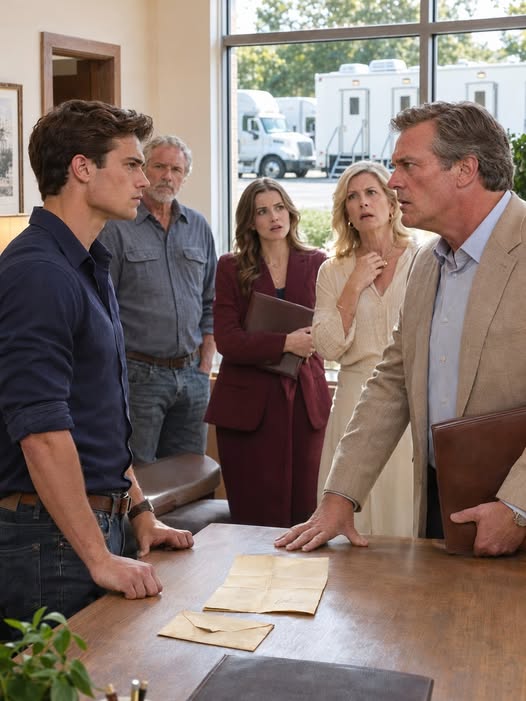
My name is Reed. Six years after that night, my father sat across a desk from me and asked me for a job. My sister sat beside him, asking for one too. And before he walked out, my father told me that half of my uncle’s company rightfully belonged to him.
But let me back up a little.
My dad’s name is Manti. For twenty-six years, he worked as the financial controller at a wire factory on the east side of Sedalia, Missouri. If you don’t know what a controller does, don’t worry. My father would be delighted to explain it to you. He explained it to every waitress, every pastor, and every man who ever sold us a lawn mower. He was the first person in his family to graduate from college, and he never let a Thanksgiving pass without making sure somebody heard about it.
Dad ran our house the same way he ran the factory. He had a spreadsheet for the electric bill, another for Christmas expenses, and a college savings account for Skyler that he’d opened the same week she was born. I know because he told that story at the luncheon after her baptism, at her eighth-grade graduation, and again at my high school graduation party, about forty minutes before telling me there wasn’t an account for me.
I’d never had a college fund. I found that out when I was fourteen and happened to ask.
“We’ll cross that bridge when we come to it, champ,” Dad said.
I guess we finally reached that bridge that afternoon beside the garage.
Skyler was the smart one. In our house, that was simply a fact, as certain as the furnace being in the basement. She learned to read early, collected all those little school certificates, and made the honor roll every semester. Mom stuck every single award on the refrigerator with a cardinal-shaped magnet.
I was a C student until somewhere around my junior year of high school. Then something clicked. I started earning Bs, and eventually mostly As in anything involving numbers. But nobody ever moved that magnet on the refrigerator.
I also had a job. Starting when I was fifteen, I spent my summers and Saturdays working at the grain elevator on the west side of town. I swept floors, used the probe to check trucks, and did whatever else needed doing. By graduation, I’d managed to save $6,800. It wasn’t a fortune, but it was mine.
And here’s the part my parents didn’t know.
In October of my senior year, I’d applied to the University of Central Missouri in Warrensburg. I’d done it entirely on my own, using a computer in the school library. In December, the letter arrived. I’d been accepted into the business administration program.
I didn’t tell anyone because I wanted to show them the letter at my graduation party.
I carried it folded in my back pocket the entire time Dad stood there explaining why school had always been harder for me. I wasn’t even planning to ask them for money. I’d already done the math. I needed just one thing from them.
In the United States, there’s a financial aid form that practically every college student has to fill out. Until you turn twenty-four, the government generally treats your parents as financially responsible for you, whether they’re actually helping you or not. That means you need information from their tax returns. Without it, getting certain types of financial aid becomes nearly impossible.
That was all I wanted. I needed Dad to fill out his section of the form. Twenty minutes sitting at the kitchen table.
But I never got around to asking him during the party. He told me school had always been harder for me, Mom added that neither of them believed I’d actually go to college, and I stood there with the acceptance letter in my pocket until I decided I wasn’t going to show it to either of them.
Later that night, while I was packing, I did ask him about the form. Dad didn’t even look up from his phone.
“I’m not putting my tax returns on some government website so you can borrow money you’ll never pay back.”
So the letter stayed in my pocket and ended up traveling with me to Warsaw.
My uncle Joe is my father’s older brother. He’s three years older. Their father, my grandfather Emmett, founded Emmett & Sons Pumping in 1971 with a single truck. Most of the work involved pumping septic tanks, along with renting a few portable toilets to construction sites and the county fair. Grandpa had personally painted the wooden sign hanging above the shop door.
When he died, Joe kept the business running. Dad, meanwhile, had gone off to college.
That was the entire story, at least as I’d always understood it. Grandpa died, Joe took the business, and Dad got nothing. My father told it at Christmas, at Grandma Doris’s birthday gatherings, and so many other times that whenever Joe walked into a room, I already knew exactly how I was supposed to feel about him.
Joe was the family loser. He was divorced, had never attended college, lived in an apartment above his own shop, and made his living pumping septic tanks. Whenever he showed up for Christmas wearing a clean flannel shirt, Dad always found a way to make the same joke.
“Look who finally washed his hands.”
Everybody laughed. Joe just smiled and kept eating his ham.
The only real conversation I’d had with him happened at Grandma Doris’s funeral, when I was fourteen. He found me outside near the church parking lot, where I’d gone because I didn’t want anybody seeing me cry.
He didn’t say a word about my tears. He simply handed me a business card and tapped a number written in pen on the back.
“If you ever need anything, call this number. Not the shop number. This one.”
On the drive home, Dad noticed the card sticking out of my shirt pocket.
“Don’t go getting any ideas,” he warned me.
I kept that card in my wallet for four years anyway.
On the night of my graduation party, I called the number on the back. Joe answered on the second ring, as though he’d been sitting beside the phone waiting for someone to call.
“It’s Reed,” I said.
After that, I didn’t know what else to say.
“Where are you?” he asked.
I told him.
“Pack a bag. I’m leaving right now.”
That was it. He didn’t ask what had happened or what my father had said. Forty minutes later, he was outside our house.
The next morning, I woke up on a couch in the office of Emmett & Sons Pumping, just off Highway 65 south of Warsaw. The business consisted of a metal building, a gravel lot, one pumping truck, and forty blue portable toilets lined up on a flatbed trailer like they were waiting for a bus.
Behind the desk sat a gray-haired woman with reading glasses hanging from a chain around her neck. An old coffeemaker was brewing coffee, making a noise that sounded like somebody trying to start a lawn mower.
The woman looked at me over her glasses.
“You must be the nephew.”
“Yes, ma’am.”
“I’m Marva. I handle the books, answer the phones, and I don’t make breakfast. There’s cereal upstairs.”
She pointed toward the ceiling with her pen.
“Joe says you’re good with numbers.”
“I do all right.”
“Good,” she said, “because he isn’t.”
I went outside with my bowl of cereal. Above the shop door hung Grandpa’s old wooden sign. The paint had faded so badly that the letters, once bright red, had turned almost pink.
Emmett & Sons Pumping. Since 1971.
I remember standing there with that bowl in my hands, thinking about one particular word: Sons. There had been two of them, but only one had ever shown up to work.
I didn’t ask about it. I figured it was just a sign.
By noon, my phone displayed the words No Service. Dad had removed me from the family plan. It hadn’t even been a full day since I’d left home.
Marva looked at my phone, then at me.
“Bet he called the phone company before he finished his coffee.”
Joe took me to Walmart in Clinton that afternoon and bought me a prepaid phone. When I tried to pay him back, he told me to take it out of my first paycheck.
“What paycheck?” I asked.
“The one you’ll get Friday. You start Monday.”
Mom called my new number about a week later. I never found out how she got it. Joe probably gave it to her because, despite everything, he believed my mother ought to have a way to reach me.
“Your father’s very hurt, Reed. Come home. Tell him you’re sorry, and we’ll forget this whole thing.”
“No.”
“Reed, sweetheart, be reasonable.”
“I said no, Mom.”
She hung up. It was a long time before I heard from her again.
There’s something you need to understand about that business. People hear the words pumping and portable toilets, and they immediately wrinkle their noses. My father had made that exact same face for thirty years. But the work wasn’t really just about that.
The work was about trucks, routes, and schedules. It was about delivering forty units to a construction site at six in the morning so the crew never had to think about where they’d use the bathroom. It was about setting up twenty portable toilets for a church picnic long before anybody unfolded the first lawn chair. It was about servicing every unit on a precise schedule so nobody had a reason to call the office and complain.
Joe’s entire business philosophy fit on a sticky note. He kept it on the dashboard of his truck, written in his own handwriting:
Get there before they need you.
“Nobody ever thanks you in this business,” he explained during my first week. “That’s how you know you’ve done the job right. The day somebody notices you is the day you’ve screwed something up.”
I worked the routes on Mondays, Wednesdays, and Fridays, plus Saturdays, all that summer. In August, I started classes at the University of Central Missouri. Warrensburg was about an hour north of Warsaw, so I drove up there Tuesdays and Thursdays in a beat-up work truck Joe let me borrow. I took the rest of my classes online at night.
The money part turned out to be considerably more complicated, especially because I didn’t have the information for the financial aid form my father had refused to complete.
At first, the financial aid office told me there was nothing they could do. Then a woman named Mrs. Albright took pity on me and explained that there might be one possibility. If I could prove my parents had completely cut off financial support and weren’t contributing anything toward my living expenses, she could authorize a small student loan in my name alone.
It wasn’t much, just a few thousand dollars a year, but it was something.
So Joe sat down at his kitchen table in the upstairs apartment and wrote a letter. He did it in that slow, careful handwriting of his, explaining that I lived with him, worked for his company, and hadn’t received a single dollar from my parents since graduation night.
Marva reviewed the letter. She couldn’t notarize it because she wasn’t a notary, but she typed it up to make it look official, and Mrs. Albright said that would be enough.
Then Joe said something I hadn’t expected.
“The company pays part of the college tuition for anybody who works here.”
Marva looked up from her desk.
“Since when?”
“Since today.”
“Joe, we’ve only got one employee that applies to.”
“Then it won’t cost us too much.”
In reality, it ended up costing considerably more than a company with one truck should have been paying. Marva said it could be treated as a tax deduction. I later learned that a tax deduction doesn’t mean something is free.
Joe had to put off buying a new transmission for his own truck that year so he could cover part of my tuition. He never mentioned it. Marva was the one who told me several years later.
Between the $6,800 I’d saved working at the grain elevator, that small student loan, and the help from the company, I managed to get through my freshman year without taking a single dollar from my old home.
And during that entire first year, absolutely nobody in my family asked how I was doing.
Not once.
The idea that ended up changing everything came from the mother of a bride.
During the summer after my freshman year, we set up several portable toilets for a barn wedding outside Lincoln. The bride’s mother came out, looked at our blue units sitting on the grass, and frowned slightly.
“Oh. I was expecting the nice kind.”
I asked what she meant, and she explained that she was talking about a luxury restroom trailer.
If you’ve never seen one, imagine a small white trailer with steps leading up to a door. Inside, it looks like the bathroom of a nice restaurant: flushing toilets, sinks with running water, mirrors, proper lighting, and air-conditioning. The kind of facilities you’d find at a fancy wedding or a golf tournament.
She told me the nearest company renting them was in Columbia, and they were booked every weekend through October. She’d been trying to reserve one since January.
That night, I went home and started researching. She was right. There was one company in Columbia and another near Springfield. Both had their trailers completely booked for the summer. They rented for thousands of dollars a weekend, and there wasn’t a single company offering the same service in the lake area or anywhere around Sedalia.
I filled two pages of a notebook with figures and calculations that night.
The next morning, I put the notebook in front of Joe on the shop table. He read it twice, took off his glasses, and looked at me.
“You want me to borrow money to buy fancy bathrooms?”
“I want you to borrow money to buy one fancy bathroom. A used one, with two stalls, a sink, and air-conditioning. There’s one for sale in Kansas City for thirty-eight thousand dollars. If we can rent it twelve weekends a year, it’ll pay for itself in a year and a half. We could do that with weddings alone.”
Joe looked down at the notebook again, then raised his eyes to mine.
“Your dad said school was harder for you.”
“School is,” I answered. “Math isn’t.”
Joe went to the bank in Warsaw that very Friday and took out a loan using the shop as collateral.
That was the first time I truly understood how much he was risking for me. The building belonged to him. It was practically the only thing he owned in the world.
We rented that first trailer for nineteen weekends that summer. We took it to weddings, a family reunion, a church welcome event, and a car show in Clinton. By the following spring, we had a second trailer. By the spring after that, we had four.
Skyler graduated from high school two years after I did. There was a huge party, much bigger than mine. Mom rented a white tent for the backyard and hired a catering company. Since she didn’t want 150 guests wandering in and out of her house to use the bathroom, she ordered a luxury restroom trailer through the tent rental company.
The thing was, that company didn’t own any restroom trailers. Nobody in Sedalia did. So they ended up calling us.
I saw the address on Marva’s schedule that Monday. Delivery was set for the following Saturday, and the address was one I’d known my entire life. Marva watched me while I read the work order.
“Want me to send Junior?”
Junior Teague had been our first hire after me. He was a big, quiet man who could back a trailer into a space with barely a couple of inches to spare on either side.
“No,” I said. “I’ll take it myself.”
I pulled into the driveway at seven on Saturday morning. Dad came out of the garage wearing a polo shirt and holding a cup of coffee. He stopped halfway down the driveway when he saw the truck.
Emmett & Sons Pumping was painted on the door.
Then he saw me climb out.
“Your mother ordered this through the tent people,” he said, as though that explained some kind of mistake.
“The tent people call us,” I answered. “We’re the only company with trailers like this in four counties.”
He didn’t say anything. He just stood there watching while I leveled the trailer, hooked up the water, and ran the electrical cable to an outlet on the side of his house.
Two years earlier, he’d told me I’d come crawling back by the Fourth of July. Now I was standing in his driveway again, only this time I was plugging my own equipment into his electricity.
Skyler stepped onto the porch wearing a summer dress. She was eighteen now and had already chosen her college. She was going to the University of Missouri in Columbia to study marketing.
She looked at the trailer, then at me.
“Oh my God, Reed. So now you deliver toilets?”
“It’s a restroom trailer,” I corrected her. “It has air-conditioning, and it’s a whole lot nicer than the bathroom you’ve got upstairs.”
She actually laughed. Then she looked at Dad, and the laughter stopped.
Mom came outside a few minutes later.
She didn’t say hello.
She looked at the trailer, then toward the street, and frowned.
“Could you move it around back? I don’t want people seeing it from the road.”
“The tent’s in the backyard, Mom. And this is where the trailer needs to go.”
She went back inside without another word.
Dad finished his coffee.
“Send somebody else to pick it up tomorrow.”
“Nobody else works Sundays,” I said. “I’ll be here at eight.”
And I was there at eight the next morning.
For the record, that trailer was spotless. Whatever else you could say about that party, 150 people used our facilities, and not a single one complained.
The third year was the biggest turning point for the company.
We’d reached a point where the bank in Warsaw could no longer finance our expansion with nothing more than a handshake. We wanted four additional restroom trailers, a second service truck, and enough working capital to bid on events considerably larger than church picnics.
The bank assigned us a loan officer named Gordon Pike. He was a meticulous man with an equally meticulous mustache, and he wanted to examine every last document bearing the company’s name, going all the way back to its founding.
“Your grandfather left this business to both his sons,” he explained. “I need to see exactly how it ended up belonging to only one of them.”
So one Saturday, Joe and I went to the back corner of the shop, where Grandpa’s old four-drawer filing cabinet sat beneath a blue tarp. It hadn’t been opened in years. The drawers squealed when we pulled them out, releasing a smell of aging paper and motor oil.
Joe opened the top drawer, looked through a few documents, and removed a single folder before letting me continue searching. He placed it facedown on top of the cabinet.
On the tab, written in Grandma Doris’s handwriting, was a single letter: M.
Then he stepped back.
“Go ahead. Everything else is fair game.”
I found Grandpa’s will, the original company formation documents from 1971, and a photograph of Grandpa standing beside a pumping truck that looked almost as old as a Model T Ford.
I didn’t touch the folder marked M.
When we met with Gordon Pike, Joe handed him everything I’d found. Then he took one more piece of paper from an envelope, the one he’d kept in that folder, and laid it on the desk.
Gordon read it, nodded, and slid it back across the polished wood.
“Well,” he said, “that clears everything up.”
Joe slipped the document back into the envelope.
I never got to see what it said at the time.
But we’ll get to that folder.
We got the loan, and that same August, we won the contract to provide restroom facilities for the Missouri State Fair.
The fair is held in Sedalia. It runs for eleven days every August and draws about 300,000 people. There are livestock barns, grandstand concerts, carnival rides, and everything else you’d expect from a major state fair.
The previous vendor had lost the contract after a flood of complaints. Now the fair board wanted restroom trailers near the grandstands and exhibition halls. We were the only company close enough to service them every night.
So that August, the name Emmett & Sons was everywhere in my father’s hometown.
It was on every unit near the midway, on the trailers parked beside the grandstands, and on the service trucks rolling along the fairground roads at five in the morning.
Dad’s old friends from the factory started sending him pictures.
I know because Mom called me.
“Your father can’t even walk past the grandstand without seeing that name. Every structure out there has your uncle’s name on it. Couldn’t you at least take it off while the fair is going on?”
“No.”
“Reed, it’s embarrassing for him.”
“It’s Grandpa’s name, Mom. It’s been on that sign since before Dad was born.”
“You know perfectly well what I mean.”
“Yeah, I do,” I said. “And my answer is still no.”
That Thanksgiving was the first time anyone from my old house invited me to a family celebration. Mom called the week before.
“Come for Thanksgiving. Just you. Your father doesn’t want a scene.”
“Is Joe invited?”
“Reed, don’t turn this into—”
“I’ll come the year he’s invited too,” I interrupted.
That year, we had Thanksgiving dinner at Marva’s house with her husband, Delmar. He carved the turkey with an electric knife and the intense concentration of a man defusing a bomb. Joe brought a pie he’d bought at a gas station and acted like he’d baked it himself. Marva played along.
Nobody called to invite me the following Thanksgiving.
Or the one after that.
I graduated from college the following May. I earned my bachelor’s degree in business administration with a 3.6 GPA while continuing to work the routes the entire time.
Joe and Marva drove to Warrensburg for the ceremony and sat together in the bleachers. Joe wore a tie I’m fairly certain was older than I was. When they called my name, he stood up and clapped so hard that several people sitting in front of him turned around.
My parents didn’t attend.
I hadn’t expected them to. I hadn’t sent them invitations, and they’d never asked when my graduation would be.
That afternoon, Mom sent me a text message.
Congratulations!
Four minutes later, she sent a picture of Skyler holding her dean’s list certificate from the University of Missouri.
Joe read both messages over my shoulder.
He didn’t say anything.
He just took me to Golden Corral, which is where Joe takes people when he’s proud of them.
The next two years went by fast. We kept saying yes to just about everything that came along. More fairs, construction crews working on the new highway, bass fishing tournaments at Truman Lake, and a major golf tournament at the Lake of the Ozarks. We took graduation parties, weddings, and festivals too.
We opened a second operations yard on the north side of Sedalia, my father’s hometown, simply because about half our customers were in that area.
By the summer I turned twenty-four, Emmett & Sons Pumping had twenty-two trucks, fifteen restroom trailers, around a hundred portable units, and thirty-one employees who received a paycheck every Friday.
Marva signed every one of those checks.
And, for the record, she still didn’t make breakfast.
I ran operations and handled hiring. Joe, meanwhile, continued driving one of the routes every Friday. He said that if he ever stopped doing that, he’d eventually forget what the work was really about.
In January of that year, the wire factory closed its doors.
The news was all over Sedalia for a week. The company had decided to move its entire operation to a plant in Tennessee, and 240 people lost their jobs.
My father was one of them.
Twenty-six years of service, and suddenly he was unemployed at fifty-seven.
I heard about it from Marva, who’d caught the news on the radio. Mom called me in March. Her voice sounded different, quieter somehow, almost smaller.
“Your father has sent out more than forty job applications, Reed. Forty. And nobody wants to hire a fifty-seven-year-old controller. They’re all looking for somebody younger they can pay less.”
I told her I was sorry to hear that.
And I meant it. I really did.
“His severance runs out in May,” she added. “And we still owe money on the house.”
She paused.
She waited, as though I was supposed to finish the sentence for her.
I didn’t.
In May, Skyler graduated from the University of Missouri with her marketing degree. The same degree their sixty thousand dollars had paid for.
She moved back in with our parents and got a part-time job at a clothing boutique on Ohio Avenue while continuing to send applications to other companies.
Then, during the first week of June, Marva walked into my office and closed the door behind her.
“Your dad called asking for Joe.”
I looked up.
“What did he want?”
“He said he wanted to make an appointment with the owner. And he said it in this tone, like I was the receptionist at some fancy law firm.”
“What did Joe tell him?”
“That Reed handles the hiring.”
The appointment was scheduled for Tuesday at ten sharp.
All three of them arrived together in Mom’s car.
Dad wore a sport coat despite the fact that it was June. Mom had on her church clothes, and Skyler carried a leather portfolio under her arm, one of those expensive-looking ones with a zipper running all the way around the edge.
I hadn’t seen my father in four years.
He looked considerably older. His hair had gone gray around his ears, and there was an expression on his face I didn’t remember seeing before.
When he stepped into my office, he looked around as though he were calculating what everything cost.
Then he sat across from me and slid a résumé over the desk.
“I’m not here as a member of the family,” he began. “I’m here as a professional.”
“Okay,” I said.
“A company this size needs somebody watching the money. A controller, a chief financial officer, whatever you want to call it. I have twenty-six years of experience.”
“We don’t have a chief financial officer,” I told him. “We have Marva.”
From the hallway, through the open door, Marva’s voice rang out immediately.
“And Marva isn’t planning on retiring!”
Dad’s jaw tightened.
He took a breath and tried again.
“Then an office manager. Somebody has to run this place, doesn’t somebody?”
“Yeah,” I answered. “Somebody already does.”
Skyler unzipped her portfolio.
“I could handle your marketing. No offense, but your website looks like it was made in 2009, and you’re not even on Instagram. I could build you an entire brand.”
I sat there looking at the two of them.
My father, the man who’d told me school would always be harder for me.
And my sister, the girl who’d received sixty thousand dollars for college and a brand-new Jeep when she turned sixteen.
“We do have openings,” I finally said. “We need route technicians and people to help set up trailers. We pay seventeen dollars an hour, with overtime during the summer. The trucks leave at seven in the morning.”
I paused to make sure they both understood what I was saying.
“It’s exactly the same job I started with.”
Dad let out a laugh, but there was nothing genuine about it.
“I have an accounting degree, Reed.”
“And I have a business degree,” I answered. “I still started on the routes.”
Skyler zipped her portfolio shut.
“I’m not driving a truck full of toilets.”
“Nobody’s asking you to drive anything yet,” I explained. “For the first month, you’d ride with Junior.”
My sister reached over and put a hand on Dad’s arm.
“Manti, tell him.”
Dad leaned forward and planted both elbows on my desk.
It was exactly the same posture he used to take at the kitchen table when I came home with a bad report card.
“Let’s be honest with each other, champ. Half of this should have been mine. My father left the business to both of us. It says so right there on the sign. Sons.”
He tapped his fingers against the desk.
“Joe took it all, and I let him because I had a real career. But I’ve been talking to a friend of mine who’s a lawyer, and partnerships don’t just disappear.”
I stayed quiet.
“So you can offer me seventeen dollars an hour,” he continued as he stood and buttoned his sport coat, “or you can think about what’s fair. Talk to your uncle.”
When he reached the door, he turned around.
“Think carefully about this, champ.”
And with that, they left.
I sat there for about a minute, staring at the empty desk.
Then I walked out of my office and climbed the stairs to Joe’s apartment.
I found him standing in front of the kitchen sink, eating a bologna sandwich.
“I need to see the folder,” I said.
He didn’t ask which one.
He put the sandwich down on its plate, wiped his hands on a kitchen towel, and walked straight to the small safe inside his bedroom closet.
He came back with an envelope and placed it on the kitchen table.
It was the same table where, six years earlier, he’d written the letter to Mrs. Albright that had helped me qualify for financial aid.
I opened the envelope.
Inside was a single sheet of paper.
It was typed on the letterhead of a Sedalia attorney named Mr. Kessinger, who I later learned had died several years earlier.
The document was dated April 1998, roughly six months after Grandpa’s death.
It stated that Manti, son of Emmett, was selling his entire fifty-percent ownership interest in Emmett & Sons Pumping to Joe.
The sale included the truck, the tanks, the customer list, and the right to use the company name.
All for the sum of nine thousand dollars, paid in full.
And there, at the bottom of the document, was my father’s signature.
It was exactly the same careful, slanted signature I’d seen on every report card I’d brought home throughout my childhood.
Stapled behind the agreement was a copy of a cashier’s check for nine thousand dollars, made payable to my dad.
I read the document three times.
“April of 1998,” I said aloud.
Joe nodded.
I knew that month perfectly.
Every single member of my family knew that month.
Every year on my parents’ wedding anniversary, Mom told the story of how she and Dad had closed on their house during the same week as their first anniversary, back in April 1998.
She always told it like a fairy tale.
She said they’d gotten lucky, and that luck had somehow given them the money they needed for the down payment.
I looked at the document again.
“He sold you his half of the business just so he could buy the house.”
“He wanted out,” Joe explained. “He’d just started working at the factory. He had a new wife, and he wanted absolutely nothing to do with pumping septic tanks.”
Joe leaned back against the counter.
“I didn’t have nine thousand dollars. Had to borrow it from the bank. Took me ten years to pay it off.”
He shrugged.
“I was still paying that debt when you were barely in elementary school.”
I stared at my father’s signature.
“Then why does he tell everybody you stole the business from him?”
Joe picked up his sandwich, looked at it for a moment, and put it back on the plate.
“Because it’s a whole lot easier to be the brother who got robbed of his inheritance than the brother who sold his dead father’s truck to make a down payment on a house.”
He went quiet for a few seconds before continuing.
“Grandma knew. Mr. Kessinger knew. Your mother knew. Everybody else just heard your dad’s version.”
I looked back at the envelope in front of me.
“Why did you keep the word Sons in the company name?”
“Because Dad was the one who painted that sign,” Joe answered. “I wasn’t going to erase one of his sons just because that son decided to leave.”
“And you never told me,” I said. “Six years went by. You even covered for him after he threw me out.”
Joe looked through the window toward the gravel parking lot.
“He’s your dad, Reed. I wasn’t going to make you choose between us.”
“He already made that choice for me,” I said. “That night by the garage.”
Joe didn’t argue.
I carried the document downstairs, made a copy on Marva’s machine, and then went back upstairs to put the original inside Joe’s safe with my own hands.
Dad sent Joe a text message on Thursday.
My uncle showed it to me.
I’ll come by Saturday morning to talk to my brother. Family businesses should stay in the family.
Joe responded, typing with one finger.
Shop opens at seven.
They arrived at nine on Saturday.
All three of them together again: Dad, Mom, and Skyler.
Marva also showed up for work that Saturday, something she almost never did. She claimed she had some old paperwork she needed to organize.
She didn’t file a single sheet of paper all morning.
This time, Dad didn’t head toward my office.
He walked straight up to Joe, who was standing beside the coffeemaker, and dropped a document onto the counter.
It was a copy of Grandpa’s will.
“There you have it,” Dad declared. “Equal shares for my sons. Joe and Manti. It’s written right here in our father’s will. I’ve let this go for twenty-five years, Joe, but I’m done letting it go.”
Joe didn’t say a word.
He simply raised his eyes and looked at me.
I walked over to the counter and placed my copy of the sale agreement directly on top of the will.
Dad looked down at the paper.
I watched him read the first line.
Then I watched his eyes slowly travel down the page until they reached the bottom, right where his own name appeared.
His face turned almost the same shade of red as the sign hanging outside the shop.
Mom’s hand flew instinctively to the small gold cross she wore around her neck.
She didn’t need to read the document.
She knew exactly what it was.
Skyler leaned over Dad’s shoulder and began reading aloud, slowly, like someone trying to understand something that didn’t make any sense.
“Hereby sells his entire fifty-percent ownership interest, including the right to use the business name… for nine thousand dollars.”
She looked up at our father.
“Dad, what is this?”
“That’s something very old,” he said quickly. “It was basically a loan. Some kind of family arrangement.”
“It says sold,” I corrected him. “It specifically mentions the right to use the company name. It says paid in full. And that’s your signature, Dad.”
I pointed to the bottom of the page.
“I’ve seen it on every report card I brought home my entire life. You used to sign them right underneath my Cs.”
“You don’t understand how things were back then.”
“April 1998,” I continued, ignoring his excuse.
I turned toward Mom.
“Mom, when exactly did you and Dad close on the house?”
She didn’t answer.
“Every anniversary,” I reminded her. “Every single anniversary, you tell everybody how you bought the house in April of 1998. You always say you were incredibly lucky to come up with the down payment.”
I tapped the document with one finger.
“Well, there’s all that luck. It was Grandpa’s truck.”
Mom lowered her eyes.
“Joe had to borrow money from the bank to buy Dad’s share,” I continued. “Then he spent ten years paying off that debt. And the whole time, Dad went around telling the entire family, for twenty-five years, that Joe had stolen the business from him.”
“We needed a house, Reed,” Mom whispered.
Her voice was so quiet I could barely hear it.
“So you knew it was easier for people to…” I began.
I stopped halfway through the sentence, suddenly understanding exactly what I was about to say.
“It was easier to let everybody think Joe was some pathetic loser.”
Mom didn’t look up.
“Yeah,” I added. “I’ve been hearing that story my whole life.”
Skyler was still staring at the paper.
“You told me Uncle Joe stole Grandpa’s business,” she said to our father. “You’ve told me that my entire life, Dad. You told me at Christmas. Every single Christmas.”
Dad couldn’t bring himself to look her in the eye.
And then he did what he’d always done whenever things stopped going his way.
He turned the whole situation into a story about himself.
He straightened his back, tugged down the edges of his sport coat, and lifted his chin.
“I’m the one who made something of himself. I worked twenty-six years at that factory. I put my daughter through college without borrowing a single penny. I didn’t spend my life wasting it pumping garbage.”
I watched him for a few seconds before answering.
“And the factory doesn’t exist anymore, Dad. But he’s still here.”
I gestured around the shop.
“Just yesterday, thirty-one people got paid inside this building. Marva signed every one of those checks.”
“Every single one,” Marva confirmed from her desk, without even bothering to look up.
I turned back to my father.
“You came here looking for a desk, and I offered you a truck. That’s not an insult. It’s exactly the same job Joe offered me the night you threw me out of the house. And it turned out to be the best thing anybody has ever done for me in my entire life.”
Dad’s voice began to rise.
“So that’s it, then. My own brother is going to turn his back on me.”
That was when Joe, who had remained silent through the entire conversation, set his coffee cup down on the counter.
“Nobody’s turning their back on you, Manti,” he said calmly. “The boy offered you a job. The same job he accepted without complaining when you sent him out of your house with two duffel bags.”
Joe glanced briefly at me before continuing.
“He didn’t have nine thousand dollars. And nobody bought him anything to help him get started.”
The shop fell completely silent.
For several seconds, the only sound was the old coffeemaker working behind the counter.
Dad looked at Joe and, despite everything he’d just heard, said exactly what he’d apparently been waiting to say since the moment he walked in.
“You think you’re pretty smart now, don’t you, champ?”
I looked him straight in the eye.
“You always told me school was harder for me,” I answered. “And maybe you were right. But as you can see, I know how to read a date, Dad. And I know how to read your name.”
Nobody said anything for a long time.
Finally, I broke the silence.
“The route positions will remain open until Monday. Both pay seventeen dollars an hour, and the trucks leave at seven sharp in the morning. They’ll leave at that time whether you’re on board or not.”
Dad picked up the copy of Grandpa’s will but left the sale agreement exactly where it was.
He walked toward the door without saying another word.
Skyler followed close behind him, clutching her leather portfolio against her chest.
Mom was the last to leave.
She stopped in the doorway, turned around, and looked at me.
“We’re still your parents, Reed.”
I watched her for a moment.
“I asked you for one thing, Mom,” I reminded her. “I didn’t ask you for money. I asked you for one form.”
My mother stood motionless.
“It would have taken twenty minutes of your time, sitting at the kitchen table. You had six whole years to be my parents, but you’re six years too late.”
Mom left.
The door slammed so hard that Grandpa’s old sign rattled on its hooks above the frame.
Marva got up from her desk, walked over to the coffeemaker, and poured three cups of coffee.
She set one in front of me, another in front of Joe, and kept the third for herself.
Then she let out a long sigh.
“Well,” she said, “I think I’m done organizing my files for today.”
We never heard another word from any lawyer.
Not that week.
Not that month.
Not ever.
I’ve thought about that quite a bit.
Somewhere in Sedalia, there’s probably a lawyer who’s friends with my father and, after looking over the documents, told him the hard truth right to his face.
Or maybe that lawyer never existed at all.
At 6:55 on Monday morning, a car pulled into our parking lot.
It wasn’t my father.
It was Skyler.
She was wearing white sneakers, her hair pulled back into a ponytail, and she carried an enormous insulated water bottle.
She got out of the car, walked into the office, and barely said a word.
“Mom says I need to start bringing some money into the house.”
That was it.
I assigned her to work with Junior, and thank goodness I did, because Junior is an extraordinarily patient man.
Skyler lasted until noon on Tuesday.
The temperature had reached ninety-one degrees Fahrenheit that day. They were setting up forty portable units at a highway construction site south of Clinton.
At some point, after several hours in the sun, my sister climbed into the cab of Junior’s truck, turned the air-conditioning up as high as it would go, and called Mom to come pick her up.
She didn’t return the next day.
Marva mailed her a check for the day and a half she’d worked, about $204 before taxes.
She said she’d put the stamp on the envelope with the same satisfaction she’d have felt mailing a birthday card.
Dad never showed up at the shop.
I learned the rest of that story the same way practically everybody learns things in a small town: through somebody who knows somebody who heard something.
In July, Skyler’s white Jeep appeared in the front row of a used-car lot on Broadway.
There was a price written across the windshield in yellow marker.
Mom had confided in her sister, my Aunt Gail, that they needed money for the mortgage a whole lot more than they needed to keep a third car.
Aunt Gail told her hairdresser.
And the hairdresser told Marva.
Skyler now drives Mom’s old Chevrolet Equinox and still works at the boutique on Ohio Avenue.
The last I heard, she’d landed a second job managing social media for a dental office.
And honestly, I’m glad she got it.
Then August came around.
The Missouri State Fair.
Every year, the fair hires a large number of seasonal workers to sell tickets, check admission passes at the gates, direct parking, and handle other jobs around the grounds. They’re hourly positions, and most of the people who apply are retirees or college students looking to earn a little extra money over the summer.
On the first Thursday of the fair, around six in the evening, I was driving a golf cart from the grandstands toward the livestock barns.
I had to inspect one of our restroom trailers, so I decided to cut through the big parking lot on the south side to save time.
That’s when I saw him.
My father was standing out in the sun, wearing a yellow reflective vest, holding a small orange flag, and sporting a fair visor with a little blue ribbon pinned to it.
He was waving the flag to direct incoming cars, showing drivers where to line up in the parking lot.
And he was doing it right beside the grandstands.
As it happened, he was also standing directly across from twelve white restroom trailers, parked one after another.
Every single one proudly displayed the name Emmett & Sons Pumping in large red letters along its side.
My father lifted his head and saw me.
And I could tell, beyond any doubt, that he recognized me.
He didn’t wave.
He simply raised his orange flag a little, signaling that I could go ahead, then quickly turned away to direct the next car into its parking space.
I didn’t stop.
I had to check a restroom trailer near the pig barns. One of the sinks wasn’t draining properly, and we needed to fix the problem before somebody complained.
That same night, after finishing maintenance on the last trailer of the day, when the fairgrounds had gone almost completely dark, I drove back to Warsaw.
Joe was sitting on the open tailgate of his pickup in the gravel lot outside the shop.
It was the same old white Ford he’d driven to pick me up six years earlier.
He was eating sunflower seeds and staring quietly at the building.
I walked over and sat down beside him.
For a long while, neither of us said a word.
We just sat there, listening to the distant sounds of the highway and looking at the shop beneath the outdoor lights.
Finally, I broke the silence.
“I saw Dad at the fair today.”
“Yeah?”
“He was parking cars.”
Joe spat a sunflower seed shell onto the gravel.
“Honest work.”
“That’s exactly what I told him six years ago.”
Out of the corner of my eye, I could almost make out a small smile beginning to form on his face.
I looked up at the sign hanging above the shop door.
Grandpa’s sign.
Emmett & Sons Pumping. Since 1971.
The paint was peeling worse than ever. One of the upper hooks had bent slightly from all the times the old door had slammed over the years.
“I’m going to have that repainted,” I said. “I know somebody in Clinton who restores old signs. We could fix up the lettering and make it look exactly like it used to.”
Joe kept looking at the sign.
“Leave the words the same,” he said after a long silence.
“It says Sons, Joe,” I reminded him.
“I know perfectly well what it says.”
He held out the bag of sunflower seeds.
“After all, there are still two of us.”
My dad once told me I’d come crawling back by the Fourth of July.
He was right about one thing.
I did come back.
But he was wrong about everything else.
That night, I went home.
