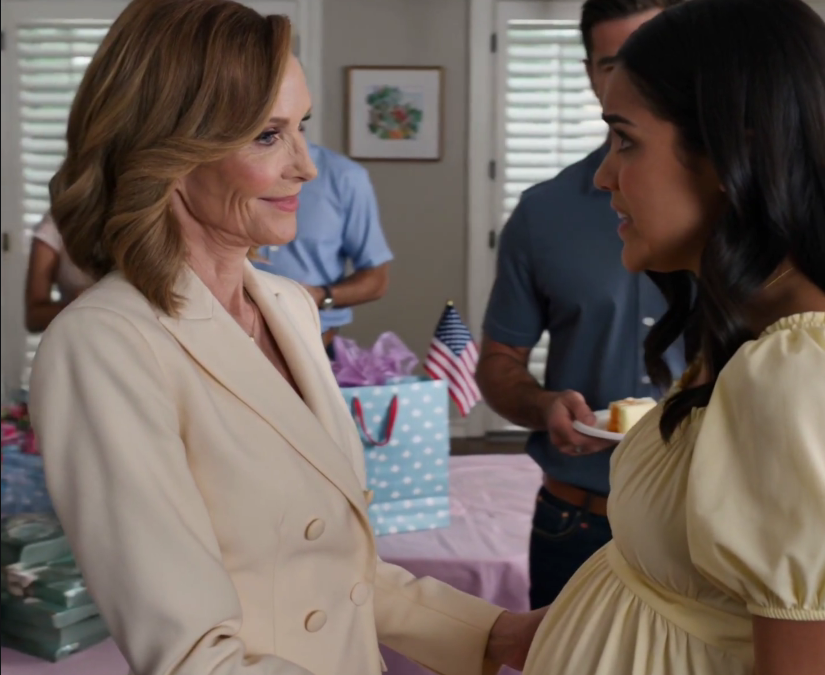
I stood in my sister-in-law Sienna’s living room, thirty-six weeks pregnant, holding a cup of punch that had gone warm in my hand while I stared at two gift tables arranged beside each other.
The larger table sat beneath a blue-and-cream banner.
REGINA’S BABY.
The smaller one had been pushed closer to the kitchen doorway.
A printed card stood in front of it.
THE SURROGATE.
For a second, I laughed.
Not because anything was funny.
Because sometimes your brain gives you one useless sound while it tries to catch up with reality.
Surely somebody had made a printing mistake.
Surely Regina had gone too far with a joke and Sienna had not noticed.
Surely my husband, Owen, standing across the room with a paper plate in his hand, was about to walk over and explain whatever bizarre misunderstanding had created two separate gift tables at my own baby shower.
Then Regina stepped into the center of the living room.
Cream blazer.
Pearl earrings.
Hair set exactly the way she wore it every Sunday morning.
She tapped a spoon lightly against her glass.
Conversations faded.
About forty people turned toward her.
I looked at Owen.
He did not look confused.
He looked afraid.
That was worse.
“Thank you all for coming,” Regina began.
Her smile was the same smile she used at church luncheons and family Christmas photographs.
“I know this journey has been unusual.”
My mother, sitting three chairs away, slowly lowered her cup.
Regina placed one hand against her chest.
“But this child is God’s way of returning something that was taken from me.”
My heart started beating harder.
Then she looked directly at me.
“I want to thank Amara for carrying him.”
Carrying him.
Not carrying our baby.
Not my daughter-in-law.
Not the mother.
“Amara has been a wonderful vessel.”
Vessel.
She called me a vessel in front of forty people.
I watched my mother go completely still.
Owen’s sister Sienna stopped pretending to rearrange napkins and turned fully toward Regina.
Regina wasn’t finished.
She walked to the fireplace.
A large poster board was leaning against the brick, covered by a white sheet.
She pulled the sheet away.
There were colored lines.
Boxes.
Dates.
A title written across the top in blue marker.
REGINA’S CUSTODY TRANSITION PLAN.
I felt something inside me drop.
Week One:
Baby resides with Grandmother Regina.
Month One:
Birth mother receives supervised visits.
Six Months:
Transition away from maternal dependence.
Year One:
Child calls Regina “Mama.”
Child calls Amara by first name.
For several seconds, nobody spoke.
I could hear the refrigerator humming from Sienna’s kitchen.
Somebody near the window whispered, “What is this?”
Owen stood frozen in the corner.
He had known something was coming.
Maybe not the poster.
Maybe not the two gift tables.
But enough that he had spent the morning convincing himself his mother would not actually do what she had been threatening to do for months.
That was the moment I understood something I should have understood much earlier.
With Regina, hoping she would stop herself had always been our family’s main safety plan.
It was never a good one.
Then Sienna stood.
No raised voice.
No shaking.
She simply walked to the middle of the room and held up her phone.
“Since you love contracts so much,” she said, “I think we should discuss what the law actually says.”
Regina turned toward her.
“Sienna.”
“No.”
That one word changed the room.
Sienna had been documenting Regina quietly for weeks.
I did not know the full extent of it yet.
Neither did Regina.
Sienna opened a file on her phone.
She had consulted publicly available information about grandparents’ rights, custody standards, and circumstances involving fit married parents.
She had also spoken to an attorney before the shower.
Then she began reading.
Not dramatically.
That made it land harder.
She explained that a grandparent did not simply gain automatic authority over a baby because she wanted it.
She explained that a private “custody contract” printed at home did not erase the rights of fit parents.
She explained that repeated attempts to insert oneself into medical care, create false paperwork, or publicly claim another person’s baby could become highly relevant if a court later had to consider whether contact should be limited.
Regina’s smile disappeared.
Several guests slowly put their drinks down.
Sienna looked directly at her mother.
“And before you say nobody can prove what you’ve been saying, I have recordings.”
That was when Regina’s face changed.
Not anger yet.
Calculation.
But to understand how a woman ended up standing in her daughter’s living room announcing that my unborn child belonged to her, you have to understand that Regina did not wake up one morning and suddenly become this person.
She arrived there one boundary at a time.
And for almost two years, every one of us helped by explaining each violation separately.
My name is Amara.
I met Owen when I was twenty-six at a mutual friend’s engagement party in Charlotte.
He was thirty.
Commercial insurance.
Dry sense of humor.
The sort of man who remembered your coworker’s name after hearing it once.
We dated fourteen months before he proposed at the botanical gardens.
I loved him.
I still believe the version of Owen I married was real.
That matters.
This is not a story where I discovered my husband had secretly been planning everything with his mother.
His problem was different.
Owen had spent his entire life managing Regina by shrinking problems until they fit inside his ability to tolerate them.
She was dramatic.
She was lonely.
She had sacrificed a lot.
She meant well.
Give her time.
Those phrases had been the insulation around his relationship with his mother for decades.
Regina was fifty-eight when Owen and I married.
She had raised him mostly by herself after his father, Walter, left when Owen was nine.
Walter re-entered the picture years later.
He remarried a woman named Diane and lived about forty minutes away.
According to Regina’s version of history, Walter had abandoned her and forced her to sacrifice everything for Owen.
According to Walter, their marriage had simply become impossible.
I stayed out of it.
Old divorces belong to the people who survived them.
Or so I thought.
Regina’s entire identity was built around one role.
Owen’s mother.
Not a mother.
The mother.
She discussed motherhood the way some people discuss military service.
Years.
Sacrifice.
Duty.
Debt.
Three months after our wedding, we attended a Fourth of July barbecue at Owen’s aunt’s house.
Regina pulled me aside near the cooler.
She was holding a plate of potato salad.
“When you have a son,” she said, “he’s mine to raise.”
I laughed.
“What?”
“You took my boy.”
She smiled.
“You owe me another one.”
I thought she was joking.
The kind of weird joke older relatives sometimes make about grandchildren.
Then she said:
“I’ve already asked about grandparents’ rights.”
And took another bite of potato salad.
I told Owen in the car.
He closed his eyes.
Rubbed his forehead.
“She’s dramatic.”
“She said our future son would be hers.”
“I know.”
“She said she talked to a lawyer.”
“She probably asked somebody one question and turned it into a whole thing.”
“Owen.”
“She doesn’t mean it literally.”
I wanted to believe him.
I wanted a mother-in-law who liked me.
So I filed the moment away as uncomfortable instead of important.
That became a habit.
Regina brought up her future grandson at almost every gathering.
Not our future child.
Her grandson.
At Christmas dinner, she announced she had already chosen nursery colors.
Sage green.
Cream.
“Gender-neutral,” she said.
Then added:
“But obviously perfect for a little boy.”
She began buying baby-boy clothes when she saw them on sale.
Tiny blue sweaters.
Little sneakers.
Sleepers with trucks.
She stored them in her spare bedroom.
Owen discovered the room when he went over to fix her garbage disposal.
“She has a whole nursery started.”
He laughed when he told me.
I did not.
“Why is that funny?”
“It’s Mom.”
“What does that mean?”
“It means she gets carried away.”
“She has a nursery for a baby that doesn’t exist.”
“She likes planning.”
“She calls it his room.”
He looked at me.
“What do you want me to do?”
“Tell her to stop.”
And he did.
That is important.
Owen was not completely passive.
He told Regina to stop several times.
The problem was what happened immediately afterward.
Regina would cry.
“You’re ashamed of me.”
“No, Mom.”
“She’s changing you.”
“No one is changing me.”
“I had nothing except you.”
“Mom.”
“Your father left. I raised you alone. Now I lose you too.”
Within ten minutes, Owen would be comforting her.
By the end of the call, nobody remembered the original boundary.
The conversation became about Regina’s pain.
That was the pattern.
She crossed a line.
Owen objected.
Regina became wounded.
Owen managed the wound.
Nothing changed.
About eight months before I became pregnant, Regina subscribed my email address to fertility newsletters.
Not baby newsletters.
Fertility tracking.
Ovulation reminders.
Conception tips.
I never gave her permission.
“How did you get my email?”
“Owen had it.”
Owen denied giving it to her.
I believed him.
I never found out exactly how she got the address.
I canceled the newsletters.
Changed a few privacy settings.
Moved on.
At Walter’s birthday dinner, Regina asked me in front of twelve people whether my period was late.
I almost dropped my water glass.
“What?”
“You’ve been tired lately.”
“I’m not discussing that.”
She smiled.
“I’m just excited.”
Owen said:
“Mom.”
“What? We’re family.”
That sentence was Regina’s universal key.
We’re family.
Privacy became secrecy.
Boundaries became rejection.
Refusal became ingratitude.
The clearest warning arrived at Thanksgiving.
Regina brought a manila folder.
We had barely begun eating when she pulled out a document.
It was formatted to resemble a legal agreement.
Title.
Numbered sections.
Signature line.
The document stated that if Owen and I had a son, Regina would become the child’s primary custodian by his fifth birthday.
Owen and I would retain visitation.
I read it twice.
Then looked at her.
“I’m not signing this.”
Her face collapsed.
Immediately.
“You’re doing this to me again.”
“Doing what?”
“Taking my son.”
“Owen is thirty-one.”
“First you take him, and now you won’t even let me have a piece of him back.”
My mother was at the table.
She put down her fork.
“Regina, that is not an appropriate thing to ask.”
Regina began crying harder.
Owen reached for her.
“Mom, calm down.”
And there it was again.
The woman presenting me with a contract about my hypothetical child became the person receiving comfort.
I watched Owen apologize for upsetting her.
Not apologize to me for the document.
Apologize to Regina because she was crying.
On the drive home, I said:
“Do you understand what just happened?”
“Yes.”
“Do you?”
“She’s grieving.”
“Walter has been gone from that marriage for decades.”
“I mean her life.”
“What about our life?”
Owen had no answer.
When I became pregnant in March, Owen and I agreed we would wait until twelve weeks before telling anyone.
Regina learned at week nine because Owen accidentally mentioned an appointment during a call.
That evening, around ten, somebody knocked on our door.
Regina.
Bathrobe under a winter coat.
Arms full of blue baby clothes.
“I knew it.”
I stared.
“How did you—”
“Owen told me.”
She walked past me into the house.
“Where should I put these?”
“We don’t know whether it’s a boy.”
“It is.”
“We don’t know.”
“I prayed for a boy every night for two years.”
She looked at me with complete seriousness.
“God would not do that to me after everything I’ve lost.”
That sentence disturbed me more than the clothes.
Because it placed my pregnancy inside a contract Regina believed existed between herself and the universe.
Still, I tried to understand.
I told myself grief makes people strange.
Loneliness magnifies attachment.
Maybe Regina was terrified of becoming unnecessary.
I was not looking for a villain.
I was looking for an explanation that let my marriage keep functioning.
That sympathy survived until my second trimester.
At a routine appointment, the receptionist looked at me and asked:
“Are you here with Regina’s group?”
I frowned.
“Who?”
“Regina Whitfield?”
“That’s my mother-in-law.”
The receptionist’s expression changed.
She asked me to wait.
A staff member came out.
Regina had called earlier that week and introduced herself as the primary family guardian coordinating my pregnancy because I was “young and inexperienced.”
She requested access to results.
She asked to be added as an emergency contact.
The office refused.
Thank God.
They flagged the account.
My doctor asked whether there were family safety concerns.
I still minimized it.
“I don’t know.”
I called Regina afterward.
“Do not contact my doctor.”
“I was helping.”
“You tried to get my medical information.”
“I’m your mother.”
“No. You are Owen’s mother.”
“That’s a technicality.”
“No, Regina. It really isn’t.”
She told me I was paranoid.
Then:
“Most women would be grateful for a mother-in-law who cares this much.”
I thought the direct confrontation might stop her.
It did not.
Two appointments later, in August, Regina was sitting in the waiting room when I arrived.
She had not been invited.
She told the receptionist she was the “primary guardian.”
Then she called me “the surrogate.”
That was the first time I heard her use the word.
The office asked her to leave.
She refused at first.
Building security became involved.
Eventually she left.
I sat in the exam room shaking.
My doctor closed the door.
“Do you feel safe?”
I stared at the floor.
“At home, yes.”
“Does your husband support what she’s doing?”
“No.”
“Does he stop it?”
That question hurt.
“I don’t know.”
That night I told Owen everything.
Something changed in his face.
Not surprise.
Recognition.
For the first time, Regina’s behavior had become too concrete to translate into “dramatic.”
Security staff had escorted his mother from my medical office.
Owen called her.
I heard him raise his voice for the first time in our marriage.
“You do not contact Amara’s doctors.”
“I was helping.”
“You do not show up.”
“She is carrying my grandchild.”
“That does not make you her medical guardian.”
“You’re choosing that woman over your mother.”
“That woman is my wife.”
Silence.
Then crying.
But this time Owen did not immediately surrender.
“If you do anything like this again, you are going to force us to limit contact.”
It was progress.
It also came about eighteen months late.
Three weeks later, a friend sent me screenshots from a private online group for expecting mothers.
Member:
Regina W.
Profile photograph:
A stock image of a pregnant stomach.
Posts:
Miracle pregnancy.
Late-in-life blessing.
A baby boy after years of heartbreak.
Questions about securing custody “immediately after birth.”
I called her.
“Why are you pretending to be pregnant online?”
“I feel pregnant.”
“What?”
“I feel everything you feel.”
“No, you don’t.”
“This baby is as much mine as yours.”
“Regina.”
“More, honestly. I actually know how to raise a son.”
I ended the call.
Then I stood in my kitchen with my hand on the counter and finally understood something frightening.
Regina was not simply telling lies for attention.
She believed the emotional logic underneath them.
That was harder to negotiate with.
Around the same time, Walter called Owen unexpectedly.
They had been speaking more often.
Walter asked:
“Has your mother mentioned anything about an ultrasound?”
Owen frowned.
“What ultrasound?”
“Nothing.”
“Dad.”
“Forget it.”
He changed the subject.
We noted it.
Then moved on because Regina was creating too many fires for us to investigate every bit of smoke.
In September, at thirty-two weeks pregnant, a woman called from a family-law office.
She said she was following up on paperwork submitted by Regina Whitfield regarding future grandparent visitation and possible custody planning.
My name had been listed as a cooperating party.
“I am not cooperating with anything.”
The woman apologized.
“I’ll flag that immediately.”
“I never signed anything.”
“I understand.”
“What exactly did she submit?”
The coordinator would not give me details without formal verification.
But the existence of the file was enough.
That night, I told Owen:
“She isn’t going to stop because we ask.”
He looked exhausted.
“I know.”
“No, I need you to actually say it.”
He stared at me.
“My mother isn’t going to stop on her own.”
That was the first fully honest sentence he had spoken about Regina.
So we planned the baby shower carefully.
Limited guest list.
People we trusted.
Sienna offered her house.
Regina knew the date.
She was not supposed to know every logistical detail.
That morning, I almost felt normal.
Thirty-six weeks pregnant.
Soft yellow dress my mother bought me.
Owen actually relaxed in the car.
“Maybe today is just a shower.”
I looked at him.
“Don’t say things like that.”
He laughed.
“I’m serious.”
“That is exactly how horror movies start.”
For about twenty minutes after arriving, things seemed fine.
Then I saw the tables.
REGINA’S BABY.
THE SURROGATE.
Then Regina’s speech.
The poster.
The custody timeline.
Sienna’s response.
The room turned.
Sienna had recorded several conversations with Regina in the weeks leading up to the party.
In one, Regina said that if Owen and I were “not reasonable,” she intended to bring the baby home herself after delivery.
Sienna did not interpret.
She played Regina’s own words.
Guests listened.
Owen listened.
Walter was not there yet.
Regina stood beside her poster board.
For the first time in two years, her behavior existed outside private family conversations.
No one could say:
She was joking.
She was emotional.
You misunderstood.
She loves too much.
Forty people could see the laminated plan.
They could see the table labeling the pregnant mother “the surrogate.”
They could hear Regina’s recorded voice discussing plans that had never been agreed to by the parents.
That public clarity was what finally broke the family system.
Sienna said:
“This is over.”
Regina stared at her.
“You recorded me?”
“Yes.”
“I am your mother.”
“I know.”
“You violated my privacy.”
Sienna laughed once.
“Amara’s doctor would probably enjoy hearing you explain privacy.”
Several people shifted uncomfortably.
Owen finally moved.
He crossed the room.
“Mom.”
Regina opened her arms toward him automatically.
He stepped back.
She froze.
“You need to leave.”
Her face changed.
“Owen.”
“Leave.”
“After everything I’ve done?”
“Not today.”
“She’s turned you against me.”
“No.”
He shook his head.
“You did this.”
It was the first time I had ever heard him say that.
Regina’s composure broke.
Not into tears this time.
Into anger.
She accused everyone of conspiring.
She said the baby had been promised to her.
She invoked God.
Sacrifice.
Walter.
Years of motherhood.
Sienna remained calm.
She called the non-emergency police line because Regina would not leave.
That fact changed Regina’s volume but not her position.
Then Walter arrived.
I still do not know who called him.
He walked through the front door.
Looked at the poster board.
Looked at me.
Looked at Regina.
Then:
“Regina.”
She turned.
“You stay out of this.”
“What is that?”
“My grandson.”
“No.”
“He is.”
“That is your daughter-in-law’s pregnancy.”
“You abandoned me. You don’t get to lecture me about motherhood.”
Walter stayed surprisingly calm.
“Leave before this gets more complicated.”
“You always take everyone else’s side.”
“I’m taking reality’s side.”
The room went silent again.
Walter offered to drive her home.
For several minutes she argued.
Then she gathered the blue baby clothes.
Took the poster.
At the door she looked at Owen.
“You loved me before her.”
Owen did not respond.
He closed the door.
The second it latched, my body gave up holding itself together.
My mother reached me first.
I cried into her shoulder in front of forty guests.
Months of watching exits.
Checking appointment schedules.
Reading screenshots.
Wondering whether Regina would appear somewhere.
All of it came out at once.
Sienna quietly asked everyone to leave.
Some people hugged me.
Some apologized.
Several said some version of:
“I didn’t know it was this bad.”
That sentence should be printed on family conflict.
I didn’t know it was this bad.
Because each person had been shown one manageable piece.
The full picture had never been assembled in one room until that afternoon.
The following Monday, Owen and I met with an attorney.
We brought everything.
The old Thanksgiving contract.
Medical-office documentation.
Screenshots.
Sienna’s recordings.
The family-law contact.
Photographs from the shower.
The poster board.
Our attorney kept returning to one fact.
“Documentation is what makes this manageable.”
A temporary protective order limiting Regina’s contact was granted within days.
The order barred direct contact with us.
It restricted her from appearing at our home, workplaces, medical offices, and the hospital where I planned to deliver.
For the first time in months, a boundary existed that did not depend on Owen asking his mother nicely.
Family reactions were immediate.
One of Owen’s aunts called us cruel.
“She is a grieving mother.”
Owen said:
“I am alive.”
The aunt did not appreciate that.
She stopped speaking to him.
Regina’s own sister called me.
We had barely spoken before.
“I should have said something years ago.”
“About what?”
“Regina does this.”
“Does what?”
“Fixates.”
She described smaller episodes.
A niece’s wedding.
A coworker’s child.
Situations where Regina became so invested in controlling an outcome that ordinary disagreement became, in her mind, personal betrayal.
“Nobody ever made her stop for long.”
That explained far too much.
Walter became unexpectedly steady.
He drove Owen to one hearing.
Called every few days.
Asked:
“Need anything?”
If the answer was no, he said okay.
No guilt.
No performance.
Owen told me one evening:
“This is the first time my dad has acted like my dad instead of somebody visiting my life.”
Regina continued trying indirect routes.
A letter delivered through a friend.
A new social-media account.
Contact with people we knew.
A message to Owen’s workplace expressing concern that his wife was isolating him.
Each attempt was documented.
Our attorney almost sounded tired on Regina’s behalf.
“She is creating more evidence every time she refuses to leave this alone.”
I spent one afternoon sitting in the nursery crying.
We had painted it sage green.
Ironically, the color Regina had once chosen for her imaginary grandson’s room.
I stared at the walls and grieved a person who had never fully existed.
Because there had been moments when Regina could have been a wonderful grandmother.
She baked.
She remembered family birthdays.
She genuinely lit up while looking at Owen’s childhood photographs.
Her love for her son was real.
That was the tragedy.
The love had become so tangled with ownership that Regina seemed unable to understand the difference.
I could grieve what she might have been and still protect my child from who she actually was.
Both things were true.
The legal order required a follow-up hearing.
My due date approached.
Owen’s workplace required documentation because of Regina’s calls.
Every mailbox check became something I noticed.
Every unknown number made my shoulders tighten.
I resented having to spend the final weeks of pregnancy acting like an evidence clerk.
Then Sienna gave us something unexpected.
Peace.
“We are doing one small gender reveal.”
I laughed.
“No.”
“Yes.”
“No events.”
“Twelve people.”
“No banners.”
“Absolutely no laminated timelines.”
I laughed harder than I had in months.
So we agreed.
Only people who had genuinely supported us.
Sienna’s backyard.
Cool October afternoon.
My parents.
Walter.
A few cousins.
Owen.
Me.
No Regina.
We cut a cake.
Bright pink.
A girl.
Everyone cheered.
My mother cried.
Owen kissed my temple.
“I don’t care what we’re having.”
“I know.”
“I just wanted one family moment that belonged to us.”
I leaned against him.
“Then take it.”
For maybe ten minutes, everything was uncomplicated.
Then Walter pulled Owen aside.
I noticed immediately because Walter had the same expression he had used months earlier when he asked about the ultrasound.
Owen came back.
“What?”
Walter looked at me.
Then at him.
“Did your mother ever tell you she went to a fertility specialist?”
No.
Apparently, months earlier, Regina had explored late-life reproductive options.
Surrogacy information.
Embryo programs.
Possibilities available through third parties.
Walter discovered references to the consultation by accident through old insurance correspondence that still reached an address connected to him.
He had kept quiet because he hoped it meant nothing.
Regina had apparently told the clinic she needed a son of her own because her daughter-in-law could not be depended upon.
I sat down.
The entire situation seemed to deepen underneath me.
Regina had not merely built an imaginary future around our baby.
She had, at minimum, explored ways to create another route toward the child she believed she deserved.
Our attorney later told us not to chase that issue.
It was not necessary to our case.
“What if there is more?”
“There will always be more if you keep digging into every strange thing Regina has ever done.”
He looked at Owen.
“Your goal is not to write the definitive biography of your mother.”
Then at me.
“Your goal is to raise your baby.”
That advice saved us months, maybe years, of obsession.
Some information is relevant.
Some is only another hallway.
We chose not to walk down every hallway.
I went into labor three days before my due date.
Tuesday.
Early morning.
Owen had memorized the hospital procedures.
Regina’s information was already in the chart.
Staff knew there was a contact restriction.
The delivery itself was intentionally quiet.
No drama.
No unexpected visitors.
No Regina.
Our daughter arrived healthy.
We named her Josephine after my grandmother.
Not one of Regina’s names appeared anywhere on the birth certificate.
When the nurse placed Josephine against me, I stared at her tiny face and thought about the table marked THE SURROGATE.
How absurd it looked now.
Nothing about the baby in my arms belonged to Regina’s story.
Josephine was not compensation.
Not a replacement.
Not payment for Owen growing up.
She was simply herself.
Our attorney formally notified Regina of the birth several days later in the manner required under the active legal arrangements.
I did not ask how she reacted.
That surprised me.
For months, I had spent enormous mental energy anticipating Regina.
What would she say?
What would she do?
What would she post?
What would she tell relatives?
After Josephine was born, I became tired of carrying a second person inside every decision.
Regina could feel whatever she felt.
It no longer changed my next step.
A longer-term protective order was later granted.
It included Josephine specifically.
The written record documented Regina’s repeated boundary violations and her escalating sense of entitlement regarding a child who was not hers to direct.
Our attorney told us those findings mattered.
If Regina ever attempted another legal challenge, there would already be a documented history.
For the first time in two years, we stopped preparing for the next escalation.
Josephine is fourteen months old now.
She walks.
Badly but confidently.
She says “no” constantly.
“Dog” even when there is no dog.
She has no idea how much anxiety surrounded the months before she arrived.
I hope she never carries it.
Walter sees her often.
That relationship surprised everybody.
He became the kind of grandfather who arrives with no agenda.
He asks before posting photographs.
He calls before visiting.
The first time he wanted to buy Josephine a large toy, he texted:
Do you have room for this?
I nearly cried.
Such a tiny courtesy.
Do you have room?
Not:
I bought this.
Not:
Family should be grateful.
Not:
I know what she needs.
A question.
Sienna is Josephine’s godmother.
That was never really a discussion.
After everything she did, it felt obvious.
My mother stayed for nearly a month after the birth.
She made food.
Did laundry.
Held Josephine when I wanted to shower.
Then handed her back without behaving as if access were a debt.
I started noticing all the normal ways people love children without claiming them.
At the park, I watch grandmothers kneel beside toddlers.
Ask parents:
“Can she have a cookie?”
“Is nap at one?”
“Do you want me to change her?”
Ordinary respect.
Sometimes that still makes me unexpectedly sad.
Not because I want Regina back.
Because I wanted Josephine to have a version of Regina who could behave like that.
The loss of an imaginary family is still a loss.
Owen carries his own grief.
He does not speak to his mother.
That decision was his.
I never demanded permanent distance.
I only said any future contact had to respect the legal order and Josephine’s safety.
Owen eventually said:
“I don’t know how to be her son without becoming responsible for her emotions again.”
Therapy helped him more than anything I could have said.
For the first time, someone outside the family asked him:
“What happens when your mother is disappointed?”
He answered automatically:
“I fix it.”
Then stopped.
That sentence explained thirty years.
What happens when Regina is disappointed?
Owen fixes it.
What happens if he cannot?
Regina escalates.
What happens if someone else is the reason she is disappointed?
That person becomes the problem.
I had become the problem because I represented a reality Regina could not control.
Owen grew up.
Owen married.
Owen’s first loyalty shifted.
Owen’s child would have parents of her own.
All ordinary things.
To Regina, ordinary separation felt like loss.
That does not make her evil.
It made her destructive.
There is a difference.
I do not use dramatic labels for her anymore.
I don’t need them.
The facts are sufficient.
She presented a custody-style document for a hypothetical future child.
She contacted my medical provider seeking access.
She appeared at an appointment without permission.
She described herself online as the expectant mother.
She initiated legal inquiries regarding a baby before birth.
She created a shower centered on herself.
She publicly called me a surrogate.
She displayed a custody timeline nobody had agreed to.
Then she continued seeking indirect contact after being ordered to stop.
I do not need a name for that pattern beyond what it is.
It was unacceptable.
Regina apparently tells a different version now.
I heard this indirectly through one of Owen’s relatives before contact faded.
In her version, she is a devoted mother pushed away by a jealous daughter-in-law.
Owen abandoned her.
I manipulated him.
The family turned against her.
I understand why she needs that version.
The actual version asks her to confront the possibility that loving someone did not entitle her to direct his life.
That is a difficult truth.
Especially at fifty-nine.
Especially after building an identity around sacrifice.
I no longer need her to accept my version.
That may be the biggest freedom I gained.
Early in this story, I believed if I could explain something clearly enough, Regina would finally understand.
Do not contact my doctor.
This baby is mine and Owen’s.
You cannot create custody paperwork for a hypothetical grandchild.
Do not call me a surrogate.
Every boundary was followed by another explanation.
Eventually I learned a boundary does not require agreement from the person on the other side.
That is why it is a boundary.
Owen learned the same thing.
The day he closed Sienna’s front door behind Regina, he did something his younger self probably could not have imagined.
He allowed his mother to remain upset.
He did not chase her.
Did not call that evening to make sure she was okay.
Did not apologize the next morning.
The world continued.
That was important.
Children raised around emotional pressure often grow into adults who believe another person’s discomfort is an emergency.
It isn’t.
Sometimes discomfort is simply the result of hearing no.
Josephine hears no now.
She dislikes it.
Yesterday she tried to put a cracker inside Owen’s shoe.
He stopped her.
She shouted:
“No!”
He said:
“Yes, no cracker in Daddy’s shoe.”
She sat down.
Looked offended.
Then played with a block.
Five minutes later she climbed into his lap.
The relationship survived.
I watched from the kitchen and thought:
This is what Regina never learned.
A boundary does not end love.
It gives love a shape that other people can live inside.
I think about the baby shower sometimes.
The two tables.
The poster.
Forty people.
How long it took everyone to see at once what Owen and I had been seeing in pieces.
That is how patterns like Regina’s survive.
Small doses.
At one event, she makes a strange joke.
At another, she buys baby clothes.
At another, she asks a deeply personal question.
Later, she creates a fake contract.
Later still, she calls a doctor.
If you show someone the last event alone, it looks extreme.
But families rarely experience the last event first.
They arrive there one compromise at a time.
That is why patience can become dangerous.
Not because patience is bad.
Because patience without limits can become permission.
I used to believe Regina would eventually reward our patience with insight.
If we stayed calm.
If Owen explained gently.
If I did not embarrass her publicly.
If we gave her time.
If we remembered how hard her divorce had been.
If we understood her loneliness.
Eventually she would realize she had crossed a line.
She did not.
Because understanding the line was never the problem.
She disagreed that the line should apply to her.
That is different.
Sienna understood before the rest of us.
After the shower, I asked her:
“When did you start recording her?”
“Thanksgiving.”
“The contract?”
“Yes.”
“Why didn’t you tell me?”
“I wasn’t sure.”
“About what?”
“Whether I was overreacting.”
I laughed softly.
Even Sienna had doubted herself.
“That document was insane.”
“I know that now.”
She looked embarrassed.
“But when you grow up with someone, your scale changes.”
That sentence stayed with me.
Your scale changes.
Owen’s scale had changed too.
So had Walter’s.
So had the entire family’s.
Things that would alarm an outsider became:
That’s just Regina.
The shower recalibrated everybody.
There was no “just Regina” anymore.
Walter and Owen became closer afterward.
Not perfectly.
You do not repair decades in one season.
Walter had regrets.
Owen had questions.
Some conversations were painful.
But Walter learned something Regina never managed.
He stopped demanding immediate forgiveness.
“I’m here if you want me.”
That was his approach.
Sometimes Owen called.
Sometimes he didn’t.
Walter remained available.
That consistency mattered.
One evening Walter told me:
“I should have done more when Owen was young.”
I did not know what to say.
He continued.
“I spent years telling myself distance was better than fighting with Regina in front of him.”
“Do you think it was?”
“No.”
He looked toward Josephine playing on the floor.
“I think adults sometimes call giving up peace.”
That sentence hurt.
Maybe because it applied to more than Walter.
For months, Owen and I had called minimizing Regina keeping the peace.
Peace without safety is not peace.
It is quiet.
Those are not the same thing.
Sienna and I became closer too.
The poster board was eventually turned over to our attorney as documentation.
I joked once that I wanted it framed.
Sienna stared at me.
“Absolutely not.”
“You don’t want Regina’s custody timeline hanging over my fireplace?”
“I will personally remove it.”
We laughed.
Humor came back slowly.
That helped.
The first months after Josephine was born, I sometimes woke up convinced I had heard someone at the door.
I checked the monitor.
Checked my phone.
Checked the driveway.
Nothing.
The legal order was working.
Regina stayed away.
But my nervous system had not received the paperwork.
It took time.
I started therapy too.
I had expected to spend sessions talking about Regina.
Instead, we talked surprisingly often about me.
Why had I tolerated so much?
Why did I keep trying to find explanations that made behavior easier to accept?
The answer was not weakness.
I value harmony.
I like believing the best about people.
Those qualities are good until they become more important than what is happening directly in front of you.
My therapist said:
“Compassion is not an obligation to reinterpret reality.”
I wrote that down.
I had been compassionate toward Regina until compassion became editing.
She is lonely.
She is grieving.
She means well.
She is excited.
All could be true.
None changed the behavior.
Two truths can exist together.
Regina could genuinely love Owen.
And treat his independence like abandonment.
She could genuinely want to love a grandchild.
And be unsafe around that relationship because she could not respect the parents.
She could feel hurt.
And still be responsible for how she responded to hurt.
Understanding somebody’s wound does not require volunteering to become the bandage.
That is what I learned.
Josephine will eventually ask about Owen’s mother.
We know that.
There will be photographs.
Relatives.
Family history.
We have already discussed how we want to handle it.
Age appropriately.
No secret mythology.
No turning Regina into a frightening character in a story.
When Josephine is young:
“Grandma Regina is someone we don’t see because she had trouble respecting some important family rules.”
Later, if she asks more, we give more.
Truth in portions she can carry.
Not Regina’s version.
Not revenge.
Facts.
I hope someday Regina changes.
I mean that.
Not because I want access restored.
Those are separate questions.
Change would be good for Regina even if we never see her again.
I hope she develops a life large enough that Owen does not have to be its center.
I hope she can hear about Josephine someday without translating love into ownership.
I hope she learns that being a grandmother is an invitation, not a rank.
Whether she does is outside my control.
That is another freedom.
Regina once behaved as if my unborn baby existed to repair her past.
Josephine does not owe anyone that work.
No child does.
She does not exist to replace Owen’s childhood.
Or Walter’s absence.
Or Regina’s loneliness.
Or my own hopes.
She belongs first to herself.
That sentence sounds obvious.
It is the sentence Regina could never accept.
I remember standing at the baby shower under a banner that said REGINA’S NEW SON.
The irony now is almost unbearable.
A son.
Regina had built two years of expectations around a person who never existed.
She had bought blue clothes.
Painted an imaginary nursery.
Built a custody plan.
Explored legal avenues.
Joined online groups.
Even explored other reproductive routes because she was certain the universe owed her a boy.
Then we cut into that cake.
Pink.
A daughter.
Josephine.
The reveal did not magically solve anything.
Regina was already under contact restrictions.
The legal process still continued.
But emotionally, the pink cake exposed the absurdity of her entire project.
She had not been relating to a baby.
She had been relating to a role she invented.
“The son she lost.”
“The replacement.”
“The second chance.”
Our actual child did not fit the fantasy.
That is why the gender reveal felt bigger than gender.
Josephine arrived as proof that babies are people, not symbols.
Owen cried when he saw the pink center of the cake.
People assumed he was emotional about having a daughter.
Later he told me:
“I was relieved she wasn’t the child my mother had spent two years describing.”
I understood.
Not because a boy would have belonged to Regina.
Of course not.
But a daughter gave us psychological distance from the script Regina had written.
There was no “new Owen.”
No replacement son.
No boy who had to carry the weight of an old divorce.
Just Josephine.
She was born without knowing any of those expectations.
And we intend to keep it that way.
Fourteen months later, the house is quiet most nights.
Not perfectly.
Toddlers do not believe in perfect quiet.
There are toys under everything.
A spoon disappeared for three weeks and eventually turned up inside one of Owen’s shoes.
Josephine hates socks.
She loves dogs.
She says “no” with the confidence of someone addressing a board meeting.
Sometimes I sit in the nursery after putting her down.
Sage green walls.
The same color Regina once claimed for an imaginary boy’s room.
That used to bother me.
Now I like reclaiming it.
Sage belongs to nobody.
Neither does motherhood.
Neither does family.
We build ours differently.
Sienna visits.
Walter visits.
My mother visits.
People knock first.
They ask before picking Josephine up if she is upset.
They give gifts without attaching future access to them.
No one brings paperwork.
No one presents timelines.
No one tells us who Josephine should call Mama.
She figured that one out herself.
The first time she clearly said it, I was in the kitchen.
“Mama.”
I turned.
She was reaching toward me from Owen’s arms.
I cried instantly.
Owen laughed.
“What happened?”
I took her.
“Nothing.”
But of course I knew.
For two years, Regina had tried to assign that word before Josephine even existed.
Mama.
As if it could be scheduled.
Transferred.
Declared on a poster board.
Then one random morning, our daughter said it because she wanted me.
No contract.
No timeline.
No audience.
Just a child recognizing her mother.
I think that was the final answer to Regina’s poster.
Not a judge.
Not a recording.
Not Sienna reading legal material at the shower.
A toddler in a kitchen saying Mama to the person she knew as Mama.
The gift table marked THE SURROGATE feels very far away now.
I kept the photograph.
Not because I enjoy looking at it.
Because for a while, I worried the whole event would eventually become something I questioned.
Was it really that extreme?
Am I remembering it dramatically?
Then I see the photograph.
Two tables.
Two signs.
There it is.
I no longer need to look often.
My memory is enough now.
People ask whether I hate Regina.
I do not.
Hate would require more daily involvement than I am willing to give her.
What I feel is distance.
And some grief.
And clarity.
She did not become a problem because she loved her son too much.
Love was not the issue.
Entitlement was.
She believed loving Owen gave her authority over him.
She believed raising him created a permanent debt.
She believed becoming a grandmother would expand that authority.
Everything else followed.
The lesson I took from it is simple.
Love without respect becomes something else.
Family without boundaries becomes hierarchy.
Help without permission becomes control.
And patience without consequences teaches the wrong person that the next boundary is also negotiable.
We spent two years hoping Regina would stop.
What finally changed everything was when we stopped making stopping her responsibility.
Sienna documented.
Owen said no.
Walter supported the boundary.
I stopped explaining.
Attorneys formalized what we could not enforce privately.
Then the chaos began shrinking.
Not because Regina agreed.
Because agreement was no longer necessary.
That is where peace began.
Not when she understood.
