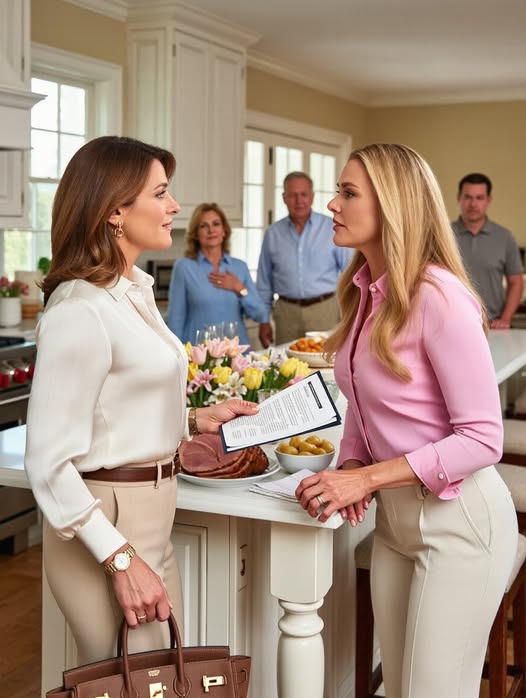

My family used to call me “the thrift store girl,” but at easter, my sister discovered that i had 9 million dollars, and they insisted that i give it all to her; i couldn’t stop laughing as i slammed the door in their faces…
My family used to call me the thrift store girl. Then, one Easter, my sister discovered I had more than nine million dollars, and my family insisted I hand over a fortune to her. I couldn’t stop laughing. By the time that afternoon was over, a door had been slammed in my face, and I was finally free of the people who had spent my entire life making me feel worthless.
Growing up, I learned early that I was the disappointment of the family. My name is Jennifer Ayes, and for as long as I can remember, I was the punch line to every joke my family told about failure. My older sister, Victoria, got the looks, the charm, and, according to our mother, apparently all the brains, too. I got hand-me-down clothes and lectures about being practical. The nickname started when I was fourteen, and it followed me for years.
Victoria needed a homecoming dress, something glittery and expensive from Nordstrom. I needed school clothes because I’d outgrown everything over the summer. Mom took us both shopping, but apparently there was only so much money to go around. Victoria walked away with an expensive dress she wore exactly once. I was dropped off at Goodwill with a tiny budget and told to make it work. I found a vintage leather jacket that day, genuine leather, barely worn, and I was ridiculously proud of it. It was the nicest thing I’d ever owned.
I wore that jacket to school the following Monday. When I got home, Victoria was sitting in the living room with her friends. She spotted me, grinned, and announced loudly, “Look, everybody. It’s the thrift store girl. Find any good deals on those sad little secondhand dreams of yours?”
Her friends burst out laughing. Mom was in the kitchen and heard every word, but she didn’t say anything to defend me. Dad was away on a business trip, which was practically his permanent condition. The name stuck. Family dinners, holidays, random Tuesday evenings—it didn’t matter. Whenever Victoria wanted to put me in my place, out came the thrift store girl. I developed a thick skin because I had no other choice.
While Victoria was pledging sororities at USC and posting endless pictures of beach parties, I was working two jobs to put myself through community college. I lived in a studio apartment that smelled like the Indian restaurant downstairs. I ate ramen, learned to hem my own clothes, and counted every dollar because nobody was giving me anything. My parents paid for Victoria’s entire college education. When I asked whether they could help with even one semester of tuition, Dad gave me a speech about learning the value of hard work. Victoria had been handed her degree on a silver platter, but apparently I needed to build character.
I majored in computer science because I was good at it and because the jobs paid well. While my classmates socialized, I coded. I built websites for small businesses, created applications, and learned everything I could about software development. I graduated with honors and no debt, which felt like winning a war nobody knew I was fighting.
My first real job was at a tech startup in Austin. The pay was decent, and for the first time in my adult life, I could breathe without checking my bank account every five minutes. I rented a one-bedroom apartment and bought my first brand-new clothes in years. I was so proud of my little place that I sent a picture to the family group chat.
Victoria replied, “Cute. Very minimalist. I guess thrift store furniture is coming back in style.”
I’d bought everything new. Her comment hurt less than it would have a few years earlier, but it still landed. I’d moved five hundred miles away, partly for the job and partly to escape the constant comparisons. Austin felt like a fresh start, a place where nobody knew me as the disappointing daughter. I could just be Jennifer, the developer who wrote clean code and met her deadlines.
My apartment was in a complex near the office. Nothing fancy, but it was mine. There was a balcony overlooking a courtyard where other young professionals gathered on weekends. I made friends slowly, mostly coworkers who appreciated my dry sense of humor and knew nothing about my family dynamics. When they asked about my background, I kept it vague. Parents in California, one sister, not particularly close. That was usually enough.
The startup culture was intense but exciting. We had ping-pong tables and free snacks, sure, but we also had a purpose. Everybody there believed we were building something important. Late nights felt less like sacrifices and more like investments. I learned from people who had sold companies before, people who understood the game we were playing and how much could change if we got it right.
I started saving aggressively. Every paycheck, I calculated exactly what I needed for rent, utilities, groceries, and a small entertainment budget. Everything else went into savings or investments. My coworkers thought I was paranoid. They spent money on nice dinners and weekend trips, while I packed lunches and looked for discounts. But I remembered being broke too vividly to be careless with money. I remembered what it felt like to stand in a grocery store calculating whether buying eggs meant I couldn’t afford laundry detergent. I never wanted to feel that helpless again.
Around that time, Victoria announced she was pregnant. The family group chat exploded with excitement. Mom was over the moon about becoming a grandmother, and Dad started talking about legacy and carrying on the family name. I sent my congratulations and a gift card, which Victoria acknowledged with a generic thank-you.
The baby shower was in California. I couldn’t afford the plane ticket, the gift, and the time away from work, so I chose work. Victoria posted pictures of the event: elaborate decorations, designer baby clothes, and a cake that probably cost more than my monthly grocery budget. Mom commented on every picture, saying how beautiful everything was and how blessed they were.
I worked overtime that weekend and managed to finish a significant portion of a difficult project. My boss noticed. That recognition led to more responsibility, which led to more money, which led to more opportunities. It was one of the first times I truly understood that the life I was building could take me somewhere my family had never imagined.
The startup was where I met Brian Cooper, one of the cofounders. He was brilliant, awkward, and completely obsessed with developing software that would revolutionize data security. I started as a junior developer, but Brian saw something in my work. Within a year, I was leading my own team. Within two years, I was his partner in every professional sense that mattered.
Brian reminded me of myself in certain ways. He’d been underestimated, too, and was driven by something deeper than money. He’d been the weird kid in school, the one who programmed computers instead of socializing. His parents had wanted him to become a doctor, and he’d disappointed them by dropping out of medical school to start a technology company. We bonded over family expectations and the peculiar freedom of disappointing people who had never really known us in the first place.
Our working relationship had an almost effortless chemistry. He would sketch impossible ideas on whiteboards, and I would figure out how to make them real. His vision, my execution. We balanced each other, and the rest of the team noticed. They started calling us the brains, which was flattering and slightly annoying.
We worked eighty-hour weeks and survived on coffee and determination. Brian had the vision, but I had the practical skills to turn it into reality. Our software was good. Better than good. It was revolutionary. Companies started licensing it. Small contracts became larger ones, and eventually the technology giants began paying attention.
The first time a Fortune 500 company licensed our software, Brian and I went to a dive bar to celebrate. We weren’t champagne people. We ordered whiskey and sat in a booth that smelled like decades of spilled beer, grinning at each other like idiots.
“We did it,” Brian said, raising his glass. “We built something that matters.”
A little later, after another drink, he looked at me and said, “Your family must be proud.”
I laughed. “They don’t really understand what I do. My sister thinks I fix computers. Seriously, she once asked me if I could help connect her printer to the Wi-Fi. When I tried explaining what I actually do, she got bored and changed the subject to her kitchen renovation.”
Brian shook his head. “My parents still ask when I’m going back to medical school. Some people can’t see past their own expectations.”
We drank to that, to being seen by the people who mattered, even if our families weren’t among them.
As the company grew, my role grew with it. I wasn’t just writing code anymore. I was making strategic decisions, hiring team members, and negotiating contracts. Brian trusted me completely, and that meant I had equity reflecting my actual value. When we formalized the ownership structure, I ended up with forty percent of the company. Brian owned another forty percent, while early investors and key employees divided the remaining twenty.
I didn’t tell my family much about work. Why would I? Every time I mentioned a success, Victoria found some way to diminish it. When I told them I’d been promoted to senior developer, she announced her engagement to Chad Whitmore, whose father owned a chain of car dealerships. The conversation immediately shifted to her princess-cut diamond and destination wedding plans.
The engagement happened during my second year at the startup. Victoria announced it in the family group chat with a picture of her hand displaying an enormous ring, at least two carats, maybe three. Chad had proposed during a beach vacation in Maui, dropping to one knee at sunset while a photographer captured every moment. The pictures were professionally edited and posted within hours.
Mom called me crying with happiness. “Your sister is so blessed,” she kept saying. “Chad is such a wonderful catch. He’s going to take such good care of her.”
I was debugging a critical system failure when she called. Three developers were waiting for my input, and I had a client presentation in two hours. I said congratulations and told her I had to go. Mom sounded disappointed that I wasn’t more excited.
The truth was, I felt almost nothing. Somewhere along the way, Victoria’s happiness had stopped being important to me. Her life was her life, and mine was mine. The only place they intersected anymore was obligation.
I went to that wedding alone. I was twenty-five years old, wearing a dress I’d actually bought new from a department store, and I still felt invisible. Victoria’s bridesmaids were all sorority sisters who looked like they’d stepped out of a magazine. I was seated at a table with distant cousins who spent the entire reception on their phones.
The wedding was held at a resort in Napa Valley, with three days of events leading up to the ceremony. I could only afford to attend the wedding itself, flying in Saturday morning and leaving directly from the reception that night. I missed the welcome dinner and the brunch the following morning. Nobody seemed to notice.
The ceremony was beautiful in that expensive, impersonal way. White roses everywhere, a string quartet, and a stunning designer gown that probably cost more than my car. Victoria looked incredible. Chad cried when she walked down the aisle, which the videographer captured from multiple angles.
I sat seventeen rows back on the bride’s side, between a great-aunt who kept asking who I was and a family friend I’d never met. When Victoria passed me on her way down the aisle, her eyes skimmed right over me. I don’t think she even registered that I was there.
During the toasts, Victoria’s maid of honor talked about how Victoria had always been destined for greatness, how she’d always known exactly what she wanted and how to get it. Dad’s toast mentioned how proud he was of his successful daughters, but every example he gave was about Victoria. Mom cried happy tears. I drank champagne and wondered why I’d bothered coming.
The reception was held at a vineyard, with golden-hour light making everything look like a movie. I tried to mingle, but I kept finding myself in conversations where I was the outsider. Victoria’s friends talked about spin classes and vacation homes. Chad’s relatives discussed golf handicaps and investment properties. I sipped my drink and checked my phone, reading work emails just to have something to do.
At one point, one of the groomsmen approached me. He was drunk but friendly and asked how I knew the couple.
“I’m Victoria’s sister,” I told him.
He looked genuinely surprised. “Really? She never mentioned having a sister.”
“We’re not close,” I said.
He nodded as if that explained everything, then wandered off to find someone more interesting to talk to.
I left during the dancing, claiming I needed to catch my flight. Nobody tried to stop me. I took an Uber straight to the airport, changed into comfortable clothes in a restroom, and worked on code for a project due Monday while waiting for my red-eye. It was a better use of my time than pretending to enjoy a party where I didn’t belong.
Flying back to Austin, I felt relieved. I’d fulfilled my family obligation. I’d shown up, been polite, and done what was expected of me. Now I could return to my real life, the one I was building brick by brick, the one that actually mattered. I texted Victoria another congratulations from the airport. She replied with a heart emoji. That was the extent of our communication.
Victoria announced her first pregnancy about eight months after the wedding. By then, she’d fully committed to the lifestyle-influencer path, documenting everything online. Gender-reveal parties, nursery-design posts, maternity photo shoots—her pregnancy was a carefully curated production. She gave birth to Lily that summer, and the birth announcement received thousands of likes.
I sent a gift, practical baby items from the registry. Victoria posted a generic thank-you story on Instagram, tagging everyone who had sent presents. I wasn’t even sure she knew which items had come from me.
The thing about being underestimated is that nobody watches you. While my family was obsessed with Victoria’s perfect Instagram life, I was building something real. Brian and I had developed software that was attracting serious attention. Technology companies didn’t just want to license it anymore. They wanted to buy the entire company.
Three months after Victoria’s wedding, Brian called me at midnight. A major corporation wanted to meet with us about an acquisition. He could barely get the words out, his voice shaking with excitement and fear. We’d always known the possibility existed, but there was something entirely different about watching a theoretical opportunity collide with reality.
We met with their team the following week. Corporate executives in expensive suits asked technical questions and demanded financial projections. Brian handled the questions about vision. I handled the technical details and practical implementation. We made a good team, and by the end of the meeting, they were more interested than when they’d arrived.
The paperwork started flowing. Nondisclosure agreements, preliminary offers, due-diligence requests. Our attorney, a woman Brian had worked with before, guided us through every step. She was blunt about the odds. Most acquisitions fell apart, she warned us, sometimes at the very last minute.
“Don’t get excited until the money is in the bank.”
I took her advice. I didn’t tell my family. I didn’t tell my friends. I just kept working, kept living in my modest apartment, and kept saving money the way I always had. If the deal happened, wonderful. If it didn’t, I still had a good job and equity in a growing company.
I was twenty-six when the first serious offer arrived: fifteen million dollars. Brian and I each owned forty percent of the company, with the remaining twenty percent divided among early investors and employees. My share would have been six million dollars.
I couldn’t process the number. It felt like Monopoly money, something imaginary that existed only on a screen.
Brian wanted to wait. He believed we could build something bigger, and I trusted his instincts. He’d been right about everything else. We turned down the offer and kept working.
Six months later, another offer came. Twenty-five million. Then thirty-five. We kept saying no. Every rejection felt like a gamble. What if we’d already peaked? What if we were turning down life-changing money only to watch the company collapse?
Some nights, I lay awake doing the math, calculating how long six million dollars could last and how different my life might be. But Brian’s confidence was contagious. He showed me projections, market analysis, and growth potential. Our software was becoming an industry standard. Companies weren’t merely licensing it anymore. They were building entire security infrastructures around it.
We were becoming essential. And being essential meant leverage.
We hired a chief financial officer who had helped other companies navigate successful exits. She was in her fifties, sharp as a knife, and didn’t tolerate nonsense from anyone. She looked at our books, our contracts, and our growth trajectory, then told us we were idiots for considering anything less than fifty million.
“You’re not just selling software,” she said. “You’re selling the future of data security. Price it accordingly.”
So we did.
When the next offer came in at forty million, we countered with eighty. They laughed. We walked away. By then, three companies were interested, which meant competition, and competition meant better terms.
I was still living in my modest apartment and shopping sales. The money was theoretical, tied up in a company that existed primarily as code and contracts. My family had no idea because I’d never told them. What would have been the point? They’d already decided who I was.
Victoria had quit her marketing job after the wedding. The Whitmore family money meant she didn’t have to work, or so everyone believed. She spent her days doing yoga, getting her nails done, and posting about her blessed life online. Mom forwarded Victoria’s posts to me with captions like, “Your sister looks so happy.”
The implication was always clear. Victoria had won at life, and I was still struggling.
By then, Victoria had Matthew, her second child. Two kids before thirty, both planned, both extensively documented on social media. Her life looked perfect, at least within the carefully curated squares of Instagram. Beautiful house, beautiful children, beautiful wardrobe. She’d become a lifestyle influencer with a modest following, receiving free products in exchange for posts.
What I didn’t know then was that Chad’s financial situation wasn’t nearly as stable as it appeared. His father owned several dealerships, yes, but Chad had insisted on running his own location independently to prove himself. He’d taken out significant loans to purchase a franchise, convinced he could make it profitable. When things started going badly, his pride wouldn’t let him ask his father for help.
I wouldn’t learn any of that until much later. From a distance, I watched Victoria’s life with a mixture of fascination and revulsion. How much of it was real? Did she genuinely love the life she portrayed, or was she as trapped as I’d once been, performing for an audience that demanded perfection?
We barely spoke outside obligatory holiday messages. She was busy with her perfect life, and I was busy building something real.
That Christmas, Mom tried to organize a family gathering. I declined, citing work obligations. It was partly true. We were in the middle of intense negotiations, but mostly I didn’t want to spend a week watching the Victoria highlight reel while being reminded of my own supposed inadequacy.
Mom was hurt. She sent a long email about how important family was, how I shouldn’t let work consume my life, and how I was missing out on watching my niece and nephew grow up. She didn’t mention that I’d only seen Matthew twice, both times briefly. She didn’t mention that Victoria never asked about my life or expressed any interest in visiting me.
Apparently, maintaining the family connection was entirely my responsibility. I didn’t respond to the email. I worked through Christmas instead, and I felt perfectly fine about it.
Thanksgiving that year had been particularly brutal. Victoria and Chad had just bought a house in a gated community, and she spent the entire dinner talking about crown molding and granite countertops. When Mom asked about my life, I mentioned that our company was in acquisition talks.
“That’s nice, sweetheart,” she said vaguely. Then she turned to Victoria. “Tell us more about the master bathroom renovation.”
I stopped trying to share after that.
The final offer arrived in February: eighty-five million dollars for the complete acquisition. Brian called me at eleven that night, his voice trembling. The buyers were serious. They wanted our software, our team, and our vision. This was it, the moment we’d spent six years working toward.
My share would be thirty-four million dollars. After taxes and the various financial arrangements involving early investors who had accepted reduced returns, I would walk away with approximately nine million dollars in liquid assets.
I sat on the floor of my apartment and stared at the wall for an hour.
Brian and I signed the papers in March. The money hit my account two weeks later. I watched my banking app refresh and saw a balance that didn’t look real. I was a millionaire before my twenty-seventh birthday, and nobody in my family knew.
I didn’t buy a mansion or a sports car. I hired a financial advisor and invested most of the money conservatively. I did buy a nice condominium in a good neighborhood, furnished entirely with new things. I bought clothes that fit properly. I donated to causes that mattered to me. I lived comfortably, but not extravagantly.
Keeping it a secret felt good. For the first time in my life, I had something that belonged entirely to me, something my family couldn’t diminish, claim credit for, or somehow make about Victoria.
My financial advisor had given me a folder of documents to review and sign. One morning, I grabbed it on my way out the door, intending to go through everything over lunch. Instead, I got pulled into back-to-back meetings. I shoved the folder into my purse, figuring I’d deal with it later.
Among those documents was a current portfolio statement showing my full account balance.
I completely forgot it was there until Victoria found it.
Easter was approaching, and Mom called to insist I come to dinner. I usually avoided family holidays, but something made me agree this time. Maybe I was feeling generous. Maybe I wanted to see them from my new perspective. Maybe I simply wanted to prove to myself that their opinions no longer mattered.
I drove to their house in my new car. Nothing flashy, just a reliable luxury sedan. I parked on the street and walked up to the house where I’d grown up, carrying a store-bought pie because I’d never been much of a baker.
Victoria opened the door. She looked me up and down, and I saw the exact moment she registered that my clothes were expensive. Really expensive. Her eyes narrowed slightly.
“Jennifer,” she said. “You look different.”
“Thanks.” I stepped inside. “You look great, too.”
The house was decorated for Easter, everything in pastel colors. Chad was in the living room watching basketball with Dad. Mom was in the kitchen putting the finishing touches on dinner. Victoria’s two children, Lily and Matthew, were running around on a chocolate-fueled high.
I hugged my parents and tried to settle into the familiar discomfort of a family gathering.
Dad asked about my job in the vague way he always did, without actually listening to the answer. Mom complimented my blouse and asked where I’d gotten it.
“Nordstrom,” I said.
She looked surprised.
“Splurging a little?” Victoria asked from behind me. “Did you get a raise?”
“Something like that,” I replied.
Dinner was the usual production. Victoria dominated the table, talking about Matthew’s soccer team and Lily’s dance recital. Chad occasionally contributed something about his dealership’s sales figures. Mom and Dad hung on every word.
I ate ham and scalloped potatoes and felt like I was watching a play I’d already seen too many times.
After dinner, while Mom was serving pie, my phone rang. I glanced at the screen. It was my financial advisor. I excused myself and stepped onto the back porch to take the call. Nothing urgent, just a question about some paperwork I needed to sign. The conversation lasted maybe five minutes.
When I walked back inside, the atmosphere had changed.
Victoria was standing in the hallway with my purse in her hands.
My stomach dropped.
“You left this on the chair,” she said, her voice strange. “Your wallet fell out when I picked it up. Stuff spilled everywhere.”
She held up a statement that had slipped out of the folder. The balance was clearly visible.
Nine million, four hundred thousand dollars and change.
The room went silent.
Mom’s pie server clattered against a plate. Dad’s eyes widened. Chad leaned forward.
Victoria’s face went through several emotions in rapid succession. Shock. Confusion. Anger. Then calculation.
“Is this real?” she demanded.
I took the statement from her hand, folded it carefully, and slipped it back into my wallet. My heart was pounding, but my voice came out steady.
“That’s none of your business.”
“Nine million?” Mom’s voice was weak. “Jennifer, where did you get nine million dollars?”
“I earned it,” I said simply.
Victoria laughed, but it wasn’t a happy sound. “You earned it? Doing what? You work with computers. Computer programmers don’t make nine million dollars.”
“This one did,” I replied. “My company was acquired. That’s my share.”
The silence that followed was deafening.
I could practically see all of them recalculating everything they’d ever believed about me. The thrift store girl was a millionaire. The family disappointment had more money than any of them.
Dad found his voice first.
“Jennifer, that’s wonderful. Really wonderful. Why didn’t you tell us?”
“Because it’s my business,” I said. “And because I knew this would happen.”
“What would happen?” Mom asked, looking wounded.
“This.” I gestured toward their faces. “You’ve never cared about my success before. Why would I share this with you now?”
Victoria’s shock was transforming into something uglier. I could see the wheels turning, the old sense of entitlement rising to the surface.
“After everything this family has done for you—”
“Like what?” I interrupted. “Please, enlighten me. What exactly has this family done for me?”
“We raised you,” Mom said.
“You raised both of us. You paid for Victoria’s entire college education while I worked myself to exhaustion to afford community college. You’ve celebrated every one of Victoria’s accomplishments while barely acknowledging mine. You let her mock me for years, calling me the thrift store girl like it was the funniest thing in the world.”
“That was just teasing,” Victoria said defensively.
“It was cruel,” I replied. “And every one of you let it happen. You all participated.”
Chad, who had been quiet until then, suddenly spoke.
“Jennifer, Victoria is just surprised. We all are. This is a lot to process. But family is family, right? And family helps each other.”
There it was.
The real reason for the tension in the room.
They wanted my money.
“Helps each other how?” I asked, although I already knew the answer.
Victoria stepped forward, her voice taking on a pleading quality that might once have worked on me.
“Jennifer, Chad’s dealership has been struggling. The economy, supply-chain problems, you know how it is. We could lose the house. We have children to think about. You don’t have kids. You don’t have a husband. You don’t have anyone depending on you. You have more money than you could ever spend.”
I stared at her.
This woman had made my childhood miserable. She’d mocked my struggles, humiliated me in front of other people, and never once asked whether I was okay or needed help. Now she wanted my money.
“Let me get this straight,” I said slowly. “You want me to just give you my money? The money I earned while you were posting selfies on Instagram? The money I made while you quit your job to play housewife? You want me to hand over what I worked for because Chad made bad business decisions?”
“It’s not like that,” Chad protested. “It would be a loan. We’d pay you back.”
“No, you wouldn’t,” I said flatly.
He opened his mouth, but I wasn’t finished.
“And even if you intended to, you couldn’t. If you can’t manage your own finances, why would I trust you with mine?”
Mom stepped forward, her face serious.
“Jennifer, sweetheart, please. Victoria is your sister. Those are your niece and nephew. You wouldn’t let them lose their home, would you?”
“How much are you asking for?” I asked, genuinely curious about the scale of their audacity.
Victoria and Chad exchanged a glance.
“Five hundred thousand would cover everything,” Victoria said. “The mortgage, the debts, enough to get us back on our feet. That’s nothing to you. It’s barely five percent of what you have, but for us it would mean everything.”
Something shifted inside me.
All those years of being overlooked, dismissed, and mocked crystallized into perfect clarity. These people didn’t love me. They never had, not in the way I’d spent my life desperately wanting them to. I’d been someone they kept around to feel better about themselves. Now that I possessed something they wanted, suddenly I was family.
“No,” I said.
Victoria blinked. “What?”
“No. I’m not giving you money. Not five hundred thousand dollars, not five hundred dollars, not five cents.”
Her face turned bright red.
“Are you serious? After everything—”
“After everything what?” My voice rose. “After you spent our entire childhood making me feel worthless? After you called me the thrift store girl every chance you got? After this family made it clear that I mattered less than you in every way that counted? Now you want me to rescue you?”
“We’re family!” Victoria shouted.
“Family supports each other,” I said coldly. “Family doesn’t mock each other. Family doesn’t play favorites. You want to know what family is supposed to look like? It isn’t this. It never was.”
Dad tried next, his voice taking on the authoritative tone he used when we were children.
“Jennifer, you’re being selfish. Your sister needs help, and you have the means to provide it. This is what decent people do.”
Something inside me finally snapped.
I started laughing.
I couldn’t help it. The absurdity of the whole situation was overwhelming. They were calling me selfish after a lifetime of their own selfishness. It was simply too much.
The laughter kept coming, rolling out of me in waves.
“Decent people?” I managed between laughs. “Where were all these decent people when I was eating ramen for dinner so I could afford textbooks? Where was my family when I worked two jobs while attending school full-time? Where was the support when I was building a career from absolutely nothing?”
“We didn’t know you needed help,” Mom said weakly.
“You didn’t ask!” I shouted, my laughter dying instantly. “You never asked because you didn’t care. As long as Victoria was happy and successful and posting pretty pictures, I could suffer in silence. I was just the thrift store girl, remember? I wasn’t worth your attention.”
Victoria’s face twisted with rage.
“So you’re really going to let us lose everything? You’re going to let your niece and nephew become homeless because you’re petty and bitter?”
“They’re not going to be homeless,” I said tiredly. “You’re being dramatic. Sell the house. Move somewhere smaller. Live within your means, the way I had to. Figure it out, the way I had to. Work for it, the way I did.”
“I have children!” Victoria screamed.
“Then be a better example for them,” I shot back. “Show them that hard work matters. Show them that you can’t coast through life on charm and good looks. Show them that actions have consequences.”
Chad stood up, his expression hard.
“You’re making a big mistake. We’re family. You’re going to regret burning these bridges.”
I picked up my purse and headed toward the front door.
Their voices followed me, overlapping in a chaotic mixture of pleading, demanding, and threatening. Victoria grabbed my arm, digging her nails into my skin.
“Please,” she said.
For one second, she actually looked desperate.
“Jennifer, please. I’m sorry about the stupid nickname. I’m sorry I wasn’t nice to you. I’m sorry, okay? I’m sorry. Just help us. Please.”
I looked at her.
Really looked at her.
She was still beautiful, still perfectly groomed, but there was something frantic in her eyes. She’d built her entire life on a foundation of other people’s money and goodwill, and now that foundation was crumbling.
I felt nothing.
“I’m sorry, too,” I said quietly. “I’m sorry you’re in this situation. I’m sorry you made choices that brought you here. But I’m not your rescue plan. I’m not your backup. I’m not the thrift store girl you can dismiss and ignore until you need something.”
I pulled my arm free and reached for the doorknob.
Victoria’s apology transformed back into rage almost instantly.
“You’re selfish!” she snarled. “After everything we’ve done for you! We gave you a home. We fed you. We raised you. And this is how you repay us?”
“You did the bare minimum parents are legally required to do,” I said. “That doesn’t entitle you to my money.”
Mom was crying now. Dad was red-faced and furious. Chad was pacing, and Victoria looked as though she wanted to physically attack me.
I opened the front door.
“Jennifer, if you walk out that door, you’re not welcome back,” Dad said, his voice hard. “If you choose money over family, you’re no daughter of mine.”
I stopped in the doorway and turned to face them.
“You chose Victoria over me my entire life,” I said. “You chose appearances over substance. You chose convenience over fairness. You made your choice a long time ago. I’m finally making mine.”
“You’ll regret this!” Victoria screamed behind me. “When you’re old and alone with nobody to love you, you’ll remember this moment. You’ll remember that you chose money over your own family!”
I smiled at her.
It must have been a terrible smile because she actually took a step backward.
“I’d rather be alone with nine million dollars than surrounded by people who only love me for what I can give them.”
“Get out!” Victoria screamed. “Get out and don’t come back!”
“That’s the plan,” I said.
She lunged forward and slammed the door in my face.
I heard the deadbolt slide into place. Through the door came shouting, crying, the chaos of a family unraveling.
I stood there for a moment, waiting to feel something. Regret, sadness, grief, anything.
Instead, I felt light.
I walked to my car, got in, and drove away from that house for the last time.
My phone started ringing before I reached the highway. Victoria. I declined the call. She called again, and I declined again. Then I blocked her number. I blocked Mom’s next, then Dad’s, then Chad’s.
The silence was beautiful.
Over the following weeks, they tried everything. Mom sent emails begging me to reconsider, saying Victoria was having nervous breakdowns and that the stress was affecting the children. Dad’s emails started reasonably enough but grew increasingly angry when I didn’t respond.
Victoria created new email addresses whenever I blocked the old ones. Her messages alternated between apologies and threats. Chad sent LinkedIn messages and Facebook friend requests from fake accounts, trying anything he could think of to reach me.
I ignored all of it.
When Dad’s attorney sent a threatening letter about supposed inheritance claims, my lawyer responded with a cease-and-desist letter that shut down that particular avenue immediately. Eventually, the harassment slowed. Then it stopped.
I learned through a mutual acquaintance that Victoria and Chad had lost the house. They moved into a rental in a less prestigious neighborhood. Chad’s dealership closed, and Victoria had to get a real job, working retail at a shopping mall.
The gated community and the perfect Instagram life were gone.
I felt a flicker of something that might have been sympathy, but it passed quickly. They’d made their choices. They’d built their lives on unsustainable foundations, and their financial problems were not mine to fix.
What I did with my money was my business.
I funded scholarships for low-income students studying computer science. I donated to organizations supporting women in technology. I invested in startups founded by people who reminded me of myself: hungry, talented, overlooked people who needed someone to recognize their potential.
I also bought my grandmother’s house when she moved into assisted living. It was the one place from my childhood that held genuinely happy memories. I renovated it carefully, preserving everything that mattered. The old wooden floors, the built-in bookshelves, the windows where afternoon sunlight came pouring through—those things stayed.
I live there now, surrounded by things I chose, things I earned, things that are truly mine.
I started dating someone I met through work, another developer with his own story of success, someone who understood the value of hard work because he’d lived it, too. When I finally told him about my family, he didn’t tell me I should forgive them. He didn’t lecture me about blood being thicker than water or how life was too short to hold grudges.
He simply took my hand and said, “Some people are family. Some people are relatives. There’s a difference.”
Six months after Easter, I received a wedding invitation.
Victoria and Chad were renewing their vows in what seemed like some kind of publicity stunt to show the world they were still strong. The invitation was addressed to Jennifer and Guest.
There was a handwritten note inside.
“Despite everything, you’re still my sister. I hope you’ll come. We can talk.”
I threw it away without responding.
A year after that Easter, I received a message from Victoria through some communication channel she’d somehow discovered I hadn’t blocked. It was long and rambling, filled with apologies that felt rehearsed rather than genuine. She talked about how difficult things had been, how much she’d learned, and how she finally understood what I’d gone through.
At the end, she asked if we could meet for coffee.
“Not to ask for anything,” she wrote. “Just to talk. Just to try.”
I read the message three times.
I thought about the girl I’d once been, desperate for scraps of approval from people who’d never really seen her. I thought about the woman I’d become, strong enough to walk away from people who diminished her.
Then I deleted the message without replying.
Some bridges aren’t worth rebuilding. Some doors, once slammed shut, are better left closed. Some families are better left behind.
One of the things I learned in therapy—and yes, I went to therapy, because having money meant I could finally afford the help I needed—was that I’d spent my entire life trying to earn love that was never going to be freely given.
I’d been performing for an audience that wasn’t watching. I’d been working, achieving, sacrificing, and pushing myself harder because some part of me still believed that one day my parents would look at me with the same pride they showed Victoria. I’d imagined there would be a promotion big enough, an accomplishment impressive enough, a moment undeniable enough to make them finally see me.
But there wasn’t.
The moment I stopped performing, the moment I stopped seeking their approval, I became free.
Money didn’t fix me. It gave me options, security, and comfort, but it didn’t heal the wounds. That work was harder and took much longer. I had to unlearn the belief that I was worth less, that I deserved less, that I should be grateful for scraps.
I had to learn that I was enough.
I’d always been enough.
The thrift store girl who pieced together outfits from secondhand finds was just as valuable as the millionaire I eventually became. The only difference is that now I know it.
These days, my life is quiet. I work on projects that interest me. I travel when I want to. I have friends who chose me, not because of blood or obligation, but because they genuinely like who I am. I have a partner who thinks my thrift store finds are charming, who loves hearing stories about the vintage leather jacket I still have hanging in my closet.
I built a life that belongs to me. Nobody can mock it away, diminish it, or claim credit for it.
When I look in the mirror, I see someone who survived, who worked, who refused to let other people define her worth.
Sometimes I wonder whether my family thinks about that Easter dinner. Whether they replay the moment they discovered I was wealthy and immediately demanded I share it. Whether they understand why I laughed in their faces and walked away.
Probably not.
People like that rarely understand. They’ll always believe they’re entitled to what others have earned. They’ll always think family means having a claim on someone else’s success without contributing anything to it.
But sometimes, late at night, when I’m sitting in the house that’s truly mine, I remember standing in that doorway with Victoria screaming at me to leave. I remember the sound of the door slamming in my face, the finality of the deadbolt clicking into place.
I remember how it felt to walk away, and I smile.
Because the truth is, they did me a favor.
They freed me from the last lingering obligation I felt toward them. They showed me, one final time, exactly who they were. They slammed the door on a relationship I’d been trying to preserve out of guilt and habit, and I walked away lighter than I’d ever been.
The thrift store girl became a millionaire. The family disappointment became successful beyond anything they could have imagined. The daughter they overlooked became someone they couldn’t ignore.
And when they finally noticed me, when they finally wanted something from me, when they finally needed what I’d built, I said no.
That’s the kind of power nobody tells you about. The power of walking away. The power of choosing yourself. The power of refusing to set yourself on fire to keep warm the people who would never do the same for you.
I don’t regret it for a second.
Not when I’m lying in bed in my beautiful home. Not when I’m funding scholarships that help girls who grew up like I did. Not when I’m living a life I actually chose instead of one that was chosen for me.
Victoria was right about one thing, though not in the way she meant it.
Sometimes I am alone.
But I am not lonely.
There’s a difference.
Loneliness is being surrounded by people who don’t see you. Being alone is having room to breathe without apologizing for taking up space.
I’ll take being alone over being unloved any day.
The last time I seriously considered reaching out was on my birthday last year. I woke up to messages from friends, from my partner, from people who had chosen to be part of my life. I thought about how different it was from birthdays past, when my family gave me practical gifts while Victoria received jewelry and trips.
For just a second, I thought about calling. Just to see if anything had changed.
Then I remembered Victoria’s face when she saw my bank statement. The calculation in her eyes. The speed with which supposed love transformed into demands.
I made pancakes instead and treated myself to a spa day.
Some people spend their entire lives chasing approval from people who will never give it. Some people break themselves trying to fit into spaces that were never meant for them. Some people accept crumbs and call it love.
I did that for twenty-six years.
Now I live differently.
Now I know better.
Now I understand that walking away isn’t giving up. It’s growing up.
My family used to call me the thrift store girl as if it were an insult. They thought secondhand meant second-class. They thought shopping for bargains meant living a bargain-basement life. They thought that because I didn’t have what they had, I was somehow less than they were.
They were wrong about everything.
The thrift store girl learned to see value where other people saw junk. She learned to take broken things and make them beautiful. She learned that worth isn’t determined by price tags, family approval, or Instagram likes.
She learned to bet on herself.
And she won.
So no, I won’t reconcile with my family. I won’t fund Victoria’s lifestyle or play the role of the family ATM. I won’t attend holidays, pretend everything is fine, or accept halfhearted apologies designed to manipulate rather than heal.
I’ll be here in my home, living my life, making my choices.
I’ll be the thrift store girl who became a millionaire and learned that some of the best things in life can’t be bought. Things like self-respect. Genuine relationships. The peace that comes from finally putting yourself first.
They slammed the door in my face thinking it was a punishment.
