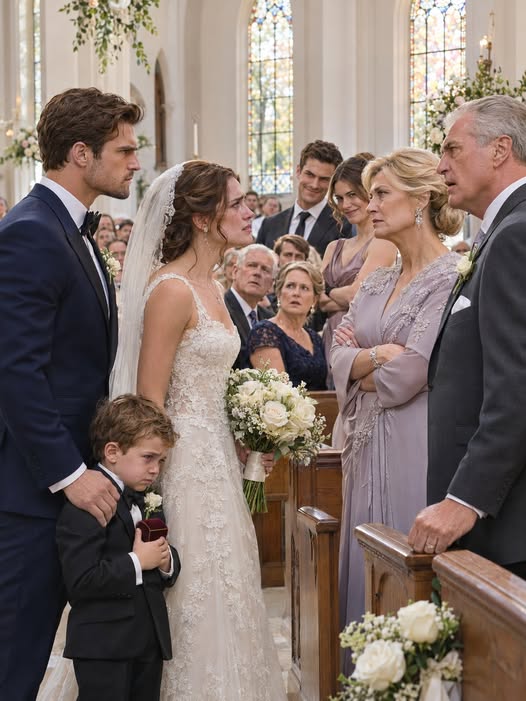

In front of 87 wedding guests, my parents turned to my four-year-old son and told him, “You don’t belong here. You’re a reminder of your mother’s failure.”
My siblings laughed. My little boy shrank into himself, but my fiancé didn’t hesitate. He stood up, looked my parents straight in the eyes, and said something that brought the entire room to a dead silence.
I knew my parents weren’t thrilled about my wedding. They had always treated my son, Dylan, like a stain on my record, as though he represented every bad decision I had ever made. But I honestly believed they could hide their feelings for one day. Just one day. Eighty-seven guests, a beautiful October afternoon, and a man who looked at me as if I were the only woman in the world. That was all I wanted.
Everything had been perfect. White rose petals lined the aisle, a string quartet played softly in the background, and my wedding dress fit better than it ever had during the fittings. Dylan looked absolutely adorable in his tiny tuxedo, smiling so brightly that everyone who passed him smiled back. He sat in the front row beside Noah’s mother, holding the little ring box in both hands as though it contained the most precious treasure in the world.
Then my parents arrived late. They didn’t apologize or even acknowledge that the ceremony was about to begin. They walked into the church as if they were entering a courtroom, ready to deliver a verdict. My father surveyed the room with the expression of a man already finding fault with the decorations. My mother carried herself as though the church should be grateful she had bothered to show up. Behind them came my siblings, Jake and Amanda, neither of whom had congratulated me once since Noah proposed.
Instead of sitting near Noah’s parents, they chose seats in the second row, slightly off to one side, as though they didn’t want to be associated with us. I noticed the looks. I heard a few whispers. Still, some foolish, hopeful part of me kept insisting they would behave themselves. I told myself they wouldn’t ruin my wedding, not with so many people watching.
Then the music changed, the doors opened, and everyone stood. It was time for me to walk down the aisle.
I hadn’t taken five steps before I noticed my mother leaning toward Dylan. She said something I couldn’t hear, but I saw his little hands tighten in his lap. His eyes dropped to the floor, the way they did when he thought he had done something wrong. His shoulders sagged. Noah noticed it too. Our eyes met for a brief second, and the smile that had been on his face was gone. Something had changed, and I could feel it even though I didn’t yet understand exactly what had happened.
I kept walking, but my legs suddenly felt as heavy as stone. By the time I reached the altar, Dylan was still hunched over, staring at the floor. Noah’s mother was rubbing his back, whispering something gentle into his ear. The officiant began speaking, but Noah couldn’t concentrate. I could see him looking at Dylan, then at my parents, then back at Dylan again.
Right in the middle of the officiant’s words, Noah interrupted.
“Don’t you ever speak to my son like that.”
The room went completely silent. The officiant stopped mid-sentence, and somewhere in the back, I heard someone whisper, “What just happened?”
I couldn’t move. I could barely breathe. Then my father spoke.
“He’s not your son. He’s a reminder of her failure.”
That was the moment everything changed. My stomach twisted so violently I thought I might be sick. Jake gave a quiet little laugh, like he was watching some ridiculous comedy sketch. Amanda smirked and looked away. And Dylan just sat there, his eyes wide, his small body perfectly still.
I had spent so many years trying to keep the peace with my family that I didn’t even know how to respond. But Noah did.
He turned fully toward my parents, his expression calm and his voice steady.
“If he doesn’t belong here, then neither do you. Get out.”
The words didn’t literally echo through the church, but they might as well have. I could feel the entire room shifting around us. People moved uneasily in their seats. My mother blinked rapidly, clearly stunned that someone had dared to challenge her. My father rose as though he was preparing to make another speech.
Before he could get a word out, Noah’s parents stood too.
His mother walked over to Dylan and knelt beside him, whispering something only he could hear. Noah’s father looked directly at mine and spoke loudly enough for every person in the church to hear.
“He’s our grandson, and we’re proud of him.”
And just like that, my parents left.
Jake followed them immediately. Amanda lingered for a second, looking as though she wanted to deliver one last nasty remark, but apparently she couldn’t find anything worth saying. She turned and followed them out.
I hadn’t even said my vows yet.
I stood at the altar in my wedding dress, my veil slipping halfway off my head, trying desperately not to cry. Then Dylan got up from his seat and walked toward me. He slipped his little hand into mine, looked up at Noah, and asked in a tiny voice, “I can still be the ring boy, right?”
Noah nodded, and his smile finally returned.
“Always, buddy.”
So we got married.
The ceremony continued, and when it ended, everyone applauded. Some people cried. Others smiled through tears. For a little while, it almost felt as though the worst was behind us.
But the real storm was only beginning.
After the ceremony, nobody mentioned what had happened directly. Nobody brought up the empty seats in the second row where my parents and siblings should have been sitting. Nobody said anything about the fact that they had walked out before Noah and I had even finished exchanging our vows.
The guests kept drinking champagne and complimenting the flowers. A few tried much too hard to fill every silence with cheerful conversation. Others kept glancing at me, only to look away the moment I noticed. I suppose everyone was trying to decide whether to pretend nothing had happened or acknowledge that they had just witnessed a family disaster at one of the most important moments of my life.
I sat at the head table beside Noah, with Dylan between us. Noah’s parents sat nearby, calm and composed, as though their presence alone was enough to keep the entire celebration from falling apart. Dylan rested his head against Noah’s arm and barely touched his dinner, even though the caterer had prepared special miniature meals for the children.
Noah leaned down and asked if he wanted to dance later. Dylan gave a small nod.
He was trying to be brave. I could see that. But I also knew what was going through his mind. He had heard those words.
You’re a reminder of her failure.
That sentence hadn’t gone over his head. He might have been only four years old, but Dylan was a smart little boy. He always had been.
There I was, sitting in the wedding dress I had dreamed about for months, surrounded by flowers I had carefully chosen, listening to music I loved. And all I could think about was the way my own family had looked at my son as though he were something worthless.
Then came the speeches.
Noah’s father stood first. I expected something about love, perhaps a little marriage advice or a funny story from Noah’s childhood. Instead, he looked directly at me and raised his glass.
“We don’t get to choose everything that happens in life,” he said. “But sometimes life brings you exactly what you need. Mali, you’ve brought strength and love into our family.”
He paused and looked at Dylan.
“And Dylan has brought us joy.”
For a moment, nobody applauded. People seemed too stunned to react. Then guests began standing, raising their glasses along with him. Even the DJ stopped the music. Dylan’s face lit up for a second, as though someone had switched on a light inside him.
Noah’s mother followed with something even simpler. She looked at Dylan and said, “Dylan, you’re ours now.”
That was it. That was her entire speech.
And I cried.
I’m not the kind of woman who cries in public. I’ve always hated feeling exposed, hated the thought of people watching me fall apart. But those tears weren’t exactly sadness. They were what happened when years of holding everything together finally caught up with me. It was the collapse that came after being strong for far too long.
After dinner, after the cake, the awkward dancing, and the bouquet toss, I found a quiet spot near the edge of the reception tent. I needed a moment to breathe. The October air was cold against my bare arms, but it felt better than standing inside and pretending everything was fine.
Noah found me less than a minute later.
“Do you want to let it go?” he asked.
I looked at him. “What do you mean?”
“Your parents. What they said. What they did. Do you want to let it go?”
I didn’t answer immediately because I honestly didn’t know. Part of me wanted to close that chapter of my life and never look back. Another part wanted to scream at them until they finally understood what they had done to my child.
Noah waited, then said, “If you want to let it go, I’ll support you. If you want to confront them, I’ll go with you. But they’re never going to hurt him again. And they’re not going to hurt you, either.”
I don’t know exactly what came over me, but I looked at him and said, “Let’s go.”
I was still wearing my wedding dress. He was still in his tuxedo. Dylan had already fallen asleep at his grandmother’s house, and everyone else assumed our wedding night was coming to a peaceful end.
Instead, Noah and I got into the car and drove straight to my parents’ house.
I didn’t even take off my heels.
We didn’t knock gently. And when my mother opened the door, Noah didn’t offer the polite smile he usually wore around my family. The moment she saw us standing there in our wedding clothes, her expression changed. But it wasn’t guilt I saw on her face. It was surprise.
She looked as though the possibility of us showing up had never occurred to her. As though she had convinced herself that she could behave however she wanted and simply walk away without consequences.
She was wrong.
My mother stood in the doorway as though she hadn’t insulted a four-year-old child just two hours earlier. No apology, no hesitation, no indication that she understood what she had done. Just that familiar, empty expression she had perfected over the years, the one that made it seem as though nothing could ever touch her and she was always right by default.
Her eyes moved from me to Noah and back again.
“It’s late,” she said.
She didn’t move aside to let us in.
“We won’t be long,” Noah replied.
My father appeared in the hallway behind her, already frowning as though he had been expecting a confrontation. He didn’t invite us inside, either. He simply stood with his arms crossed, daring us to get emotional.
Noah didn’t waste a second.
“You humiliated her,” he said. “You humiliated my son, and you did it in front of 87 people like it was some kind of family joke.”
My mother scoffed.
“We told the truth. If she didn’t want honesty, maybe she shouldn’t be playing house with somebody else’s mistake.”
I still hadn’t spoken. I couldn’t. Everything around me seemed to tilt, and I was suddenly aware that I was still wearing my wedding shoes, the very shoes I had picked out with Dylan. He had told me they made me look like a queen.
Noah stared directly at my mother.
“You just called him a mistake.”
“I said what everyone else is thinking,” my father cut in. “You’re all too sensitive to hear it.”
That was when I finally found my voice.
“I’m not sensitive,” I said. “I’m just finally realizing that you’ve never been proud of me unless I did exactly what you wanted. You didn’t come to watch me get married. You came to judge my life.”
Neither of my parents flinched. They stood there with the same expressions they had worn during countless arguments throughout my childhood, as though anything I said was simply noise they could wait out.
But Noah wasn’t finished.
“You know what really bothers me?” he asked. “You came to that wedding knowing you didn’t approve. You sat in front of a little boy and told him he didn’t belong there. What kind of person does that?”
“You’re not his father,” my mother snapped. “And you never will be.”
That was the final straw.
Noah took one step forward. He was calmer than I had ever seen him during an argument, but there was something about that calm that made the air feel charged, as though he was holding back an explosion.
“You’re right,” he said. “I’m not his biological father. I’m just the man who tucks him into bed every night. I’m the one who comforts him when he wakes up crying because he still remembers the night Mali left her ex. I’m the one who taught him how to ride a bicycle. And today, I became the man who married his mother.”
He paused, never taking his eyes off my mother.
“So yes, maybe I’m not his father. I’m his dad.”
The silence afterward was so complete that I could hear the heating system humming somewhere inside the house.
Then my father muttered something under his breath. I didn’t catch every word, but I heard enough. He was saying Noah had been manipulated, that I had used Dylan to trap him into marriage.
I stepped between them.
“Say that again.”
He didn’t.
He simply turned around and walked into the kitchen, acting as though we were beneath his attention. My mother remained in the doorway with her arms crossed.
Then Noah reached into his pocket, took out his phone, and pulled something up on the screen.
It was a screenshot of a payment.
Three thousand dollars transferred toward Amanda’s college tuition three months earlier.
“Remember when your daughter called me crying about school?” Noah asked. “She told me you wouldn’t help her. I barely knew her that well at the time, but I paid it anyway. Quietly. I didn’t ask for recognition, and I didn’t expect anything in return.”
For the first time that night, my mother seemed genuinely caught off guard.
“You didn’t have to do that,” she said.
“No,” Noah replied. “I didn’t. But I did it because that’s what family does. You help people when they need you.”
He held the phone at his side.
“But after today, that’s over. Amanda can pay her own tuition, or you can help her. If she’s such a perfect daughter, maybe it’s time you proved how much you value her.”
At that moment, Amanda appeared at the top of the stairs.
I had no idea how long she had been listening, but judging by the look on her face, she had heard enough. She opened her mouth as if she wanted to say something, then thought better of it. Without a word, she backed away and disappeared down the hallway.
Then my mother said something that pushed everything beyond repair.
“You’re going to regret this. One day you’ll realize that family is all you have.”
Noah looked at her one last time.
“No,” he said. “He’s everything we have. And he’s enough.”
We left.
We didn’t slam the door. We didn’t scream from the porch or deliver one last dramatic speech. We simply walked away in silence. It was the kind of silence that only comes when something has truly ended.
Back in the car, I pulled off my earrings and dropped them into the center console. My hands were shaking, but not because I was afraid.
“It’s over,” I said. “Really over this time.”
Noah didn’t ask what I meant. He already knew.
Two days later, just when I thought things couldn’t possibly get worse, my phone vibrated with a notification.
My cousin had tagged me in a Facebook post.
I tapped the notification, and my entire body went cold.
It was a photograph from my first wedding. There I was in my old wedding dress, holding Dylan as a newborn, my ex standing beside me and my parents smiling for the camera.
The caption read:
Before the lies. Before the disappointments. Before she forgot who she was.
My mother had posted it.
Amanda had liked it.
And I swear, something inside me went white-hot with anger.
I grabbed my keys. Noah wasn’t even home, and I didn’t call him. I didn’t tell anyone where I was going. I just got into my car and drove back to my parents’ house, determined that this would be the last time.
I had seen the photograph, read the caption, and noticed Amanda’s little thumbs-up beneath it. Something inside me simply shut down. There were no tears this time, no trembling, no frantic attempt to figure out how to fix things. There was only a quiet, focused anger unlike anything I had ever felt before.
When I pulled into my parents’ driveway, every light in the house was on. That should have warned me, but it didn’t.
I knocked once.
My mother opened the door almost immediately, as though she had been standing just behind it waiting for me. She was holding her phone, and the Facebook post was still open on the screen.
“So,” she said, “you saw it?”
I didn’t step inside. I didn’t raise my voice.
“Delete it.”
She smiled. Not a big smile, just a small curve of her mouth, enough to let me know how much she was enjoying this.
“It’s a memory. I have every right to share my memories.”
“It’s my life, my child, and my past,” I said. “Delete it.”
My father was sitting on the couch behind her, watching some game on television as though the house wasn’t seconds away from exploding. Amanda sat at the dining room table, in the same spot she always chose during family arguments. Close enough to hear every word, but far enough away to pretend she wasn’t involved.
“She’s embarrassed,” Amanda said. “That’s all this is.”
I stepped inside.
“You wanted to embarrass me,” I said. “You wanted everyone to see my first marriage, my ex-husband, and my son as a baby. You wanted to remind people that I failed, didn’t you?”
My mother didn’t deny it.
“People forget too easily,” she replied. “I was helping them remember.”
“Remember what?” I demanded. “That I left a man who cheated on me? That I raised my son alone for two years? That I rebuilt my life from nothing? Which part of that embarrasses you the most?”
She didn’t answer the question.
Instead, she tilted her head and said, “You think your new husband is some kind of hero? We’ll see how long that lasts. Men don’t stay when things get complicated.”
That was when I understood something I should have realized years earlier.
This had never really been about the wedding. It wasn’t even about Dylan. It was about control, and the fact that my mother was losing hers.
“Delete it,” I repeated.
She gave me a challenging look.
“Make me.”
So I stepped forward and took the phone right out of her hand.
That was the part she hadn’t expected. I don’t know what she thought I would do. Maybe she expected me to scream, cry, or beg her to show some basic decency. Maybe she thought I would stand there trying to convince her that humiliating her own daughter was wrong.
Instead, I unlocked her phone.
I knew her passcode. She hadn’t changed it in years.
I found the post myself, then turned the screen toward my father.
“She posted this after insulting my son at my wedding,” I said. “And you’re just sitting there watching television.”
He glanced at the screen, then turned his attention back to the game.
“It’s not that big a deal.”
That was when my hand moved.
I slapped my mother.
It wasn’t dramatic. It wasn’t even particularly hard. It was quick, sharp, and final.
The room fell into a silence that felt almost unnatural. My mother slowly raised a hand to her cheek, staring at me as though she couldn’t believe what had just happened.
“You just lost your family,” she said.
I looked at her.
“No. I lost the fantasy that I ever had one.”
Then I deleted the Facebook post right in front of her.
I didn’t ask permission. I didn’t hesitate. I pressed delete, locked the phone, and set it down on the table.
After that, I walked straight to the hallway closet, the one where my parents kept old keys, random mail, and all the things they never wanted to throw away.
My bank card was still there.
It was the same card they had been using to buy groceries for years. They had continued using it even after my father went back to work, even after they stopped speaking to me unless they wanted something. I pulled it out of the envelope where they kept it and held it up.
“This ends tonight.”
Amanda jumped to her feet.
“You can’t punish them like that!”
“I’m not punishing anyone,” I said. “I’m ending the punishment.”
That was when my mother said something I hadn’t expected.
“Do you really think that man will still want you when you’re completely alone? No family, no safety net, nobody to fall back on?”
I looked at her for a long moment.
“I stopped being safe here a long time ago.”
As I reached the door, my father finally spoke again.
“You’ll calm down, and you’ll come back.”
I turned around one last time.
“You said the same thing when I left my first husband and walked away.”
Then I left.
When I got home, Noah was already awake. He had seen the post before I deleted it, but he didn’t ask me what had happened. I told him anyway. I told him about the slap, the bank card, my parents, Amanda, and every ugly word that had been exchanged.
He didn’t judge me. Not even a little.
He just listened, then said, “Then it’s over.”
I thought he was right.
I was wrong.
Because what my parents did next started quietly. It was subtle, calculated, and designed to spread.
Honestly, I had believed the whole thing was finished. I thought I had taken their final blow, removed my mother’s poison from the internet, and walked away with whatever peace I still had left.
But I had underestimated how desperately my mother needed to win, even if winning meant burning down everything she touched, including her own daughter.
Three days after I left her house, my phone lit up with a message from my cousin Michelle.
Michelle rarely involved herself in family drama. She was usually the type to stay out of arguments, avoid taking sides, and let everyone work through their problems. I almost didn’t open her message.
Then I saw the first line.
I thought you should see what your mother sent us.
There was a screenshot attached.
My mother had forwarded a message to nearly half our extended family. It wasn’t some vague, passive-aggressive remark or an indirect insult. It was a full-blown smear campaign.
She had shared an old conversation between Amanda and me from the worst year of my life. It was from the period right after I left my ex, when Dylan barely slept, I was exhausted all the time, and I felt as though I was falling apart.
In those messages, I had written things I could barely remember saying. I had admitted that I felt like a failure, that I didn’t know how to be a good mother, and that sometimes I wondered whether Dylan would be better off without me.
Those were the words of a frightened, overwhelmed young mother who was trying to survive. But my mother had taken them out of that moment and presented them as proof of who I supposedly was.
She added her own caption.
Some people don’t grow up. They just get better at hiding who they really are. Remember that the next time you praise her fairy-tale wedding.
It felt as though she had been saving those messages for years, waiting for the perfect opportunity to dig up my past and turn it into a weapon.
She wanted everyone to question me. She wanted them to look at the life I had built and believe it was all a lie. And Amanda had liked the message. She hadn’t just stood aside and allowed it to happen. She had publicly supported it.
I sat on the couch holding my phone, reading the screenshot again and again until I could barely feel my hands.
Then I got up, walked into the kitchen, and handed the phone to Noah without saying a word. He was cooking something on the stove. He read the message once, then a second time, before turning off the burner.
“That’s it,” he said. “We’re done. With all of them.”
I nodded.
“Let’s mail them the ending.”
We didn’t drive to my parents’ house. We didn’t call or arrange another confrontation. We sent them exactly what they deserved: a package wrapped in silence.
We placed two things inside an envelope.
The first was a printed copy of my mother’s message to the family, with the names of everyone she had sent it to highlighted. The second was a single sheet of paper with a message written in my own handwriting.
This is the last time you will hurt me. You are no longer my family. This is final.
Noah added one more thing: a copy of the tuition payment he had made for Amanda. He highlighted the amount and wrote one line underneath.
No more help. No more phone calls. No more second chances.
We mailed the envelope and never looked back.
At least, that was the plan.
Then Amanda showed up.
Not at our house, but at Noah’s parents’ home.
She knocked on their door alone, holding a folder as though a stack of apology letters might somehow repair everything that had happened.
She told them our mother had gone completely out of control after reading the letter. Apparently, she had smashed a plate, thrown a chair against the wall, and threatened to cut Amanda off for not defending her more aggressively.
Amanda said she was scared.
Then she told them something that made my blood run cold when I heard about it later.
Our mother had started talking about showing up at Dylan’s school to remind him where he came from.
Noah’s father listened calmly without interrupting. When Amanda finished, he told her the truth.
“We’re not part of that story anymore,” he said. “Mali doesn’t need to hear anything else.”
Then they closed the door.
They told me everything that evening, and that was when I made a decision I should have made years earlier.
Thanksgiving was only a week away.
Every year, I had shown up at my parents’ house carrying some dish I had spent far too much time preparing, pretending we were still a normal family. Even the year before, after months of cold silence, I had brought Dylan and watched him eat dinner across from people who barely acknowledged his existence.
Not this year.
This year, I stayed home.
It was just me, Noah, Dylan, and Noah’s parents.
There was no drama, no tension, and no passive-aggressive commentary about calories, parenting, or my life choices. There was only warmth, good food, and Dylan laughing so hard that he nearly spilled gravy all over himself.
Noah carved the turkey. Dylan insisted on trying a little of everything, hated most of it, and eventually settled for three dinner rolls and a mountain of whipped cream.
Noah’s mother made the same sweet potato casserole she had been preparing since Noah was a little boy. His father built a fire even though it wasn’t particularly cold outside, simply because he knew I loved the sound of crackling wood.
That evening, after we put Dylan to bed, I sat on the couch with a mug of hot chocolate and checked my phone.
There were six messages from Amanda, two from my mother, and one from a cousin telling me I was overreacting.
I deleted every single one.
Then something unexpected happened.
I didn’t feel sad.
I didn’t feel as though I had lost anything. I simply felt free, as if a weight I had carried for years had finally slipped off my shoulders. For the first time, I didn’t feel obligated to explain myself, defend my decisions, or prove my worth to anyone.
A little while later, Dylan called for me from his bedroom. I went upstairs to tuck him in again, and he looked up at me with those sleepy eyes of his.
“I like this family better,” he whispered.
I brushed the hair away from his forehead.
“Me too, sweetheart.”
That first Thanksgiving without my parents felt like stepping into sunlight after spending years underground.
There was no drama, no walking on eggshells, and no forced smiling around a table heavy with unspoken tension. There was just Dylan laughing over his mashed potatoes and Noah teasing his father about the turkey being a little overcooked.
We didn’t talk about what had happened at the wedding. We didn’t need to.
For the first time in my life, I walked away from a holiday dinner feeling lighter than I had when I arrived.
I thought that peace might disappear once the holidays were over. I thought perhaps guilt would eventually settle in, or regret, or some other feeling I hadn’t prepared myself for.
But it never came.
Christmas arrived with the same quiet happiness.
Dylan received a green bicycle and a matching scarf from Noah’s parents. He rode that bike in circles around the driveway until he fell, then came running inside laughing with scraped knees.
Noah’s father showed him how to take care of the scrape, while his mother made hot chocolate. Nobody raised their voice. Nobody made the entire room go cold with a single look. Nobody had to measure every word before speaking.
New Year’s Eve was just the three of us on the couch, wrapped in blankets, eating popcorn and watching a countdown Dylan didn’t quite understand.
At midnight, Noah kissed me and whispered, “No more hurt this year.”
And so far, he has kept that promise.
I didn’t hear from my parents for weeks.
Then one afternoon, a message appeared on my phone from an unknown number.
It contained only one line.
You went too far.
No name, no explanation, no signature.
I blocked the number without hesitation.
A week later, another message arrived, this time from a cousin. Apparently, my mother had started spreading a new version of the story, one in which I was an ungrateful daughter who had married a controlling man and cut off her loving family.
She was telling people I was unstable, that I had slapped her for no reason, and that Noah was isolating me from everyone who cared about me.
There was a time when hearing those stories would have destroyed me. I would have spent hours explaining myself, calling relatives, sending screenshots, and trying desperately to make people understand what had really happened.
But this time, I didn’t care.
I wasn’t going to waste another second trying to convince people who had already decided what they wanted to believe.
The silence between my parents and me continued.
There were no birthday messages, no apologies, and no signs that they missed me.
And honestly, I didn’t miss them either.
I was too busy living.
Noah and I began talking about buying a house somewhere with a big backyard and a proper fence, someplace where Dylan could run around without us worrying about him.
Noah’s parents offered to help with the down payment. Not because they were obligated to, and not because they wanted anything in return. They offered because they believed in us and wanted to see our little family build something lasting.
One afternoon, Dylan came running in from the backyard holding a dandelion.
He stretched out his hand and offered it to me.
“Make a wish, Mommy.”
I smiled, bent down, and whispered something into the soft white seeds before blowing them into the breeze.
Dylan watched them scatter, then looked at me curiously.
“What did you wish for?”
I smiled at him.
“It already came true.”
And it had.
I had a son who laughed in his sleep and believed wishes could come true. I had a husband who never flinched when life got ugly, a man who chose us again and again, even when doing so meant standing up to people who should have loved us from the beginning.
I had in-laws who loved me as though I had always belonged to them.
And for the first time in my life, I wasn’t begging anyone to love me.
I hadn’t heard from Amanda since the flood of messages she sent months earlier. I never blocked her, but I never replied, either. It was strange how little I thought about her now. It felt like losing interest in a television series I used to follow obsessively, then realizing one day that I didn’t even care how it ended.
The final confirmation came in the spring.
I was scrolling through photographs from a friend’s wedding when I came across a group picture. It had been taken from far enough away to capture several guests mingling in the background.
On one side of the photograph, there I was, holding Dylan’s hand and talking with Noah and his mother.
On the other side sat my parents.
They were stiff in their chairs, alone, with nobody gathered around them. They looked like statues that people had stopped visiting a long time ago.
I stared at the picture for a moment.
And it didn’t hurt.
I didn’t feel a sudden wave of sadness or loss. I didn’t wish things had turned out differently. The photograph simply confirmed something I had already come to understand.
Family isn’t necessarily the people who raise you. Family is the people who lift you up. It’s the people who stay when staying matters, the ones who stand beside you when life becomes difficult. It’s the people who make sure your child never feels small, unwanted, or ashamed of who he is.
Family is the man who looks at a frightened little boy and says, without hesitation, “That’s my son.”
It’s the grandparents who stand up in a room full of strangers and proudly claim a child as their own. It’s the people who offer love without attaching conditions to it, who make room for you at their table without expecting you to earn your place.
I spent so many years believing I had to be better, do more, and make fewer mistakes before I deserved the love of my parents.
But love was never supposed to work that way.
